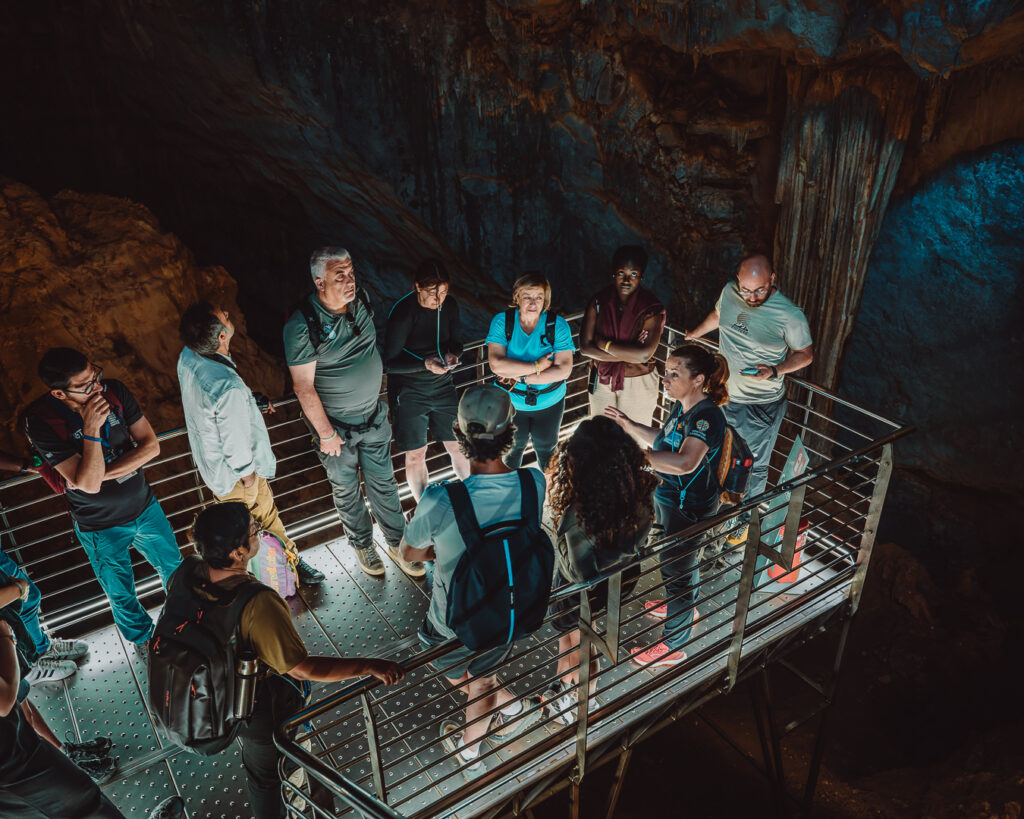
Fieldtrip in Asinara National Park. Picture by Alessio Mitol.
The 14th edition of the ECST Network Meeting brought together 130 people from 18 countries in Stintino, Sardinia (Italy) from 26 – 28 May 2026.
From Loving Parks to Death to Restoring Them to Life
From May 26 to 28, 2026, the ECST Network Meeting brought together experts, Protected Area managers, and tourism stakeholders in the stunning setting of Asinara National Park, Sardinia, an ECST awarded park and co-host of the event. The event took place in Stintino (Le Tonnare).
Around 130 attendees from 18 countries across Europe (Belgium, Bulgaria, Cyprus, Czech Republic, Denmark, Estonia, Finland, France, Germany, Greece, Italy, Ireland, the Netherlands, Portugal, Romania, Slovenia, Spain, UK), plus Canada and Lebanon participated in the event.
Under the theme “From Loving Parks to Death to Restoring Them to Life,” the meeting marked the 25th anniversary of the European Charter for Sustainable Tourism in Protected Areas (ECST) and served as a platform to chart a new course for tourism in Europe’s most precious natural areas.
Discover the photo album:
Day one – A Vision For The Future
The institutional opening emphasised that 2026 is a pivotal year to re-evaluate the ECST as a tool for territorial resilience against current climate and socio-economic challenges.
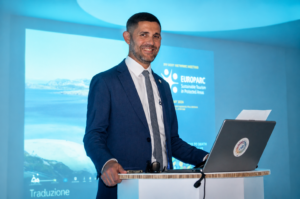
Gianluca Mureddu
Sardinia’s rich natural, cultural and landscape heritage was the perfect backdrop for these discussions. The island and its Protected Areas are a popular tourist destination. As such, Gianluca Mureddu, President of Asinara National Park, spoke of the necessity of ensuring that tourism acts as an active tool for conservation while contributing directly to the development of local communities.
The connection between local actions on the ground and the wider framework in which tourism is organised was underlined by Maria Lombardi, Head of Division II, Italian Ministry of Environment and Energy Security (MASE). She urged that there is a need to validate the national commitment to integrating Protected Area management with European sustainability and supervision frameworks
Santina Grande, Board Member of Federparchi-EUROPARC Italy, echoed this message. She also underscored the importance of multilevel coordination and the role of national federations in supporting the ECST network.
Finally, Alberto Arroyo Schnell, Director of the EUROPARC Federation, looked to the future. He emphasised that while the ECST remains a gold standard for governance, it must now adapt to new social and environmental challenges as well as review its position in the certification scheme framework.
These interventions set the scene for the following discussions. A range of keynote speakers highlighted different approaches to sustainable tourism and tourism development:
Protected Areas in Sardinia: governance and participatory processes for sustainable tourism experiences – Matteo Muntoni
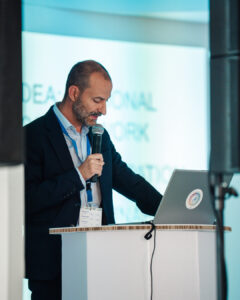
Matteo Muntoni, by Alessio Mitol
Matteo Muntoni, Director-General of the Department for Environmental Protection of the Autonomous Region of Sardinia argued that participatory processes are a prerequisite for high-quality sustainable tourism experiences in Sardinian Protected Areas: A shift toward “shared governance” was proposed, involving the administration, the private sector, and local communities as co-responsible actors in the management of Protected Areas:
Shared governance of Protected Areas can see the private sector, and local communities as co-responsible actors in the management of Protected Areas.
Sustainable Tourism and Nature Conservation in Europe: perspectives and developments – Federico Minozzi
It followed a speech delivered by Federico Minozzi, Head of EUROPARC Policy and Projects unit, focusing on the critical intersection between environmental conservation and EU tourism policy to better understand how the ECST relates to past and current EU policies, and how EUROPARC is working towards this goal.
His intervention highlighted the following strategic and technical areas:
He noted that EUROPARC played a pivotal role in connecting DG MOVE (responsible for the European Sustainable Tourism Strategy) and DG Environment (developing Natura 2000 guidelines on tourism), stating:
By positioning the ECST within the broader EU tourism strategy, Protected Areas can better leverage financial resources to fund sustainability projects and foster cross-sectoral collaboration.
While acknowledging the importance of the wider tourism agenda, the speech reinforced that EUROPARC’s strongest leverage remains within the environmental and nature protection sectors (such as the Natura 2000 network), where it acts as a primary expert voice for how tourism can actively support conservation goals.
From Sustainable to Restorative: the Role of Tourism in Protected Areas
The subsequent session focused on the most common types of tourism related with Protected Areas:
- Regenerative Tourism, presented by Prof. Marco Vanini, University of Sassari
- Ecotourism, presented by Andrei Blumer, president of the Romanian Association of Ecotourism
- Active Tourism, presented by Maurici Carbó, Sports & Tourism Consultant
Prof. Marco Vannini offered a critical reflection on the evolution of the sustainability concept. He distinguished between “weak sustainability,” which assumes that different forms of capital (economic, social, and natural) can be substituted for one another, and “strong sustainability,” which views natural capital as irreplaceable and as the foundation for all human activities.
From this perspective, the biosphere and ecosystems should be at the core of any development strategy. Vannini argued that many current challenges stem from the fact that, for decades, public policies and business strategies have relied on an overly simplified and inadequate interpretation of sustainable development.
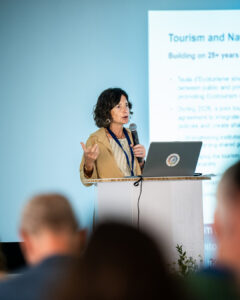
Mireia Cañellas by Alessio Mitol.
Andrei Blumer, from the Romanian Ecotourism Association, presented ecotourism as a strategic tool for linking conservation, local development, and the tourism experience.
The discussion highlighted the need to strengthen collaboration with tour operators, as they play a key role in communicating the values of Protected Areas to visitors. Several participants agreed on the importance of involving tourism intermediaries more actively in the implementation of the European Charter for Sustainable Tourism and in the promotion and marketing of products aligned with its principles. Blumer highlighted the formation of the Alliance for European Ecotourism Destinations (signed October 14, 2025), which aims to advocate for the formal recognition and institutional support of the ecotourism destination concept at the European Union level.
Maurici Carbó highlighted that active tourism activities are not inherently sustainable and can generate significant ecological pressures despite their low carbon footprint, necessitating a transition from a product-based approach to a stewardship governance model. Central to this strategy is the suitability framework, a matrix that evaluates the compatibility of specific activities by intersecting ecological and social sensitivity with visitor impact potential, resulting in four management imperatives: protect, manage, encourage, or organise.
Maurici highlighted that ultimately, the strategic goal is to transform infrastructure like trails into “stewardship infrastructure,” shifting the role of the visitor from a consumer to a custodian to ensure that active tourism leaves Protected Areas more resilient and “more cared for,” rather than merely more visited.
A new approach, or better implementation?
One of the most interesting discussions revolved around whether it is necessary to introduce new labels such as “regenerative tourism,” or whether the main challenge is simply to apply the principles of sustainable development correctly. Several participants warned of the risk of creating confusion in the market through the proliferation of new concepts (sustainable tourism, ecotourism, regenerative tourism, active tourism, etc.) without these necessarily leading to any real changes in management practices. It was argued that visitors prioritise the quality of the experience over technical labels, necessitating the construction of strong, value-based territorial brands.
Visitors prioritise the quality of their experience over labels.
Sustainable Tourism in Protected Areas. Regional and national strategies and perspectives.
In this session, we could hear the perspectives from delegations of Italy, Ireland, Spain, and Catalonia.The session showed that Protected Areas are transitioning from peripheral conservation zones to core components of territorial destination management.
The specific technical and strategic points included from those perspectives were:
- Italy (Marco Katzenberger): The shift from sustainability as an ethical choice to a market structure, the rapid expansion of GSTC certification (over 200 businesses and 30 destinations in Italy), and the proposal for a permanent commission to align the ECST with global auditing standards.
- Ireland (William Cormacan & Sam Birch): Management of high-sensitivity habitats through remote infrastructure (Wild Nephin) and the pilot of sustainable mobility services (the Burren bus service) to reduce vehicular pressure.
- Spain (Amanda Guzmán): The “Soy Ecoturista” initiative, boosted by the Spanish Ministry of Tourism and Industry, as a model for authentic ecotourism, focusing on conservation-based products and the launch of a centralised booking platform to ensure economic returns for committed businesses.
- Catalonia (Mireia Cañellas): The implementation of multilevel governance through the CETSCAT network (Catalan ECST network), the strategic alliance between the Departments of Environment and Tourism, and the “Fet al Parc” program to support local primary sector productivity as a tool for conservation.
Workshops
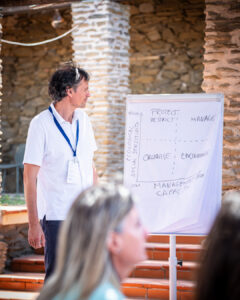
Workshop discussions. Picture by Alessio Mitol
The afternoon workshops explored a range of challenges and opportunities related to sustainable tourism in Protected Areas, with discussions focusing on governance, cultural heritage, active tourism, biodiversity conservation, and stakeholder partnerships. Key outcomes of the workshops include:
- Tourism should move beyond visitor management towards regeneration and stewardship. Participants highlighted the value of engaging visitors more actively in conservation, environmental education, and species monitoring, while also reimagining cultural heritage sites as spaces for dialogue, reflection, and environmental restoration rather than static attractions.
- Stronger collaboration and evidence-based planning are needed to balance tourism and conservation goals. Discussions emphasised the importance of cross-sector partnerships, improved governance structures, suitability-based planning, and better scientific understanding of tourism impacts and carrying capacity to ensure tourism supports rather than compromises Protected Areas.
Open Mic Session
Through the Open Mic Session, an opportunity is provided to share all the knowledge that is in the room.
It was designed as a dynamic technical platform for sharing specialised projects and innovative management experiences. Moderated by Filipa Lima, ECST Coordinator at EUROPARC, the session featured 10 presentations focusing on mobility, social inclusion, youth engagement, and cross-sectoral collaboration.
- Governance and Cross-Sectoral Collaboration
- The CONNECT Project (Teresa Pastor): Focused on establishing lasting institutional frameworks between Protected Area managers and the outdoor sports sector
- From Recognition to Participation (Marco Piergotti): Analysed how the implementation of the European Charter (ECST) has fundamentally transformed stakeholder engagement in Monti Lucretili.
- Sustainable Mobility and Visitor Management
- Moving Around Naturally in La Garrotxa (Arnau Dorca Tomas): Presented as a benchmark model for sustainable mobility, this project prioritizes non-motorized transport (walking, cycling) and public transit to mitigate vehicular pressure on sensitive volcanic habitats.
- When Footsteps Help Nature (Daniel Ružanski): A technical study on how specific visitor patterns can be leveraged to support salt marsh conservation efforts.
- Social Inclusion and Specialised Tourism Tools
- Accessibility for All (Guido Guarino): Detailed the implementation of inclusive sustainable tourism frameworks within the Vesuvius National Park.
- IamaGoodTraveller™ Guide (Loris Bondio): Validation of a platform designed to promote ECST-adhered businesses through behavioural nudges for tourists.
- Wilder Places (Bart Schutz): An analysis of the emerging “Rewilding Tourism” market and its operational drivers in Europe.
- Education, Youth, and Human Resources
- Park Management Experiences (Andrea Gennai): An innovative programme allowing visitors to experience the operational reality of a park employee for a limited duration to foster deep environmental stewardship.
- Youth Conservation Corps in Lebanon (Teddy Habchy): Positioned youth involvement as a central structural pillar for sustainable tourism development in Middle Eastern Protected Areas.
- Nature in Child Development (Daniela Pandurska): A scientific perspective on the critical role of environmental education in early childhood development and long-term conservation advocacy.
In line with the keynotes in the morning, the session demonstrated that the future of the Sustainable Tourism depends on diversifying management tools. Moving beyond mere conservation to include active stewardship, high-resolution data in mobility, and inclusive socio-economic models that transform the visitor from a passive consumer into a custodian of the natural capital.
The future of Sustainable Tourism transforms the visitor from a passive consumer into a custodian of natural capital.
Day two – Out In The Field
The second day provided participants with the opportunity to discover tourism activities in the Asinara National Park and the Porto Conte Regional Park in Alghero. Discover the photo album above and enjoy the wonderful landscapes!
Day three – The Journey Ahead
The final day of the event set out to bring everything together to answer: where does the ECST go from here?
Drivers that bring tourists to Protected Areas – Antonio Pezzano, Tourism Expert
Antonio presented a critical analysis of visitor motivations and the strategic failure of “product-based” communication in Protected Areas. He argued that management often relies on research from existing visitors while ignoring the motivations of those who do not visit, leading to incomplete data for growth strategies. He introduced the concept of psychological triggers (triggers like “restoration,” “connection to nature,” and “local cuisine”) that initiate the travel decision-making process:
Protected Areas must shift from communicating product quality to aligning their messaging with these core psychological triggers to remain competitive.
From Sustainable to Regenerative Tourism – Ralf Pastleitner, TUI
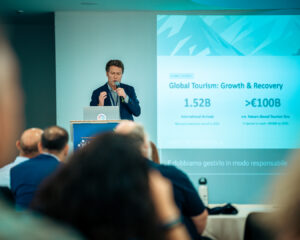
Ralf Pastleitner by Alessio Mitol
Ralf provided a sector-wide analysis of current tourism trends and the transition toward a net-positive impact model. The presentation defined sustainable tourism as “net zero” (doing no harm) and advocated for a shift towards regenerative tourism, which aims to leave destinations in a better state than they were found. Ralf argued that sustainability is no longer a niche differentiator, but a standard expectation integrated into the core product offering. At TUI initiatives are highlighted to mitigate “overtourism” by shifting demand to shoulder seasons (e.g., through the Mediterranean Marathon League) and promoting “undertouristed” rural areas to alleviate pressure on hotspots.
Territorial Intelligence and Data-Driven Management – Mattia Ucchiello, Mindicity/TIM
Mattia detailed the application of advanced technologies to transition from reactive to proactive adaptive management. The deployment of anonymized telco data and high-resolution satellite imagery allow for real-time monitoring of visitor density and environmental impact. He presented a case study from Foresta Casentinese National Park in Italy, where AI correlates meteorological data with historical patterns to predict visitor spikes using Predictive AI Modelling (e.g., during mushroom picking seasons), allowing managers to adjust parking and access control in advance. The session concluded that objective data is essential for setting scientifically sound carrying capacities and managing mobility flows effectively.
Strategic Roadmap and the “World Café”
A highlight of the final day was the World Café discussion, introduced and facilitated by Teresa Pastor, ECST programme and policy manager. The session provided an interactive platform for participants to exchange ideas and help shape the future direction of the ECST.
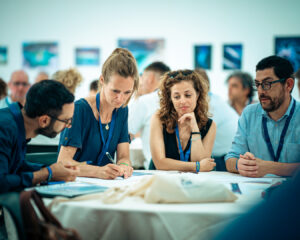
World Café by Alessio Mitol
Participants engaged in a series of discussion rounds focused on the following topics:
- The European Alliance of Ecotourism Destinations: What role should EUROPARC play in its development and governance?
- From Protected Areas to Territories: Should the ECST evolve towards a Phase IV territorial recognition model?
- Brand Architecture: How can the ECST better communicate and promote the identity of Charter-awarded protected areas?
- Strengthening the ECST as a Methodological Tool: How can the Charter continue to support and guide sustainable tourism management effectively?
The contributions and insights shared by practitioners working directly in Protected Areas are of immense value to EUROPARC. Their perspectives will help inform ongoing developments and ensure that the ECST continues to evolve as a relevant, effective, and practical framework for sustainable tourism in protected areas across Europe.
Round Table: ECST Perspectives and Expectations
A Round Table followed in the afternoon which brought together a panel of tourism experts, verifiers, and Protected Area managers to evaluate the current state of the ECST and define its strategic trajectory.
The discussion was moderated by Federico Minozzi, Head of EUROPARC Policy and Projects unit, and the participants of the Round Table were as follows:
- Richard Denman: Chairman of the ECST Evaluation Committee.
- Andrea Gennai: Board member of Federparchi-EUROPARC Italy.
- Bettina Kreisel: ECST Verifier.
- Nele Sõber: Representing the Estonian Environmental Board and Matsalu National Park.
The experts reaffirmed that the ECST remains one of the most robust instruments for tourism governance within European Protected Areas. A critical need was identified to significantly enhance its external recognition beyond the conservation sector to reach final consumers and high-level policymakers. The panel emphasised that the network must move toward better documenting and demonstrating the tangible results and measurable impacts of the Charter on both biodiversity and local economies.
The insights from this session will directly inform the final “Report for the future of the ECST,” prioritising the evolution of the ECST into a more transformative territorial tool. The consensus highlighted that the Charter is entering a new stage where communication of the “value of Protected Areas” is as critical as their physical management. This report will be shared with participants and the ECST Netowrk.
EUROPARC Directorate sincerely thanks the Asinara National Park for the great management of this event.
