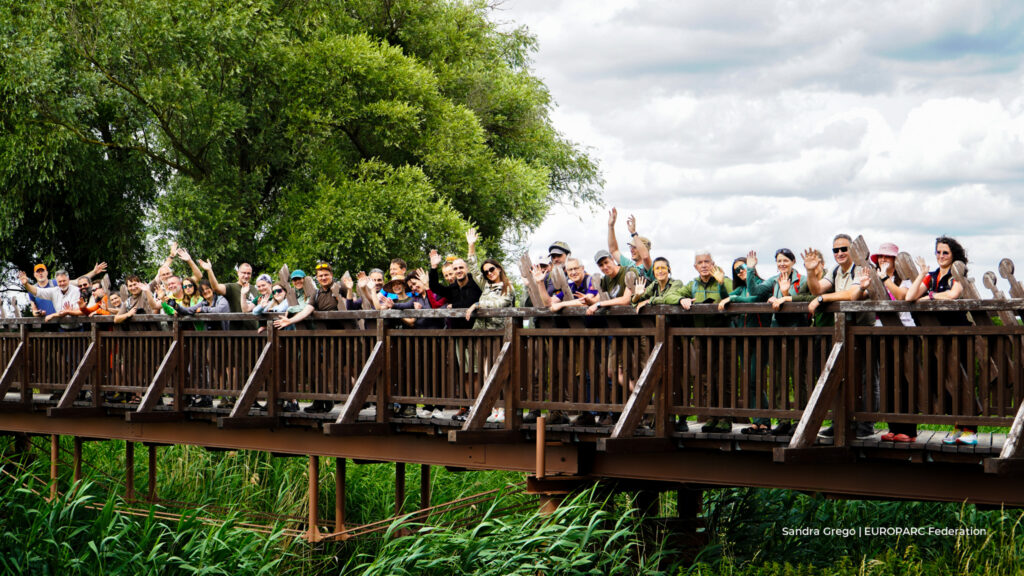
(c) Sandra Grego
EUROPARC’s network of Transboundary Parks, TransParcNet, came together for their annual meeting on the border of Austria and Hungary to learn more about cross-border grassland management.
Dates: 8–12 June 2026
Location: Neusiedler See–Seewinkel National Park (Austria) & Fertő–Hanság National Park (Hungary)
Theme: Cross-border Grassland Management
Europe’s grasslands are biodiversity hotspots shaped by centuries of traditional land use. Unlike forests or other more self-sustaining ecosystems, many semi-natural grasslands depend on continued human management to maintain their exceptional diversity. Without grazing or mowing, shrubs and trees gradually take over. As a result, open habitats shrink, threatening the specialised plants, insects and birds that depend on them. Conserving these landscapes therefore requires both active management and long-term protection. It also makes cross-border cooperation essential wherever ecosystems extend beyond national boundaries.
This shared challenge brought conservation professionals, researchers and Protected Area managers to TransParcNet 2026, hosted by Neusiedler See–Seewinkel National Park (Austria) and Fertő–Hanság National Park (Hungary). Throughout the week, they exchanged practical solutions and explored how transboundary cooperation can safeguard Europe’s shared natural heritage.
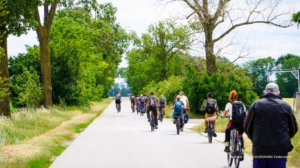
Participants cycling 70km on e-bikes during field trips.
Learning from the Landscape
The meeting was built around the idea that some of the best lessons happen outdoors. Participants travelled by bicycle, ferry and bus through the transboundary landscape. Along the way, they visited the iconic soda pans of Seewinkel, restored grasslands around Lake Neusiedl and grazing sites on both the Austrian and Hungarian sides of the border.
During these visits, participants saw how cross-border grassland management works in practice. Although separated by a national border, the grasslands form one connected ecosystem. Maintaining their ecological value requires coordinated grazing regimes, habitat restoration, monitoring and knowledge exchange. Together, these efforts ensure that management actions complement one another and that species can thrive across the wider landscape.
Traditional Grazing Creates Healthy Grasslands
A clear message emerged throughout the meeting: Europe’s grasslands thrive through active management. At Fertő–Hanság National Park, participants discovered how traditional grazing with Hungarian Grey cattle, water buffalo and Racka sheep, combined with mosaic mowing, maintains species-rich meadows and wetlands. These time-tested practices continue to play a vital role in conserving biodiversity across thousands of hectares.
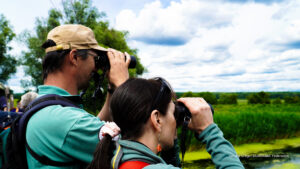
Birdwatching during field trips.
Protecting Pollinators Starts with Healthy Habitats
Healthy grasslands are essential for Europe’s pollinators. Grace Bond from IUCN presented the European Pollinator Action Plans, highlighting threatened teasel bees and the need for flower-rich meadows, suitable nesting sites and connected habitats. Practical measures such as late mowing, low-intensity grazing and habitat restoration can protect these species while strengthening entire grassland ecosystems.
Sharing Knowledge Across Borders
The meeting also highlighted experiences from across Europe. Shar Mountain National Park presented its work to conserve high-mountain grasslands through pasture inventories, habitat assessments and cooperation with local communities. Despite challenges such as rural depopulation and climate change, the presentation reinforced a common message: successful grassland conservation depends on sound science, active management and strong cross-border partnerships.
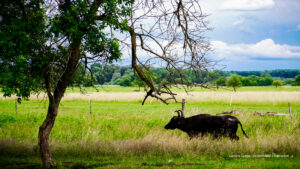
Grazing practices with Black buffalo.
From Experience to Best Practice
The final workshops focused on turning ideas into practical guidance. Participants identified successful examples of transboundary grassland management and began developing a new TransParcNet publication [coming soon!] that will showcase best practices from across the network.
Nature Thrives When Working Across Borders
TransParcNet 2026 demonstrated that conserving Europe’s grasslands requires more than protecting individual sites. Success depends on active management, respect for traditional knowledge, scientific innovation and, above all, cooperation across borders.
From extensive grazing and habitat restoration to pollinator conservation and high-mountain pasture management, every presentation reinforced the same message:
Healthy grasslands are living landscapes that depend on people working together.
Click on the image to open the full album
TransParcNet 2026 Programme:
TransParcNet 2026 Report:
TransParcNet 2026 Presentations:
- Presentations are available upon request