Photographer: Sebastian Freiler @ EUROPARC Conference 2022 in Austria
EUROPARC is the lead partner of the groundbreaking LIFE PAME-Europe project, which aims to create a unifying approach to Protected Area Management Effectiveness.
A unifying approach to Protected Area Management Effectiveness: The LIFE PAME-Europe Project

Effective management of Protected Areas is a cornerstone of all leading biodiversity strategies. But how do we measure that effectiveness? And just as importantly, how do we transform the wealth of data we collect into actionable insights?
The LIFE PAME-Europe project, led by the EUROPARC Federation, aims to answer these questions by developing a Management Effectiveness Evaluation (MEE) framework that harmonises with existing national and international systems.
Not Just Another Methodology—A supporting framework
Currently, the evaluation of Protected Area Management Effectiveness in Europe is fragmented. Some Member States rely on their own national or international systems, while others have none. This patchwork leads to unreliable and incomparable data, making it challenging to form a clear picture of biodiversity trends across the EU.
LIFE PAME-Europe seeks to change that—not by imposing yet another system, but by building upon the best of what already exists. The project will analyse established MEE methodologies such as the IUCN Green List, European Diploma, the Management Effectiveness Tracking Tool (METT), and WWF’s Rapid Assessment and Prioritization of Protected Area Management (RAPPAM), along with national approaches. By identifying their strengths, LIFE PAME-Europe will create a flexible, adaptable framework tailored to the diverse needs of EU Member States.
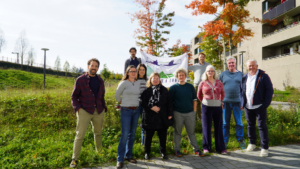
LIFE PAME Europe Projects partners at the Kick-off meeting,
From data to insight: a digital tool for Member States
To ensure consistent, comparable data, the European Environmental Agency will develop a digital tool based on the LIFE PAME-Europe framework. This tool will enable Member States to report their MEE findings, creating a cohesive dataset that provides a comprehensive overview of Europe’s biodiversity management. It will also promote a landscape-scale approach, shifting from isolated site-based assessments to a broader, interconnected perspective.
Supported by experts
LIFE PAME-Europe is kindly supported by a range of external Management Effectiveness experts from across Europe. The members of this External Advisory Board have a wealth of experience that they will bring to the project. You can get to know the members of this group here.
Building a community for success
The project isn’t just about theory; it’s about practical, impactful solutions. The framework will be tested in 45 pilot sites across Europe, providing opportunities to refine and adapt the framework. Additionally, an online training course will be developed and employed on EUROPARC’s European Nature Academy (ENA) to enhance the competencies of those conducting MEE assessments.
The project’s commitment to Capacity Building ensures that the framework will serve both Member States with advanced systems and those just starting their journey. After all, how data is gathered is just as important as the fact that it is gathered.
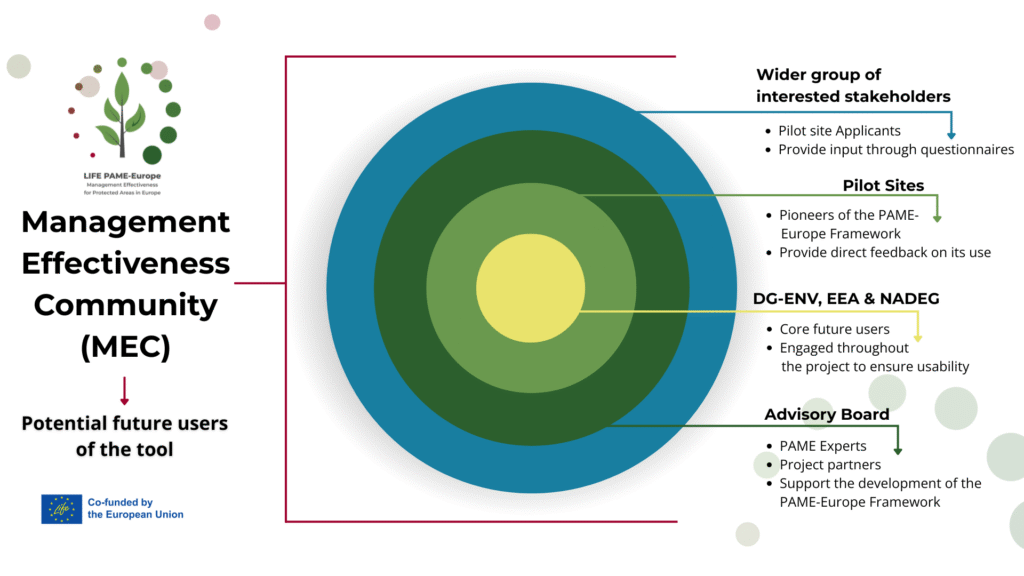
Additionally, a core component of the LIFE PAME-Europe project is the establishment of a Management Effectiveness Community (MEC). This group, comprising key stakeholders and tool users, will offer valuable feedback and share on-the-ground experiences to ensure the methodology meets real-world needs.
Meet the pilot sites!
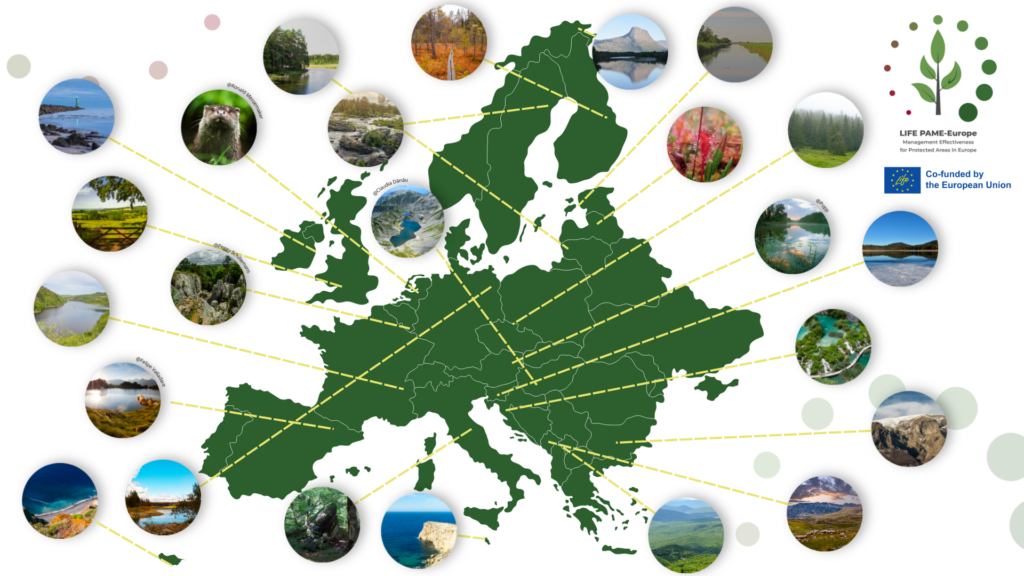
An overview of some of the 47 PAME-Europe Pilot Sites.
After a careful selection process, the following Pilot Sites have been accepted into the LIFE PAME-Europe project, ensuring a broad geograhpical coverage, as well as different management structures, and a range of experiences with PAME systems. These sites are currently taking part in online training, hosted on the European Nature Academy, to prepare them for piloting the draft PAME-Framework during the summer of 2026. Their experiences will directly feed into the improvement of the Framework to ensure that it is fit for purpose. The following sites are part of the piloting phase:
- Austria: Lobau, Wiener Teil des Nationalparks Donau-Auen/Lobau, Viennese share of the Donau-Auen National Park
- Belgium: Parc national de l’Entre-Sambre-et-Meuse / Entre-Sambre-et-Meuse National Park
- Bulgaria: Национален парк “Централен Балкан”/Central Balkan National Park
- Bulgaria: Atanasovsko lake Natura 2000 zone
- Croatia: Nature Park Medvednica/Park prirode Medvednica
- Croatia: Nacionalni park Plitvička jezera / Plitvice Lakes National Park
- Czechia: Krkonošský národní park / The Krkonose Mts. National Park
- Czechia: Národní park Podyjí / Podyji National Park
- Czechia: EVL Ralsko/SAC Ralsko
- Czechia: SAC Praděd
- Estonia: Matsalu rahvuspark / Matsalu National Park
- Finland: Elimyssalon luonnonsuojelualue/Elimyssalo Nature Reserve
- Finland: Inarijärvi Natura 2000 -alue / Lake Inarijärvi Natura 2000 Area
- France: Réserve Naturelle Régionale des Gorges de la Loire / Loire Gorges Regional Nature Reserve
- Germany: Nationalpark Unteres Odertal/ Lower Oder Valley National Park
- Germany: Pommersche Bucht – Rönnebank / Pomeranian Bight/Rønne Bank
- Ireland: The Burren (An Bhoirne)
- Ireland: North Bull Island
- Italy: Parco nazionale delle Foreste Casentinesi/Foreste Casentinesi National Park
- Italy: Riserva naturale regionale orientata di Ripa Bianca di Jesi / Ripa Bianca di Jesi Regional Nature Reserve
- Latvia: Gaujas Nacionālais parks/Gauja National Park
- Lithuania: Žemaitijos nacionalinis parkas / Zemaitija National Park
- Malta: Il-Majjistral Nature & History Park
- Montenegro: Durmitor National Park
- Montenegro: Orjen Nature Park
- Montenegro: Trebjesa Area of Exceptional Features
- North Macedonia: Национален парк Галичица / Galicica National Park
- Norway: Pasvik naturreservat / Pasvik Nature Reserve
- Norway: Reisa Nasjonalapark (National Park) and Ráisdouttarháldi landskapsvernområde (landscape protected area)
- Poland: Karkonoski Park Narodowy/Karkonosze National Park
- Poland: Białowieski Park Narodowy / Bialowieza National Park
- Portugal: APP Vale das Amoreiras (Área Protegida Privada Vale das Amoreiras)/ Protected Private Area of Vale das Amoreiras
- Portugal: Reserva Natural Parcial do Garajau / Garajau Nature Reserve
- Portugal: Banco Princesa Alice/Princess Alice Bank; Banco Condor/Condor Bank
- Romania: Parcul Național Retezat / Retezat National Park
- Slovenia: Krajinski park Pivška presihajoča jezera / The Seasonal lakes of Pivka Nature park
- Spain: Parc Natural de l’Alt Pirineu / Alt Pirineu Natural Park
- Spain: Parc Natural de la Serra de Collserola / Serra de Collserola Natural Park
- Spain: Parque Nacional de la Sierra de Guadarrama / Sierra de Guadarrama National Park
- Sweden: Hoburgs bank och midsjöbankarna/ Hoburg’s bank and the Midsea banks.
- Sweden: Storforsen / Storforsen Nature Reserve
- The Netherlands: Nationaal Park Zuid-Kennemerland
- The Netherlands: Weerribben-Wieden National Park
- Ukraine: Природний заповідник “Розточчя” / Nature reserve “Roztochya”
- United Kingdom: Cotswolds National Landscape
- United Kingdom: Forvie National Nature Reserve
- United Kingdom: Ben Nevis SAC
Project updates
- December 2024: Introducing LIFE PAME-Europe in EUROPARC’s Annual Journal Protected Areas In-Sight. Learn more here.
- March 2025:LIFE PAME-Europe’s Advisory Board meets in Siggen to prepare for the Pilot Sites launch. Learn more here.
- Decemer 2025: Updates from LIFE PAME-Europe and the Framework in the latest edition of EUROPARC’s Annual Journal ‘Protected Areas In-Sight. Learn more here.
- March 2026: Pilot Sites start their learning co-learning journey! Learn more here.

Project steps:
- Assess existing approaches;
- Develop the LIFE PAME Europe Methodology;
- Pilot the methodology in Parks;
- Assess the Pilot;
- Create capacity building on the use of the methodology.
LIFE PAME Europe in numbers:
- 5 Project Partners: EUROPARC Federation, Metsähallitus Parks and Wildlife Finland, DHP Conservation, Nationale Naturlandschaften e.V., Generalitat de Catalunya – Departament de Territori, Habitatge i Transició Ecològica
- 52 months: September 2024 – December 2028.
- 47 pilot sites.
- €1.6m total budget over four years.

LIFE PAME Project Partners
EUROPARC Staff involved in the project:
You can get to know all EUROPARC staff here. The following staff are involved in the project:
- Neil McIntosh – Project Manager
- Sanna-Kaisa Juvonen – Policy Development Manager
- Esther Bossink – Communications Manager
- Sandra Grego – Communications Officer and ENA expert
