EUROPARC Federation and Parco Nazionale Foreste Casentinesi welcomed 16 Teams of Junior Rangers for the Annual International Camp, from the 27th July – 3rd August 2025. The Junior Rangers experienced frontline nature conservation in the ancient beech forests of the Appenines in central Italy.
21st International Junior Ranger Camp – Junior Ranger in Ancient Forests
- When: 27 July – 3 August 2025
- Where: The Casentinesi Forest National Park, Italy
- Who: Junior Rangers 14 – 17 years old at the time of the camp
- How many: 16 teams of 1 Mentor and 2 Junior Ranger
The Programme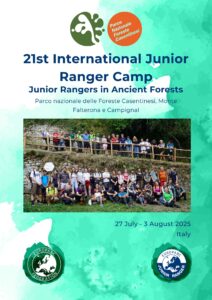
This camp was an amazing week for the Junior Rangers where they shared and learned from one another, and had plenty of fun! The Casentinesi Forest National Park put together a very diverse programme together with local partners and stakeholders! Highlights were kayaking on lake Ridracoli, seeing the fireflies at night, playing volleyball in the evenings and finding many wonderful bugs, moths, butterflies and even a salamandar on the last day!
Camp ReportTo see the camp in photos, have a look at the full photo album
Photo AlbumNew resources from the Mentors workshop: A guide to setting up a Junior Ranger programme in the Casentinesi Forest National Park and a collection of basic data that should be included in a local JR programme when registering new Junior Rangers.
Guide for a JR programme Data CollectionWe would like to express our full gratitude to the Andrea Gennai, director of the Casentinesi Forest, Monte Falterona e Campigna National Park for hosting us and making us feel very welcome, the Villaggio San Francesco for accommodating us and the local carabinieri for organisign activities and presenting their work to us throughout the week.

About the Park?
The Foreste Casentinesi, Monte Falterona, Campigna National Park covers an area of approximately 36,000 ha, equally divided between Emilia Romagna and Tuscany. It extends along the Tuscan-Romagna Apennine ridge, descending steeply along the parallel valleys of the Romagna side and more gradually on the Tuscan side, which has gentler slopes, up to the wide valley floor formed by the Arno. The park is largely covered by woods: we can find centuries-old fir trees, beech and mountain maple forests, mixed forests with incredible variations of species that create colourful spots of colour in autumn. The ancient beech forests of the National Park and the Integral Reserve of Sasso Fratino have become part of the UNESCO world heritage site.
The territory of the park is characterized by its great richness and variety of fauna: among the vertebrate fauna, the most fascinating one is represented by the large mammals, in particular the ungulates, which are present with five species (Deer, Fallow Deer, Roe Deer, Wild Boar and Mouflon) and by wolf, the largest predator present in the park today. The very rich avifauna currently includes around a hundred nesting species.
2025 Camp Brochure