Drive Until The End Of The Road – A Visit To The Weerribben
In July 2026, representatives of the LIFE PAME-Europe project visited one of the project’s Pilot Sites, the Weerribben-Wieden. Learn more about how this place is managed, and what makes it so unique. Scroll down for the video interview with Ruben!
Blog written by Esther Bossink, EUROPARC Federation Communications and Operations Manager.
Meeting Where the Road Ends & The Journey Begins
“Drive until the end of the road, that’s where you’ll find our office.”
Those were Ruben Achter de Molen’s instructions before our visit to the Staatsbosbeheer office in the Weerribben, the Netherlands.
As a native Dutchie, I was surprised by how accurate that description turned out to be. In a country where everything is planned and every road seems to lead somewhere, not many roads truly end. Yet our narrow, winding road did exactly that, stopping at the Staatsbosbeheer office.
This is where Ruben was waiting for us. He works for Staatsbosbeheer, the Dutch National Forestry Agency, as area manager for the Weerribben. With the neighbouring Wieden, managed by the NGO Natuurmonumenten, the area forms National Park Weerribben-Wieden and is one of the LIFE PAME-Europe Pilot Sites. The project supports nature managers in assessing the effectiveness of Protected Area management through the development of the PAME-Europe Framework and its accompanying digital tool.
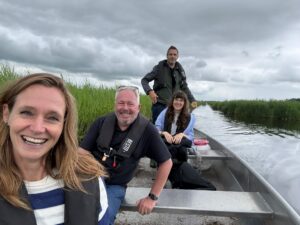
Myrthe Fonck, Neil McIntosh, Esther Bossink and Ruben Achter de Molen
Together with project manager Neil McIntosh and Myrthe Fonck from National Park Zuid-Kennemerland, another PAME-Europe pilot site, Ruben invited us to discover what makes the Weerribben-Wieden such a valuable landscape, and why both organisations wanted to join this European project.
The Staatsbosbeheer office sits alongside a busy “water highway”, where recreational boats pass every few minutes in the summer months on their way to the waterways of Friesland in the north of the Netherlands. However, for the greater part of the year, the area is marked by tranquility. Across the canal, the marshes of the Weerribben stretch into the distance. Together with the Wieden, they cover more than 10,000 hectares. That is a considerable area in one of Europe’s most densely populated countries. Internationally, the area is equally significant: it is the largest contiguous lowland peat bog in north-western Europe and provides habitat for a wide range of species, including the endemic Large Copper butterfly. Recognising its ecological importance, the area is protected as a Natura 2000 site.
Standing on the edge of the marsh, it is difficult to imagine that this landscape owes so much of its existence to people.
Weerribben-Wieden: Where People Shape Nature – and Nature Shapes People
Ruben welcomes us into the Staatsbosbeheer office overlooking the water with understandable pride. As we settle in, he introduces the history and management of this special place, explaining that in many ways, the Weerribben is itself a product of the interaction between people and nature.
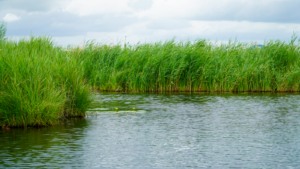
Reeds in Weerribben
Before the construction of the Afsluitdijk, this area bordered the Zuiderzee. The dynamic influence of the sea regularly removed reeds and prevented forests from establishing. Once the dike closed off the sea, those natural processes came to an end, and people gradually took over that role. Reed cutting became an important activity, supplying material for traditional thatched roofs, a practice that continues today, and fills the locals with pride. As we moved through the landscape, many signs were placed along the road stating ‘We are growing roofs here!’.
Peat extraction, however, shaped the landscape most profoundly. As peat was dug for fuel, an intricate network of waterways and marshes emerged, creating the conditions for the rich wetland habitats that define the area today.
With a smile, Ruben tells us, “Over here we say that we heated Amsterdam.”. The peat harvested in the area was transported by boat to the capital of the Netherlands, and even to ports around the Baltic Sea, becoming an important driver of the local economy.
The landscape changed again when peat lost its economic value. As land prices declined, many private landowners sold their properties to the government, and management of much of the area gradually came into the hands of Staatsbosbeheer.
A Shared Responsibility
If history explains how the Weerribben came into being, it also explains why managing it requires so many people to work together.
The Weerribben forms part of National Park Weerribben-Wieden. Staatsbosbeheer, state-owned, manages the Weerribben, while Natuurmonumenten, an NGO, is responsible for the Wieden. But those organisations are only part of the picture. Farmers, reed cutters, local residents, municipalities and many others all have a stake in this landscape.
In Dutch, we call this approach polderen: bringing everyone around the table to find a shared solution. The term originates from the polders: the reclaimed land that depended on collective effort to keep dry. That tradition of cooperation remains deeply embedded in the Dutch way of working.
Polderen: bringing everyone around the table to find a shared solution.
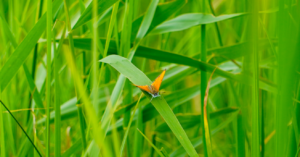
Copper Butterfly in the Weerribben
As Ruben explains how decisions are made, it becomes clear that managing the Weerribben is about much more than restoring habitats or protecting species. It is equally about maintaining the partnerships that make that management possible. It is this combination of ecology, governance and long-term stewardship that makes the site such an interesting pilot for LIFE PAME-Europe.
One example is reed cutting. Around ten percent of the reed used for thatched roofs in the Netherlands still comes from the Weerribben. Staatsbosbeheer works with over 100 tenants who continue to harvest reed by hand, and across the whole of the National Park around 200 tenants are engaged. By following management agreements, these tenants help maintain open marsh habitats while sustaining a centuries-old tradition. Their livelihoods and the area’s biodiversity are closely connected.
The results are visible. Populations of the Large Copper butterfly are increasing, species such as the Black Tern and the otter have returned, and sphagnum moss is thriving once again, strengthening the peatland’s role as an important carbon sink.
Let’s Take to the Water
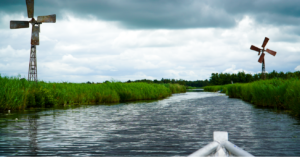
Weerribben-Wieden landscape
After our introduction inside the office, Ruben is eager to show us the Weerribben as it’s meant to be experienced: from the water.
We duck beneath low bridges before entering a maze of waterways lined by towering reeds. Every now and then an old windmill appears on the horizon, completing the unmistakably Dutch landscape.
We do not have to wait long before Ruben’s experienced eye spots the Large Copper butterfly. With its bright orange wings standing out against the sea of green reeds, it is easy to understand why this tiny insect has become the area’s flagship. Remarkably, the special subspecies L. d. batavus is found nowhere else in the world.
As we continue through the marsh, Ruben points out the different management measures that Staatsbosbeheer and the reed cutters are taking to support not only the Large Copper butterfly, but many other characteristic species of the marshland. Looking across the seemingly untouched landscape, it is striking how much care lies beneath its calm appearance.
By the end of our visit, one message has become clear: the Weerribben is not simply a landscape where nature is protected, it is a landscape where nature, history and people continue to shape one another. Its biodiversity depends not only on ecological processes, but also on cooperation, shared responsibility and long-term stewardship.
Assessing management effectiveness means looking beyond habitats and species alone.
That is also what makes the Weerribben-Wieden such a valuable LIFE PAME-Europe Pilot Site. Assessing management effectiveness means looking beyond habitats and species alone. It also means understanding the partnerships, traditions and governance that allow those habitats to thrive. The Weerribben shows that effective Protected Area management is as much about people working together as it is about the nature they care for. Understanding whether that collaboration remains effective is precisely what PAME-Europe aims to support.
Before heading back, we step ashore for one final stop to ask Ruben about the management of the area, why the Weerribben-Wieden joined LIFE PAME-Europe as a pilot site, and what makes this landscape so distinctive. Dive into the video to hear it directly from him!
As we leave the Weerribben, we found more than an office at ‘the end of the road’: instead, we were introduced to a space where biodiversity depends not only on ecological processes, but also on centuries of human stewardship and continued collaboration between land managers, reed cutters, local communities and many other stakeholders.
Interested in Protected Area Management Effectiveness? Join the LIFE PAME-Europe Management Effectiveness Community mailing list. You will stay updated on the project’s progress and be able to provide feedback throughout its development. Sign up here.