EUROPARC joins the Global Partnership on Ecological Connectivity (GPEC)
Strengthening Connectivity and Protected Areas in Europe
EUROPARC joins the Global Partnership on Ecological Connectivity (GPEC)
In times when climate change is forcing species to shift their ranges across landscapes and altitudes, ecological connectivity is becoming irreplaceable to support the long-term survival of species and habitats.
Ecological connectivity, defined by the Convention on the Conservation of Migratory Species of Wild Animals as “the unimpeded movement of species, connection of habitats without hindrance and the flow of natural processes that sustain life on earth”, is vital for maintaining healthy ecosystems and to halt biodiversity loss. In Europe, where many landscapes are heavily shaped by human activity, strategic corridors and buffer zones are essential to counteract the effects of habitat fragmentation.
Connectivity allows wildlife to move for food, shelter and reproduction, thus permitting genetic flows, and to adapt to changing climates, all of which are essential for long-term species survival. Protected Areas serve as key nodes in this ecological network. Without connectivity, even well-managed protected areas can become isolated “islands,” vulnerable to ecological collapse.
In Europe, the Natura 2000 network is the cornerstone of nature conservation, targeting threatened species and habitat types listed in the Habitats and Birds Directives. Under the EU Biodiversity Strategy for 2030, the proposed Trans-European Nature Network (TEN-N) aims to complement and expand the current Protected Area network, increasing coverage by 2030 to a minimum of 30% of the EU’s land area and 30% of the EU’s sea area. A pan-European analysis conducted by the NaturaConnect project highlights that through a strategic, coordinated approach, expanding Natura 2000 sites by approximately 11% of land could more than double the amount of species and habitats protected (O’Connor et al., under review; Visconti, O’Connor & Beher 2024). Just 5% of additional protection in strategically placed locations can lead to large gains for species and habitats.
Yet, despite the 30×30 target and the urgent need for its implementation, protected area coverage in the European Union remains at around 26%, just 4% away from the goal. However, with small patches dominating the protected area network in Europe, and 75% of Europe’s Natura 2000 sites being smaller than 1km² (Beher, J. and Visconti, P., 2026), expanding coverage is not even enough. Small, isolated patches do not guarantee the functioning of ecological processes, as they don’t support the full range of movement of species or the flow of ecosystem services, such as pollination, water purification, and climate regulation. Ecological resilience requires not just more Protected Areas, but larger, connected landscapes that can sustain both biodiversity and the critical services ecosystems provide to people.
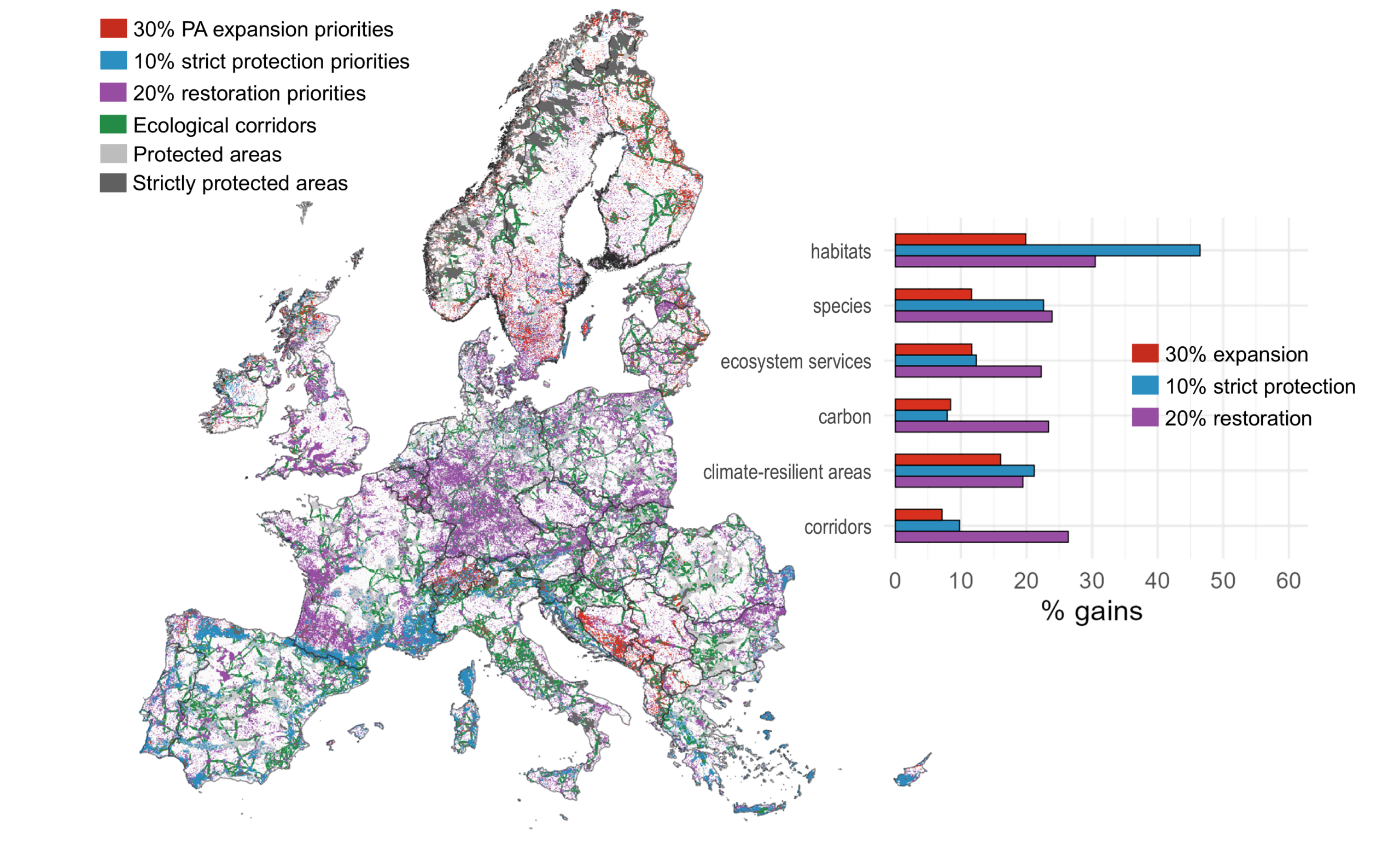
Image: Results from the NaturaConnect project (2022-2026): Blueprint for the TEN-N: European-wide consensus* priorities for conservation, strict protection and restoration. (Source: O’Conner et al. 2026).
*Consensus priority areas refers to areas that were consistently selected across scenarios and their performance across a range of ecological, structural and socio-economic indicators.
We therefore need to focus on restoring and maintaining key ecological corridors across Europe to ensure our Protected Areas are truly connected; and to secure both the current and the future core habitats of species.
By anchoring ecological corridors in spatial planning processes and prioritizing them for conservation and restoration efforts, Protected Areas can become more resilient and effective in addressing the double crises of biodiversity loss and climate change.
To amplify such efforts on a European and global scale, EUROPARC joined the Global Partnership on Ecological Connectivity (GPEC) earlier this year. GPEC was launched in 2024 in the framework of the Convention on the Conservation of Migratory Species of Wild Animals (CMS) together with several key international organisations as a multi-stakeholder platform for coordinated action. Together with GPEC, EUROPARC aims to enhance ecological connectivity and to strengthen the European and global network of Protected Areas. Specifically, EUROPARC is committed to:
- Advocate for embedding connectivity in EU and national policies, and to support transboundary coordination.
- Share best practices and facilitate knowledge exchange among the partnership on how to enhance connectivity in and beyond Protected Areas.
- Build partnerships to amplify impact across Europe and globally.
Connectivity is not just about linking landscapes and creating corridors; it’s about linking people, policies, and purpose. EUROPARC joining the GPEC and the fact that so many entities, within and beyond GPEC, are working toward the same goal, gives me hope. With our joint efforts across countries, we can increase connectivity and strengthen our Protected Area network step by step.
Marit Schnepf, Project Manager at EUROPARC for the NaturaConnect project
Do you have a best practice example of connectivity from your park or region that you would like to share? Reach out to us or submit a case study here.