Complementary EUROPARC Programmes: the European Charter for Sustainable Tourism and the Junior Rangers
Junior Rangers are the future park staff, business owners, tour guides and are important stakeholders in the European Charter for Sustainable Tourism.
Involving young people in the European Charter for Sustainable Tourism
by Rolands Auzins, ECST verifier
I care. I care about what is happening around now and in the future. I am interested. I am interested in how it works, why it happens and whether it can be different. I want to get involved. I want to be a part of the present and the future and be the one who can make things better. I’m a Junior Ranger.
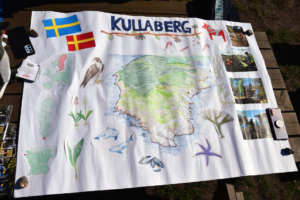
Junior Rangers showcase their Protected Area at the International Junior Ranger Camp
Sustainable Destination principles govern how tourism is developed and managed in a Protected area. The European Charter for Sustainable Tourism in Protected Areas is a management tool, to ensure a viable and healthy future for people and for nature. Let’s pause here at “people” and focus on young people – the Junior Rangers. We for nature, nature for us. It is a mutual interaction between the two EUROPARC programs.
In charter parks, engagement with young people has largely been through the EUROPARC Junior Ranger programme. This programme has been operating effectively for many years and has proven itself to be a quality activity with a clear vision for the future.
Young people are an essential part of society in a Park involved in the ECST; they are stakeholders, and they will later take our place to continue what has been started. Years from now, a former Junior Ranger will come to the Park and say – hey, I’ve been here since I was a teenager, I know you and I know what you do. I want to be part of the team and maybe do even better.
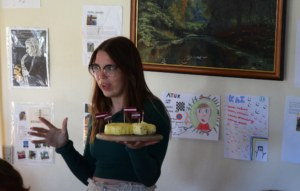
A Junior Ranger introduces others to local Latvian specialities
Young people have a different point of view, they identify their own issues, which are not only worth it, but you definitely need to delve into them, because it is another perspective. Implementation of the ECST program is not possible without the involvement of young people. Junior Ranger activities are an excellent addition to the achievement of ECST’s goals, implementing various projects, activities, and engaging in the creation of a sustainable future. The young person is a Junior Ranger all the time, whether at school, at home, or in everyday life, and when working with ECST tasks, Park staff should remember that there is a young person nearby who is ready and willing to be involved.
How we (those currently in charge of parks and especially ECST Protected Areas) manage Parks now, what decisions we make, affects us now, but will affect young people even more later. Our decisions today mostly have long-term effects, which will be best appreciated by those who do not yet have direct decision-making rights. If a park has become a Sustainable Destination, it is a long-term decision that will ensure the sustainable development of this place in the long-term and will ensure that Junior Rangers will want to return here after studying at universities. Time passes quickly, young people grow up, and they have their own requirements for life, space and place (e.g. as expressed in the EUROPARC Youth Manifesto). With the European Charter for Sustainable Tourism, a solid foundation is laid for the future together with those who now proudly call themselves the Junior Rangers.
Junior Rangers contributing to the European Charter for Sustainable Tourism in the Cairngorms National Park
by Will George, Ranger at the Cairngorms National Park and Junior Ranger Mentor
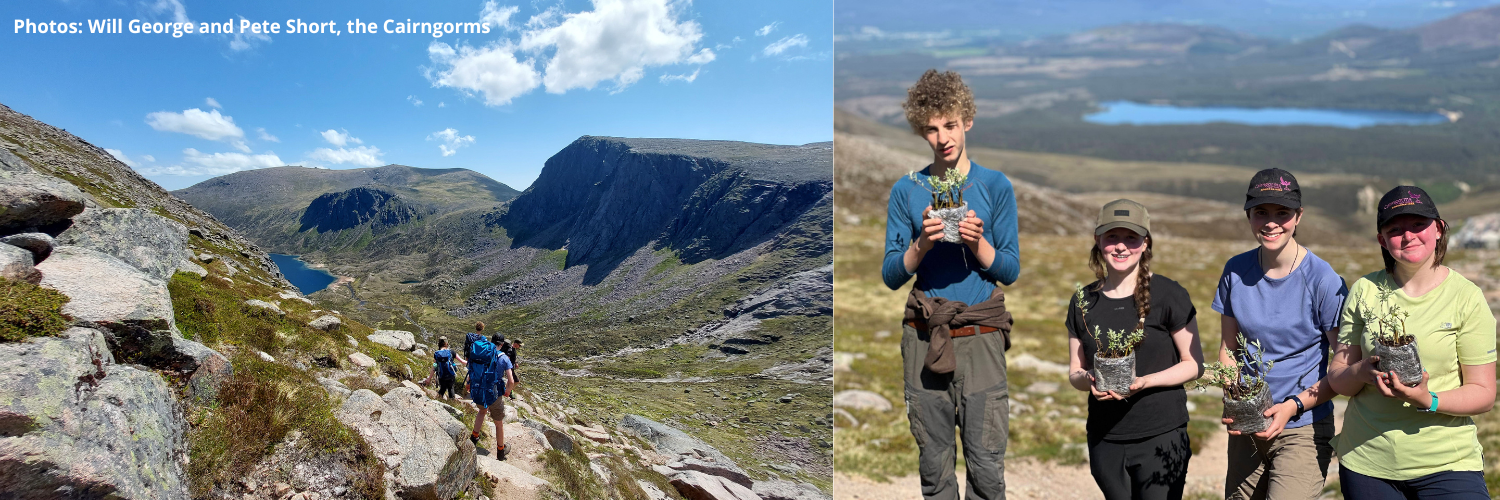
 Whether repairing mountain paths, re-locating rare twin-flower or engaging with visitors about responsible access, the Cairngorms National Park Junior Rangers help to ensure a viable and healthy future for people and nature, and directly contributing to the Principles of the European Charter for Sustainable Development.
Earlier this year, four of them hiked up into the mountain plateau at the heart of the Cairngorms to deliver montane willow species to revitalise the remnant populations and increase the extremely rare montane scrub habitat. They were the youngest volunteers amongst a group organised by the Cairngorms Connect Partnership. So not only did they help to protect and improve the environment for the future, they also added passionate youth voices to a conversation involving a variety of stakeholders.
Katherine, aged 16, described what being part of the Willow Walk meant for her. “It makes us, as in the youth, feel like we’re doing something and we’re not just sitting round doing nothing. There is that sense of belonging. Being able to conserve and guarantee a future of this place for future generations makes me very happy. Doing small things to help, like bringing in the trees today, will help towards the bigger picture.”
Is your Protected Area a part of the European Charter for Sustainable Tourism?
Perhaps consider starting a Junior Ranger Programme to complement it.
Find out more on our website or send us an email!
EUROPARC calls for the implementation of the Human Right to a Clean, Healthy and Sustainable Environment in the Council of Europe
EUROPARC presented the work of the Environment, climate change, Heritage and health committee at the General Assembly of the Conference of International NGOs from the 24th – 26th of April 2023.
EUROPARC calls for the implementation of the Human Right to a Clean, Healthy and Sustainable Environment in the Council of Europe
The General Assembly of the Conference of International NGOs (CINGO), held on the 24th to the 26th of April 2023, marks the end of EUROPARC’s two year mandate of the chairmanship of the Environment, climate change, Heritage and health committee within the Council of Europe (CoE). This committee looked at the following conventions as having particular relevance for European Protected Areas:
The conclusions of this committee are that all these conventions need better coordination and communication in order to achieve an improvement in nature heritage and health management across Europe. There remains a lack of space within the CoE to discuss and relate the crises of climate change and biodiversity loss within its competencies, namely democracy, human rights and the rule of law.
EUROPARC will remain engaged with the work being done in the creation of a protocol to enshrine the right to a Clean, Healthy and Sustainable Environment, which currently does not exist in the European Convention on Human Rights, as explained in our previous article.
In her closing remarks EUROPARC Executive director, Carol Ritchie, stressed that:
Climate change and biodiversity loss are indeed equity, social justice and human rights issues.
The effect of these crises will be experienced more by the poorest and most vulnerable in our societies. The Council of Europe has maintained that sustainable development is at the top of its agenda, stating that economic progress should not compromise key assets of humanity and the quality of the environment and landscapes and indeed further intimated that climate change is the most serious environmental problem that our shared European natural and cultural heritage is facing. Yet action on climate change and biodiversity loss are negligible across European conventions.
The Aarhus Convention
Further, the Council of Europe, fully adopted the principles of the Aarhus Convention which remains relevant to Protected Areas inthe following ways:
- Access to environmental information
That information on environmental issues should be available, and accessible.
- Public participation in environmental decision making
That people should be able to participate in environmental decisions making, something we advocate for in the EUROPARC Youth Manifesto, and through the menthodologies in the European Charter for Sustainable Tourism and Transboundary Parks Programme.
- Access to justice
That justice should be accessible, that it should be the right of every person, present and future generations to live in an environment adequate to health and being. Here it is imperative that the CoE with leadership from the CINGO to press for the greater action on climate change and nature loss as well as the Human Right to a Clean, Healthy and Sustainable Environment.
Progress on the UN Human Right to a Clean, Healthy and Sustainable Environment
Thus far, environmental violations are addressed under article 8 of the European Convention for Human Rights (the right to privacy). With the majority of European countries being Member States within the CoE and having supported the UN Resolution, the European convention becomes outdated in this regard. It is up to the CoE to show solidarity and leadership amongst its members and bring the European Convention up to speed with the international standard.
Protected Areas and their investment and management are a key mechanism to create, deliver and ensure people have this right to a heathy environment realised. EUROPARC will continue to work with others across civil society to press this case.
Toegether with 43 other INGOs, EUROPARC has signed a letter intended to the summit of CoE leaders in Iceland in May. This is only the 4th Summit of the CoE since its establishment in 1949 which is why it is such a pivotal moment to set the path for the future. The letter calls upon the Member States of the Council of Europe to seize the unique opportunity offered by the Reykjavik Summit to promote the effective protection and explicit recognition of an autonomous right to a clean, healthy and sustainable environment in an Additional Protocol to the European Convention for the Protection of Human Rights and Fundamental Freedoms.
Read the full letter here:
CINGO Letter to the MS of the CoE ahead of the 4th Summit in Reykjavik
The first European Charter for Sustainable Tourism business partners in the Baltics
In early February, the Estonian Environmental Board awarded ECST Part II certification to 10 local business partners who are working with Protected Areas to promote and deliver sustainable tourism.
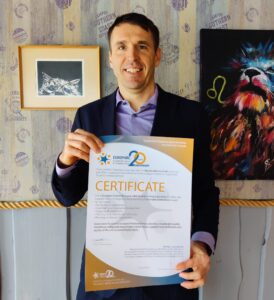
Photo credit: Nele Sõber
The first European Charter for Sustainable Tourism business partners in the Baltics
The Estonian Environmental Board, Keskkonnaamet, is a proud member of the European Charter for Sustainable Tourism (ECST). This year, they celebrated taking the next step with the ECST programme by verifying local businesses to become ECST Part II Partners. The ECST Part II are local business partners who commit to the ethos of this charter and participate in regular meetings to create and implement the sustainable tourism action plan for the Protected Area.
This awards ceremony is the first of its kind in the Baltics and is a big acheivement with 10 businesses certified. EUROPARC celebrates their commitment to continue to support the development of sustainable tourism in Matsalu, Lahemaa and Soomaa National Parks!
Sustainable tourism is Good for Parks, Good for People!
Below you can read about each of the Estonian ECST Part II partners:
Kodade Creative Centre
Business type: accommodation, event centre, tours and events
Kodade works with the Matsalu National Park on a mission to support sustainable, nature-friendly life experiences. They offer an opportunity to connect with nature, through sensory and creative activities, and with culture, through restored historical buildings and localities. Visiting Kodade and the Matsalu National Park is the ideal destination for nature and creativity enthusiasts and every year many are welcomed to take part in the creativity camps, photography training, nature hikes and boat trips and much more!
To find out more, visit their website.
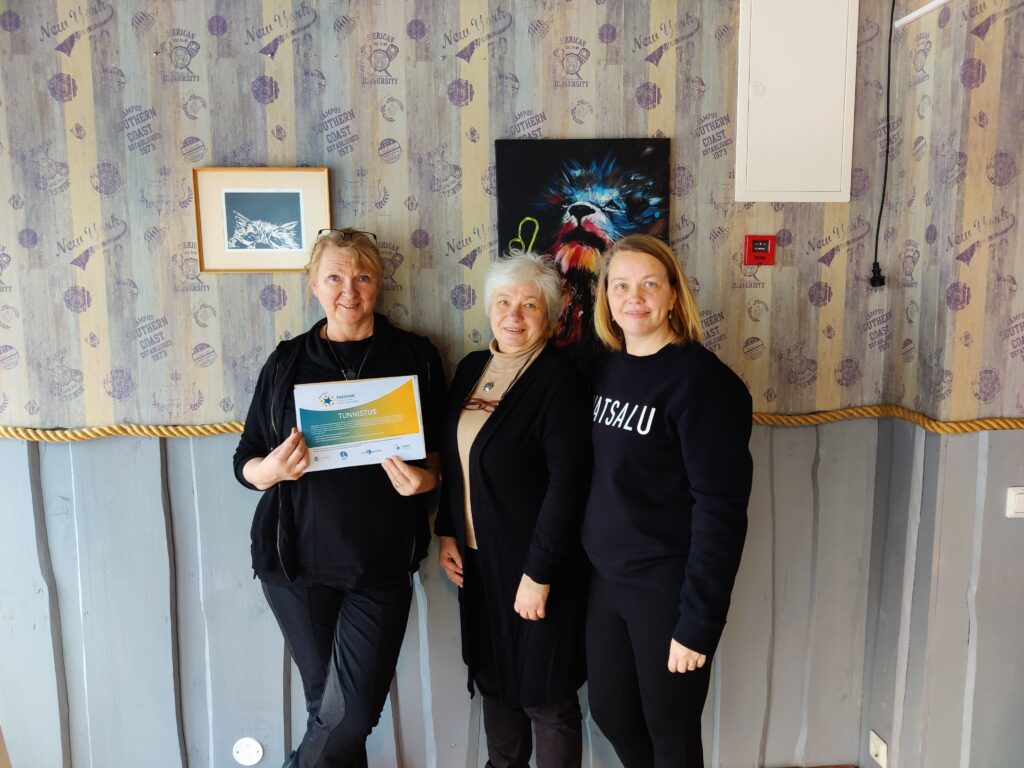
Celebrating the ECST Part II awards with partners from Matsalu National Park. Photo credit: Nele Sõber
Piesta Kuusikaru Farm
Business type: accommodation, culinary & cultural experiences
For over 150 years, the Piesta family farm has been living a life committed to the values of nature and community. The family, who have been caring for this land for many generations, want to share this rich cultural history with visitors coming to the Soomaa region and offer food tasting experiences as well as tours of the sustainable farming and crafting practices. For those looking for a travel back in time, the small riverside cottage with its traditional wood-heated sauna is available for overnight stays.
To find out more, visit their website.
Pure Water Theme Park & Ubari Center of Natural Wisdom
Business type: environmental education and excursions
Water connects us all and at the Pure Water Theme Park, where especially the young can come and learn about nature and how everything is connected. The park hosts many visitors and groups over the year, teaching them through fun outdoor learning experiences. Similarly, the Ubari Centre of Natural Wisdon is a provider of outdoor tours, experiencing nature in all its diversity for many different groups of people. Both are operated by the same company, which is committed to promoting a sustainable lifestyle by fostering a love for nature.
To find out more, visit the Pure Water Theme Park website and the Ubari Cenre of Natural Wisdom website.
Alutaguse Hiking Club
Business type: environmental education and excursions
This hiking club is committed to increasing the quality of outdoor activities by developing good relationships with partners such as the local Protected Areas and improving the environmental awareness of participants, members and customers. The hiking club has more to offer than just hiking, they also run youth camps, training courses for guides, climbing competitions and an Adventure Festival.
To find out more, visit their website.
Lahemaa Ecotourism
Business type: environmental education and excursions
Lahemaa Ecotourism has professional staff who assist local, national and international tourists have a great experience in the Lahemaa National Park and surrounding area. They are committed to providing quality service to their customers while having little to no impact on the environment and positively involving the local community.
To find out more, visit their website.
Lobi Cultural Villiage Museum
Business type: environmental education, culinary & cultural experiences
This museum is located on the Lobi Peninsula, one of the longest in Lahemaa National Park. Here, it showcases the rich cultural history of the local area, exploring themes from nature protection, to traditional livelihoods. As a business, they are committed to supporting the lifelong learning of all visitors through experiential activities, such as tasting the “Northern-Estonian local food” for which the Lobi Cultural Village Museum has a quality label. Similarly, the local staff have an inexhaustable knowledge of the regional and historical culture which they are open to sharing with visitors of all ages.
To find out more, visit their website.
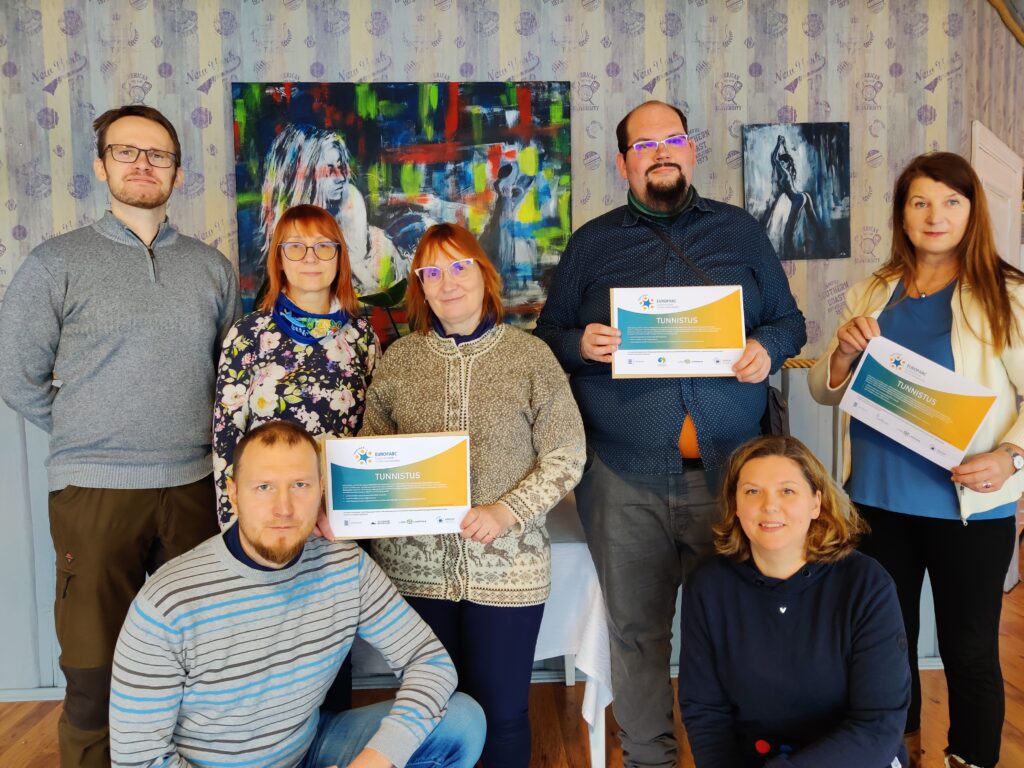
Celebrating the ECST Part II awards with partners from Lahemaa National Park. Photo credit: Nele Sõber
Tipu Nature School
Business type: environmental education & excusions
The Tipu Nature School is an NGO with a mission to connect people to nature. They run the old Tipu schoolhouse, which can be found in Soomaa National Park where they contribute by taking care of a local hiking trail, installing signs in three languages, and caring for a wooded meadow. Not only do they offer camps and outdoor activities, they also have summer volunteer placements highlighting their committment to being a place for learning, exchange and solidarity. In addition to introducing visitors to the natural and cultural heritage of Soomaa National Park region, the Tipu Nature School also strives to foster attitudes and motivation, which drives people to make informed decisions and take responsible action for nature and a sustainable future.
To find out more, visit their website.
Matka-Rebane (which means Hiking Fox)
Business type: environmental education & excusions
Matka-Rebane provides tours out in nature, introducing visitors to the nature in Soomaa across all seasons, showcasing both the natural and the cultural heritage of the landscapes and local communities. They are passionate about connecting people with nature through experiencing emotions while out in nature and using this to promote nature-friendly attitudes and behaviours.
To find out more, visit their Facebook page.
Soomaa Holiday Village
Business type: accommodation, tours and events
You can find the Soomaa Holiday Village on the banks of the Halliste River in the middle of Soomaa National Park. From here, their guests can participate in hiking, canoeing, cycling or relax in the sauna. For the small family-run business, it is important that the guests are familiar and practice ethical and sustainable outdoor behaviour and promote this through a personal approach.
To find out more, visit their website.
Soomaa.com
Business type: environmental education & excursions
This small local nature tourism company has been active in Soomaa National Park for over 25 years. Not only do they provide a plethora of guided tours in all seasons, they also promote cultural heritage through boat building workshops to promote the traditions of local dugout canoes, which were used during regular flooding (known as the 5th season). Their highly capable guides enjoy working with visitors from across the world and provide high quality nature interpretation while hiking, canoeing or snowshoeing.
To find out more, visit their website.
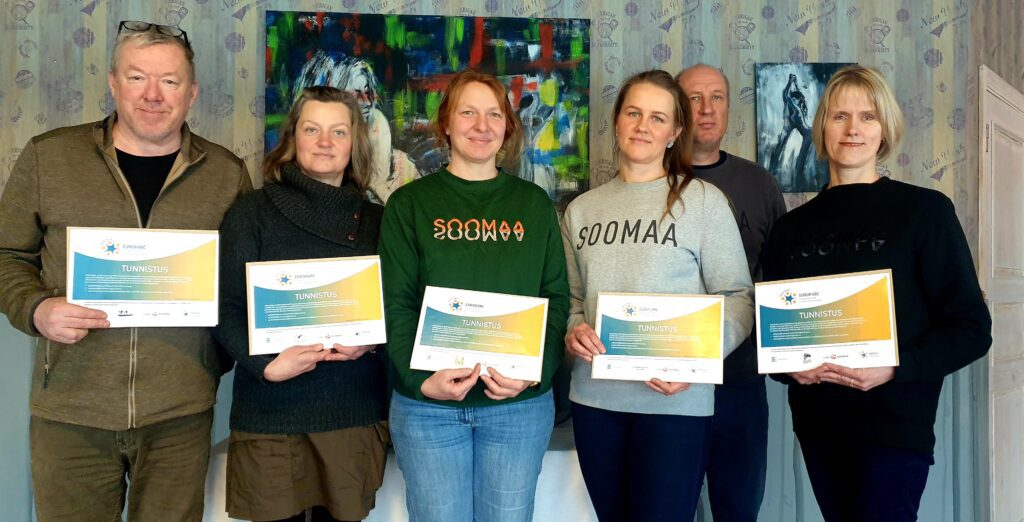
Celebrating the ECST Part II awards with partners from Soomaa National Park. Photo credit: Nele Sõber
Upcoming XII European Charter for Sustainable Tourism meeting
From the 15th to the 19th of May, tourism experts from across Europe will meet in Triglav National Park, Slovenia, to discuss, exchange and learn from each other. Interested to join them and advance your knowledge of how to implement measures for sustainable tourism and visitor monitoring?
Register Here!EUROPARC participates in a Council of Europe consultation on the Climate Crisis and Young People
EUROPARC is active in the Council of Europe in the fields of nature protection, climate change, human well-being and young people.
EUROPARC participates in a Council of Europe Consultation on the Climate Crisis and Young People
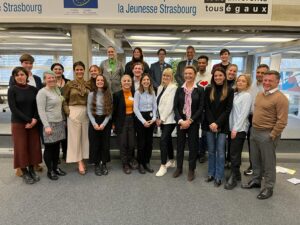
The youth consultation involved young climate activists, youth-led NGO representatives, academia and government representatives
The Council of Europe (CoE) is an International Organisation, which gathers almost all European Countries to promote Democracy, Human Rights, and the Rule of Law. The foreign ministers of all countries meet here to decide on recommendations, which are not legally binding, but they are encouraged to implement these nationally and they are reviewed every 5 years. EUROPARC’s Youth Officer, Jessica Micklem-Kolenic, was invited to participate in a consultative meeting for a recommentation on the 22 – 25 February 2023 in Strasbourg. This recommendation was on the Climate Crisis and Young People and was initiated by young people through the European Youth Department.
Meaningful Youth Participation in the Council of Europe
For over 50 years, the Council of Europe has been leading by example on praticing meaningful youth inclusion. All policies that are about young people, are co-drafted by youth and additionally, young experts are consulted for recommendations concerning them. This work is led by the Joint Council on Youth, which is a decision-making body with half the members from organised youth organisations such as European-wide youth-led NGOs, national youth committees and federations of youth political parties (Advisory Council on Youth or CCJ). The other half of this Joint Council are representatives from governments, specifically the ministries working on young people (European Steering Committee for Youth or CDEJ).
A Council of Europe Recommendation
The Youth Department organised an expert non-formal trainer, Anuschka Ruge, who facilitated the consultation for the recommendation on the Climate Crisis and Young People. Below you can see a visual she created to showcase the roadmap from the initiation phase to the implementation. Once an idea for a recommendation has been presented, approved and the drafting group has been set up, they have the choice to either research the issue to come up with the content and priorities, or to do a consultative meeting. For work with young people, consultative meetings are more worthwhile as the experiences of the youth change rapidly over time and are not often formalised into publications. For this consultation, the attendees were 20 youth climate activists, and representatives from youth organisations, committees and youth political groups, as well as a few academics and goverment representatives.
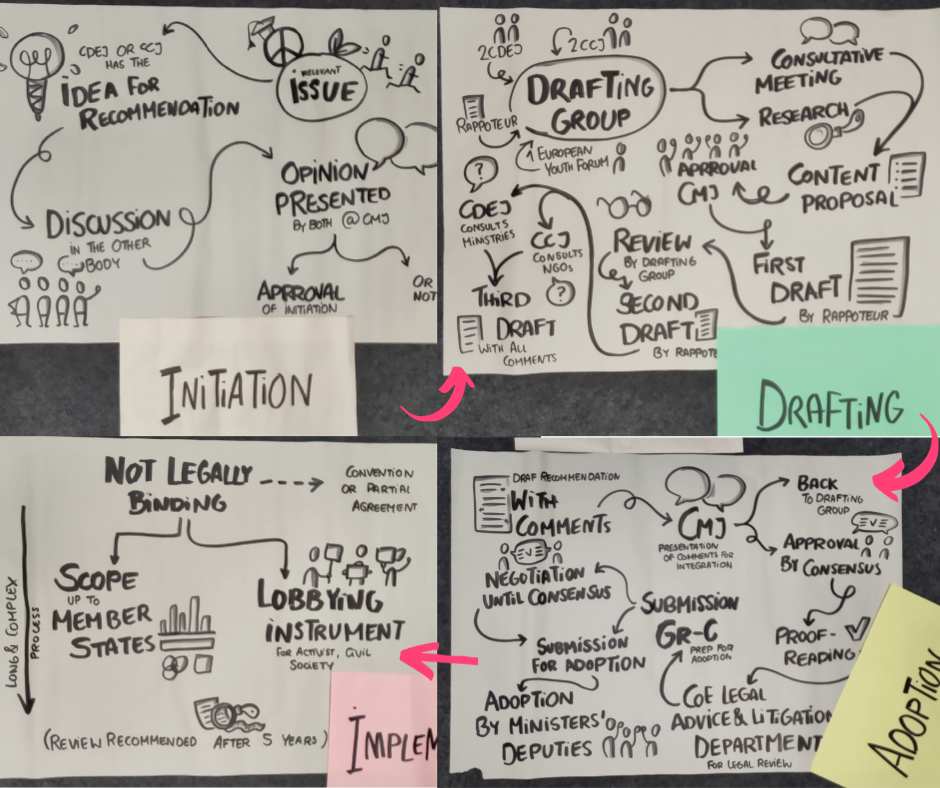
The process for a Council of Europe recommendation
All of this information was shared with the participants of the consultations within the first few hours, setting the scene for the work happening in the background of the Council of Europe. One of the strongest possible legal tools to combat climate change and biodiversity loss is the implementation of the Human Right to a clean, healthy and sustainable environment within the structure of the European Court of Human Rights. Representatives from this Court and the Council of Europe Steering Committee on Human Rights presented their work on the progress os this legal instrument. This information can be found in a previous EUROPARC news article.
The goal of the consultation, was to share experiences and perspectives as well as to prioritize about five points, which could be focused on in the recommendation. While many young people stressed tackling the root causes of the climate crisis, namely the unequal global economic system, the overuse of resources, and valuing economic growth above all else, the recommendations could only be within the mandate of the Council of Europe, namely concerning issues related to Democracy, Human Rights and the Rule of Law, not the economic system.
The Consultation with Young People
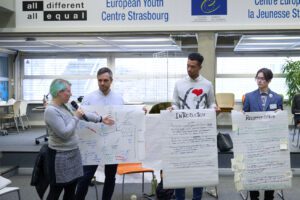
Sharing our ideas after two days of brainstorming
The first task was to dive into the four key priorities of the Youth Sector Strategy for 2023 and share challenges, barriers and opportunities:
- Revitalising a pluralistic democracy
- Access to rights
- Living together in peaceful and inclusive societies
- Youth work
Thereafter the participants ran through a series of brainstorming exercises from which they grouped together concepts and identified priorities. Some of the key points mentioned were:
- Accessible youth participation: including the voices of minorities and disadvantaged groups in democratic spaces
- How do we incentivise climate action: supporting the work on a Human Right to a clean, healthy and sustainable environment as well as changing the measures of success in our economies
- Addressing systemic drivers: implementing a youth-test for policies at all levels of governance to see their impact on young people now and in the future.
- Strengthening the link between climate justice and social justice: acknowledging that we need a socio-ecological transition and discarding language that polarises social issues and environmental issues (especially in funding proposals and budgets).
- Enforcement of previous agreements: respecting the rights of Indigenous Peoples, creating safeguards for environmental Human Rights defenders
- Just Transition: providing more incentives for green jobs in nature protection and climate action
The workshop culminated in a presentation of possible recommendations for the Secretary General of the Council of Europe, Marija Pejčinović Burić, and the Icelandic Foreign Affair Minister, Thórdís Kolbrún Reykfjörd Gylfadótti.
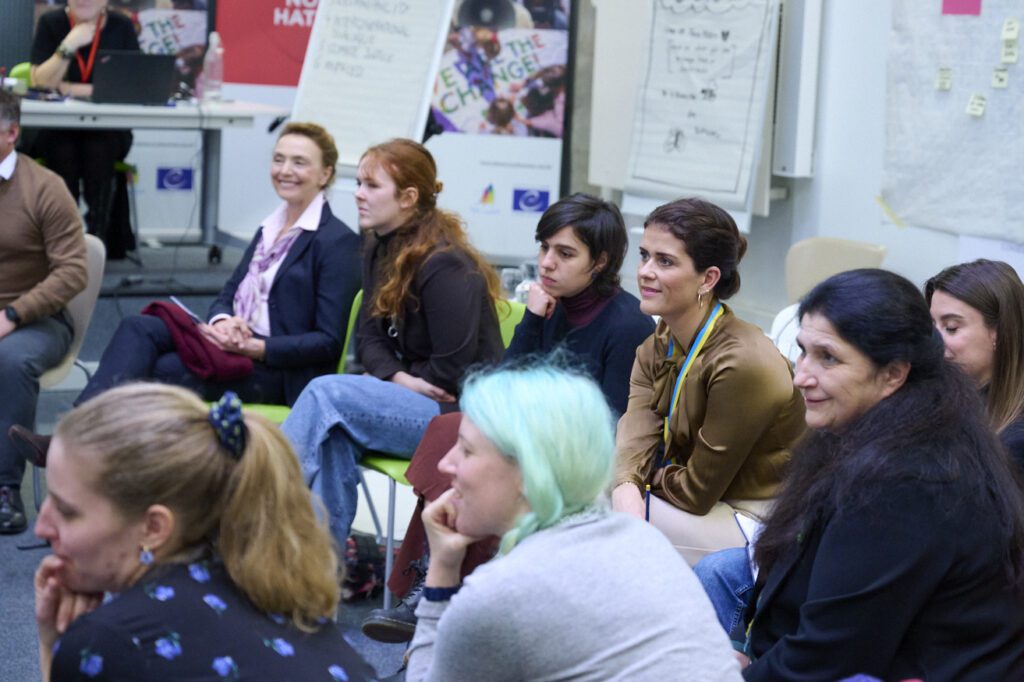
Sharing our ideas with the Icelandic Foreign Affairs minister as the current presidency of the Council of Europe
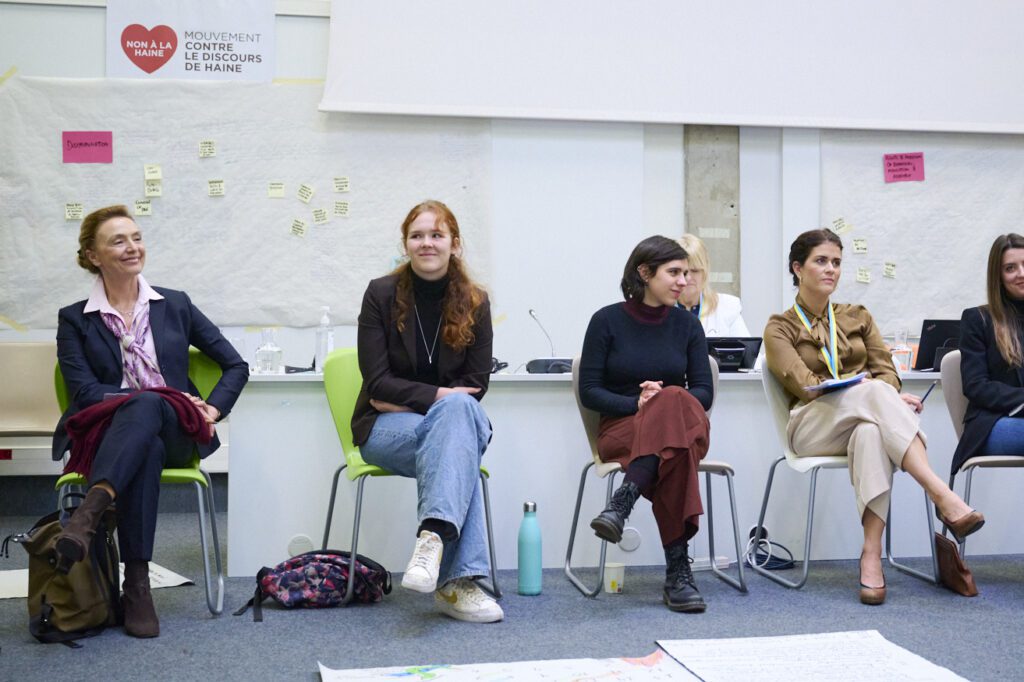
Meeting with the Secretary General (left) of the Council of Europe