Uniting Forces for Nature Restoration in Protected Areas – 4 new case studies from across Europe
The Penpont Project Partnership: celebration of diversity. Photo: Action for Conservation
Four case studies of young people, farmers, breeders, landowners and nature conservationists working together on nature restoration.
Uniting Forces for Nature Restoration in Protected Areas
Agriculture and nature conservation are often seen as competing interests, but agriculture practitioners and Protected Areas managers can and must be allies. Farmers, landowners, local stakeholders and young people have come together to unite forces for nature through nature restoration activities. Domesticated animals, such as horses and cattle, are put to work in nature restoration practices resulting in revival of natural conditions.
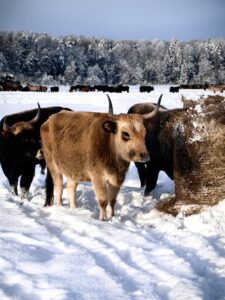
All-weather rewilded species @Kemeri National Park
Case Study 1: Wild Grazing in Ķemeri National Park, Latvia
In 2006 and 2018, large-scale wetland restoration projects were implemented in Ķemeri National Park. These projects included the meandering of two meliorated rivers, setting the stage for wild pasture development. In 2006, the first Konik Polski horses and Auroxen (de-domesticated Heck cattle) were introduced to the restored floodplains. Over time, these wild herds have grown to over 400 individuals, developing natural herd structures, interacting with other wildlife (including large predators), and shaping their environment. With over 20 years of experience, the project has provided valuable insights into natural grazing, highlighting both its ecological benefits and legal challenges.
Full Case Study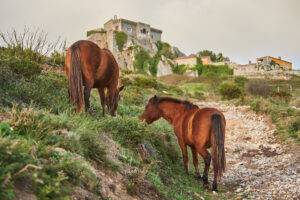
Horses grazing in the landscape @Cascais Ambiente
Case Study 2: Rewilding for Landscape Management in Sintra-Cascais Nature Park, Portugal
This rewilding initiative aims to reintroduce species of locally extinct wild herbivores and their national proxy breeds to function as natural landscape management tools. By reducing the risk of rural fires and promoting ecological restoration, the project is fostering self-sustaining ecosystems. The Functional Herbivory Plan (FHP) determines the specific composition of herbivores—species, breeds, and densities—for each intervention area, tailored to the vegetation and local conditions. Currently, the plan is being implemented over 2,270 hectares, with two monitored areas managed by Cascais Ambiente. These areas are assessed to evaluate the effectiveness of introduced herbivores in managing biomass growth and supporting biodiversity.
Full Case StudyCase Study 3: Sheperd Weeks in Finland
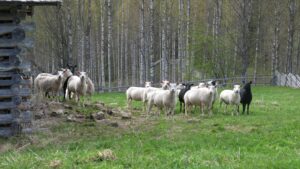
Photo Credit: Metsähallitus / Heidi Kilpeläinen
The Shepherd Weeks are unique way to organize landscape management and conservation efforts. The concept is a combination of nature conservation and management, strengthening relationships between people, nature and landscapes, and enjoying an unforgettable holiday experience.
During the Shepherd Weeks, the landscapes and nature are managed in an exemplary and effective manner that respects traditions and benefits all parties involved. The sheep owners and sheep gain access to quality pastures that may be hard to find, and the shepherds help the farmers with caring for and keeping an eye on the animals. The operations also strengthen the volunteer shepherds’ relationship with landscapes and nature.
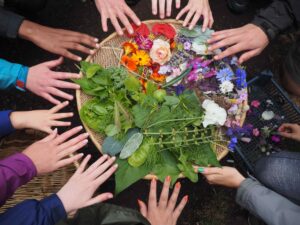
The Penpont Project Partnership: celebration of diversity. Photo: Action for Conservation
Case Study 4: Youth-Led Conservation at Penpont Estate, Wales
Penpont is a 2,000-acre estate in the Bannau Brycheiniog, Wales, home to the Hogg family, tenant farmers, foresters, and artists. Since 2019, the Penpont Project has aimed to achieve bio-cultural restoration and set a global gold standard for youth-led environmental action. Co-managed by a Youth Leadership Group (YLG) of twenty 12-18-year-olds, along with Action for Conservation (AFC), Penpont Estate, and tenant farmers, the project employs eco-cultural mapping tools to visualize past, present, and future land relationships. Developed by indigenous communities, these maps make visible the deep-rooted knowledge and connections to the landscape. Now three years into a major action plan, the project is a beacon of collaboration between youth, conservationists, and land managers.
Full Case StudyThese examples illustrate that nature restoration can be achieved by working together and using diversified tools to achieve the results.
Do you also have an example to share? Send us your case study and join the diversity of voices inspiring and promoting good practices across the EUROPARC network!
How Europe’s Protected Areas ensure coexistence with large carnivores
Picture by Zdeněk Macháček on Unsplash.
The return of large carnivores in Europe is a big win for conservation. However, it also brings challenges. EUROPARC and its members are actively implementing solutions to reduce conflicts in local communities and ensure coexistence with large carnivores.
Protected Areas as mediators in coexistence with Europe’s large carnivores
With increased conservation and decreased hunting, the large carnivore populations in Europe are expanding their ranges. Communities who have lived many generations without them, have to relearn to share space and coexist. Recognizing the challenges and opportunities of coexistence with large carnivores, from practical conservation measures to stakeholder engagement and education, Protected Areas are at the forefront of fostering coexistence.
To further support these efforts, the EUROPARC Federation is active in the EU Platform on Coexistence between People and Large Carnivores. Here, we contribute to knowledge exchange and collaborative efforts across Europe, supporting policies and practices that benefit both biodiversity and local livelihoods.
To highlight how Protected Areas are making coexistence possible, this article features two inspiring case studies from our members who are working to minimize conflict between people and large carnivores. Want to be part of the solution? Check out the webinar at the bottom of this page! It includes a role-playing game developed by the EU Platform, designed to deepen understanding between the different stakeholders impacted by the return of large carnivores.
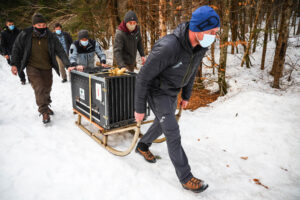
Triglav National Park
Case Study 1: Preventing Eurasian lynx extinction in Julian Alps
Triglav National Park Management has actively collaborated in the LIFE Lynx project led by Slovenia Forest Service which has had a primary objective to rescue the Dinaric Mountains and Southeastern (SE) Alps lynx population from extinction and to preserve it in the long term. Read a summary of the project in their case study.
Visit the Case Study
© Tomas Junek
Case Study 2: “Handlungsleitfaden Managementplan Wolf”
(Wolf Management Plan – Handbook)
The Black Forest Biosphere Reserve has a significant role in acting as an intermediary to the regional farmers and are involved in various projects. In the case study they share points from the Wolf Management Plan Handbook to describe measures to protect the wolves, the local population and the people who work on the land.
Visit the Case Study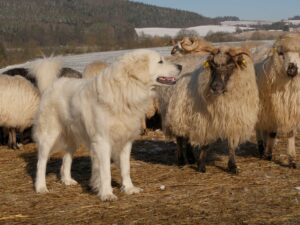
© Frantisek Groessl
Case Study 3: Coexistence with the grey wolf in Czechia
It has been 15 years since the Eurasian wolf began returning to the Czech Republic after 200 years of local extinction. The Czech Nature Conservation Agency was involved in increasing communication to foster understanding and appropriate management measures implemented by local communities around their 24 Protected Landscape Areas. Learn from their experience in their case study.
Visit the Case StudyWebinar: Tools for young people
Many young people are committed to helping build a future that is biodiverse, climate friendly and sustainable for people and the ecosystems we live in. As nature conservation organisations, we can provide young people with tools and support them in their efforts to grow, learn and shape their futures. The webinar below showcases young people’s efforts in awareness raising and advocacy of large carnivores as well as a demonstration of the EU Platform for Coexistence between People and Large Carnivores new Role-Playing Game for teenagers and young adults.
Download the role-playing gameBy sharing knowledge, experiences, and best practices, we can learn from one another and strengthen our collective commitment to living in harmony with nature—recognizing that people, wildlife, and landscapes are all part of a connected, thriving ecosystem. Discover more case studies on this topic in the EUROPARC Knowledge Hub!
Part one of the 4 Pillars 4 Youth+ Erasmus+ Project
Alberto Madrassi, Youth representative for the Youth Advisory Board of the Julian Prealps Nature Park and EUROPARC Youth Council member shares his experience in Müritz National Park for the Project 4 Pillars 4 Youth+.
Four Days in Müritz National Park
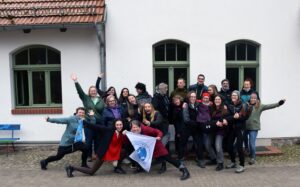 Between the 11th and the 16th of March 2024, the educational centre Steinmühle of Müritz National Park (DE) hosted a four-day seminar that gathered 23 people from seven European Countries. The seminar was the first phase of a project called “4 Pillars 4 Youth+”, aimed at creating a digital interactive toolkit that will help the Youth+ mentors. The toolkit will cover each pillar of the Youth+ Programme (Nature Conservation, Leadership, Advocacy and Communication) with clear steps on how to set up activities and examples of activities that develop skills and competencies.
Arriving at a place in darkness always increases the curiosity of discovering what it looks like in daylight. Müritz National Park didn’t disappoint. The quiet lake, the majestic beech forest, and the noise of the many birds living in the area created a soothing atmosphere. I am convinced that this helped all the participants be in the perfect mindset to approach four days of workshops.
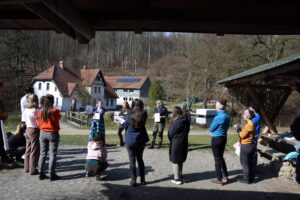 In general, this kind of schedule is associated with things one doesn’t particularly look forward to: a lot of presentations, sitting and stale air. This time, it wasn’t the case. The secret? Peer-to-peer learning, co-creation and cake breaks! Also, the weather played an important role because we were able to have a good balance of inside and outside sessions.
Then, all the participants were involved in the running of the seminar. Some ran a session due to their specific experience or knowledge, while others organised energisers. Each of the four days, the focus was on one of the pillars of the Youth+ programme. Not all Youth+ programmes are active in all four pillars; therefore, it was an opportunity to grow together and learn from each other. It was also beneficial for the project because it allowed us to harvest many good practices that will come in handy for creating the toolkit.
I liked witnessing that, during the breaks, people kept talking about what they do in their respective Protected Areas or organisations. There was a true desire to learn new things and hear about different projects. The Youth+ community is growing fast, and networking is a driving force.
The environment at the seminar was highly supportive, and I felt self-confident to the extent of being positively surprised by it. Until not so long ago, co-leading a workshop or speaking in front of an audience would have been unthinkable for me. The Youth+ programme is also this; it allows all of us to improve and shine.
This positive atmosphere helped to satisfactorily conclude the seminar. The work will continue through online meetings, and it will lead to the creation of the above-mentioned online toolkit later this year. Keep an eye out for future updates!
View the photo album here!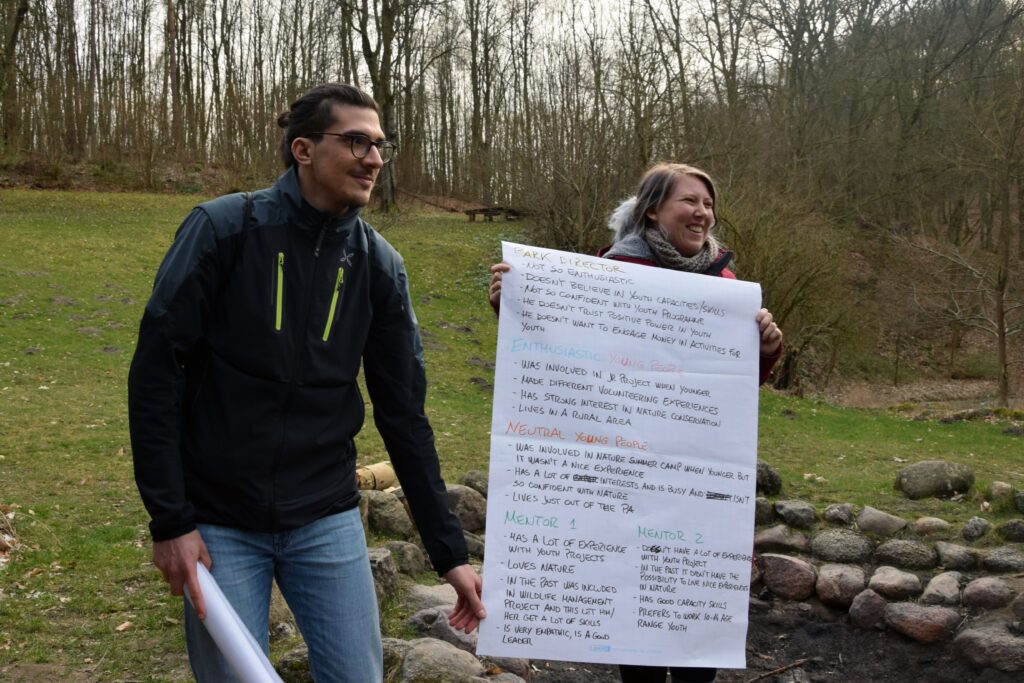
Alberto Madrassi running a role-playing session in Müritz National Park, photo credit: Anna Di Cecco

Funded by the European Union. Views and opinions expressed are however those of the author(s) only and do not necessarily reflect those of the European Union or the European Education and Culture Executive Agency (EACEA). Neither the European Union nor EACEA can be held responsible for them.
State of the EU 2023 from a Protected Areas perspective
The “2023 State of the European Union: ANSWERING THE CALL OF HISTORY”, Ursula von der Leyen’s speech analysed from a Protected Areas perspective.
On 13 September, in front of the Members of the European Parliament (MEPs) in Strasbourg, the President of the Commission Ursula von der Leyen presented the annual speech about the State of Union. This year it was especially important because the last one before the end of this Commission’s mandate. As we know, in June 2024 the European citizens will vote for the elections for the new European Parliament, and then a new Commission and a new President will be appointed.
Here EUROPARC underlines the aspects that refer to Protected Areas, analysing what Mrs von der Leyen said, and also what was missing in her speech, in order to offer more knowledge, and food for thought, about the Brussels’s current political debates directly connected to our work.
The speech, pronounced by Ursula von der Leyen, touched several points, among which the Ukraine war, digitalisation and artificial intelligence, immigration, economy, NextGenerationEU, future EU enlargement to the Balkans countries, and others.
The European Green Deal was of course one of the key themes.
Without any doubts, EUROPARC considers the launch of the Green Deal is the most important achievement of the current European Commission, and strongly appreciates that the President of the Commission stated: “We now have a European Green Deal as the centrepiece of our economy and unmatched in ambition”.
Presenting the results achieved and future actions about climate change and green transition, Mrs von der Leyen focused essentially on the industry sector, speaking about the EU’s support and related package of measures for energy transitions, competitiveness against not-European markets, job market and growth strategy, clean steel factories, investment in clean hydrogen.
Of course, without a strong acceptance of the green ambitions by the industrial sector, the Green Deal cannot reach its goals. But, speaking about industrial policies, Mrs von der Leyen says that “this is the strength of Europe’s response to climate change”. Inside of this crucial part of the discourse, EUROPARC, instead, would have much appreciated a strong declaration that climate change is not only a matter of industry but also strongly a matter of management of territories and landscapes focusing on protection and sustainable use of biodiversity and nature. The results of the two United Nations Conferences in 2022, on Climate Change (COP27) and on Biodiversity (COP15), clearly put in evidence.
Nevertheless, some of these considerations are mentioned later in the following part of the talk about nature protection that Mrs von der Leyen addressed to MEPs. Together with the cultural diversity, that makes the ”Europe of the Regions”, the President reminds us that Europe is a continent of unique biological diversity. She mentioned the Wadden Sea and the Baltic Sea, as well as the European Plain of moorland and wetland, as important allies against climate change and to secure regional water cycles, and unique for biodiversity. In EUROPARC’s eyes, this list of examples seems very limited but at least they refer to important ongoing discussions. For example, the Baltic Sea remains the most polluted sea in Europe and the European Commission is organising a high-level conference with the presence of the Commissioner for Environment, Oceans and Fisheries Virginijus Sinkevičius (“Our Baltic Conference” in Palanga, Lithuania, on 29 September 2023).
Then, Mrs von der Leyen spoke about woodland: coniferous forests of the North and East forests, cork oak forests of southern Europe, and last remnants of virgin oak and beech forest in central Europe are “irreplaceable source of goods and services”.
EUROPARC could not agree more when Mrs von der Leyen concluded:
Biodiversity and ecosystem services are vital for all of us in Europe. Loss of nature destroys not only the foundations of our life, but also our feeling of what constitutes home. We must protect it.
Immediately after, the speech continues about food security and farming. “At the same time, food security, in harmony with nature, remains an essential task”. It is clear that this part of the discourse aims to reinsure farmers that their work is appreciated and that the Commission takes into account their concerns. Indeed the speech touches at this point on one of the most sensitive topics, especially in the recent and current debates about the nature restoration law and about large carnivores: the relation between agriculture and nature conservation. About this theme, Mrs von der Leyen underlined that: “For us in Europe, this task of agriculture – producing healthy food – is the foundation of our agricultural policy. And self-sufficiency in food is also important for us.” Reminding all about the consequences of Ukraine war, droughts, fires, and flooding, as well new obligations for farmers, the President admonishes that they “are all having a growing impact on farmers’ work and incomes. We must bear that in mind.”
Only after this premise, the speech mentions the efforts done by a part of the farming sector towards a more sustainable form of agriculture. About that: “We must work together with the men and women in farming to tackle these new challenges. That is the only way to secure the supply of food for the future.” Then, with a clear reference to the last hot debates inside the European Parliament and outside between farming and environmental sectors, Mrs von der Leyen made a strong invitation: “We need more dialogue and less polarisation”, and a proposal for the next future: “That is why we want to launch a strategic dialogue on the future of agriculture in the EU.” “Dialogue” is the crucial word that EUROPARC uses about the need to reinforce partnership between farmers and Protected Areas, so we are very willing to know more about how this proposal will be implemented.
The President concluded this part of the speech with a statement that EUROPARC shares totally: “I am and remain convinced that agriculture and protection of the natural world can go hand in hand. We need both.”
What was missing in this speech?
According to EUROPARC, some very crucial topics. For instance: the Restoration Law. Probably it is too sensitive at this moment because the Commission, Parliament and Council are working in the “trialogue” to conclude the process. However, definitely, we regret the total lack of references to the importance of the law, and in general to the Biodiversity Strategy. The same for all other important Strategies (soil, forests) approved during this Commission’s mandate and ignored in the speech. Speaking about agriculture: no mention on pesticides, or other crucial and complex themes; and no mention of the large carnivores (about that the President launched recently a personal initiative about wolf that is considered quite divisive). Other big absent: marine (only rapidly mentioned with the two examples of nature diversity) and ocean conservation, and dialogue with fishermen (probably assimilated with farmers). Moreover, as said above, not enough strong message that nature protection should be a key part of Europe’s response to climate change. And last but not least for us, no mention of the role of Protected Areas and Natura2000 as key actors and key allies for the Green Deal.
EUROPARC has always been supportive of the European Commission in its efforts for the European Green Deal (see letter here) and we are ready and willing to continue in the future as it benefits our members (see webpage here). The European elections in 2024 will be crucial for the future of the Green Deal. We strongly hope that the new Parliament and the new Commission will continue, improve and reinforce the commitments towards more sustainability, more nature protection, and also more recognition of the role of key actors, such as the Protected Areas, to reach these objectives. That will be necessary if we really want to ANSWER THE CALL OF HISTORY.
The text of the speech is available here in all languages, and here in the original version.
The records of the speech, and the following interesting debate with the interventions of Members of the European Parliament from all political groups, are available here.