EU Elections & Climate change: a call for Action in Brussels
article issued by Enzo Lavarra, EUROPARC Council Member and former Member of the European Parliament
Scientists from all over the world have been warning global political global decision-makers for decades about the risks of a general collapse of the “Earth system” due to climatic changes. That must constitute a fundamental compass towards a new paradigm of sustainable development.
The climate is now widely present in public perception and our common consciousness. The driving force behind this awareness is now revealing itself to be great and unprecedented: the global movement of “Greta Thunberg’s” generation, starting with the extraordinary initiative of the “Fridays for Future“.
The system of European parks and their most representative association, EUROPARC Federation, brings to this new perspective the baggage of its own experience and actions.
Around the key principle of nature and ecosystem protection, parks are implementing initiatives based on rigorous principles of ecological sustainability, on quality agriculture connected with the local culture and traditions, on intelligent tourism and not environmentally aggressive, on the enhancement and attention to the landscape, on the relationship, typically European, between environment, cultures and territories.
How are Parks contributing?
In mountain areas, parks promote policies dealing with melting glaciers and shrinking permafrost. In marine areas, they act on the protection of species, sustainable fishing and fight against invasion of plastic. Periurban and urban parks work to reinforce green belts and to create green and ecological cities. And for the rivers, parks are committed to improve water quality and make watercourses as real “life chains”.
Most of these initiatives are supported through European funds linked to EU programs and nature directives. And recently, the European Parliament has approved a report on cohesion policies which recognizes the role of protected natural areas in the fight against climate change.
For these reasons, the system of European parks associated with the EUROPARC Federation, calls to action all elected MEPs and their political representatives, in order to
consider climate change and sustainable development as a priority of the legislative action of the new Parliament, of the Commission, of the European Council.
EUROPARC Federation is committed to dialogue and to offer its contribution in order to:
1) Consolidate the “parks system” as promoters of a new way of thinking and on acting against climate change
2) Propose transnational, national and regional parks as stakeholders representing widespread interests, and as interlocutors for political decisions on sustainable development, quality of territories and landscape, social cohesion
3) Enhance protected areas’ contribution to ecosystem conservation. Ecosystems, as expressed also by the European Commission, produce positive values e.g. in supplying water and timber, in the regulation of water cycle, in cultural services (nature and landscape);
4) Recognize networks on Climate change that EUROPARC and its members intend to build with Universities, Foundations, Environmental associations, public and private bodies.
In this context, the Parks system, through its representation expressed in EUROPARC, intends to play a significant role as an educational, informative and communicational vehicle to obtain positive effects on the awareness of the problem and of the very tight timescale for acting. Parks can act both as amplifiers of the global alarm, as sources of correct information, and as forerunners of climate change adaption and mitigation.
EUROPARC’s Call to Action
WHAT WE ASK: Put Climate Policies high on the priority list, ensuring the integration of Nature Conservation in general, and valuing the role of Protected Areas in particular, in the EU Climate strategies and targets.
WHY? Europe needs action for climate. Protected Areas are key element to tackling climate change by protecting ecosystems, which provide natural solutions for mitigation and adaption. Ecosystems perform important services for society, such as climate regulation, carbon sequestration and storage, flood protection, water purification, water provision and soil erosion prevention.
To safeguard these fundamental services, resilient ecosystems are needed to cope with the impacts of climate change. To address climate challenges faced by European landscapes and biodiversity, EUROPARC is promoting habitats conservation and restoration, ensuring better resilience of ecosystems, and is raising capacity among managers to improve adaptation measures and planning in protected areas.
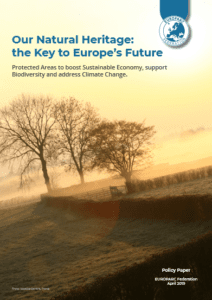
These and other measures at EUROPARC-EU-Natural-Heritage-Policy-Paper (also available in Italian and French)
The state of Protected Areas in Spain – Yearbook 2018 by EUROPARC Spain
To celebrate the World Environment Day, EUROPARC Spain launched the 2018 Yearbook of the state of Protected Areas in Spain. Following EUROPARC’s Spain commitment of “having a living observatory of protected areas in the Spanish State”, in 1999 they implemented a systematic methodology to collect annually information on the:
- Protected terrestrial and marine area coverage
- Current status of planning of protected natural areas and the Network Natura 2000
- Evolution of the economic and human resources dedicated to the management of protected areas,
- Management effectiveness
- Examples of new governance models
- Evolution of visits to national and natural parks
- Contribution to the welfare of the society of these territories.
- Perspectives on connectivity and adaptation to climate change
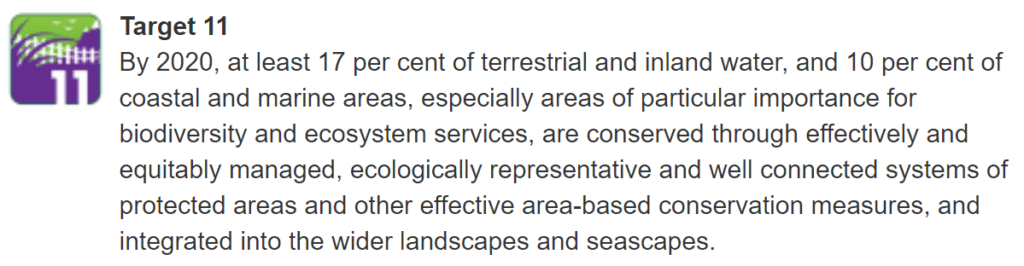
The Yearbook comes out just one year before the balance of the 20 Aichi Targets assumed a decade ago by the Convention on Biological Diversity, that aimed to halt biodiversity loss on the planet, ensure the sustainable use of natural resources and equitably distribute the benefits of conservation. The review shows that Spain will partially fulfill some of the commitments in terms of quantitative targets, specifically those set out in Target 11.
In Spain, over 27% of the protected terrestrial area and about 13% of marine protected waters are included in the Natura 2000 network,
making Spain with one of the European countries with the largest Natura 2000 coverage. In quantitative terms and on a global scale, there is a positive evolution. Currently, 238,563 protected areas are covered covering 20 million km2, equivalent to 14.9% of the land area. With regard to marine protection, it would have reached 7%, mainly in the exclusive economic zone (up to 200 nautical miles, with 16.8% and only 1.2% beyond 200 nautical miles from the coast).
However, Target 11 also poses complex challenges. In addition to designating places with the implications of previous studies, social-political commitment, they must be managed effectively and equitably. And needs to be connected and integrated into the territory. Evaluating these aspects requires necessarily deepen the analysis of the means (legal, material, economic and human resources) and procedures governing the management of such sites.
From numbers… to management effectiveness
Significant progress has also been made in the management of protected areas, but, nevertheless, despite the overcoming of the most difficult years of the economic crisis, the average investment in the parks continues to fall, which does not comply with the increase in the number of visitors.
Investment in protected areas and its efficient management are strategic in an ecological transition horizon, the fight against climate change and education and enjoyment of the values of nature. With an average investment in parks continuing to decrease € 54 / ha in national parks (the lowest registered) and € 26 / ha in natural parks (values similar to 2010), EUROPARC Spain, claims that budgetary allocations of protected areas need to be improved, so that they can adequately meet their very important functions.
For the promotion and strengthening of protected areas as preferential territories for the conservation of nature and sustainable development, in harmony with the United Nations Sustainable Development Goals (ODS).
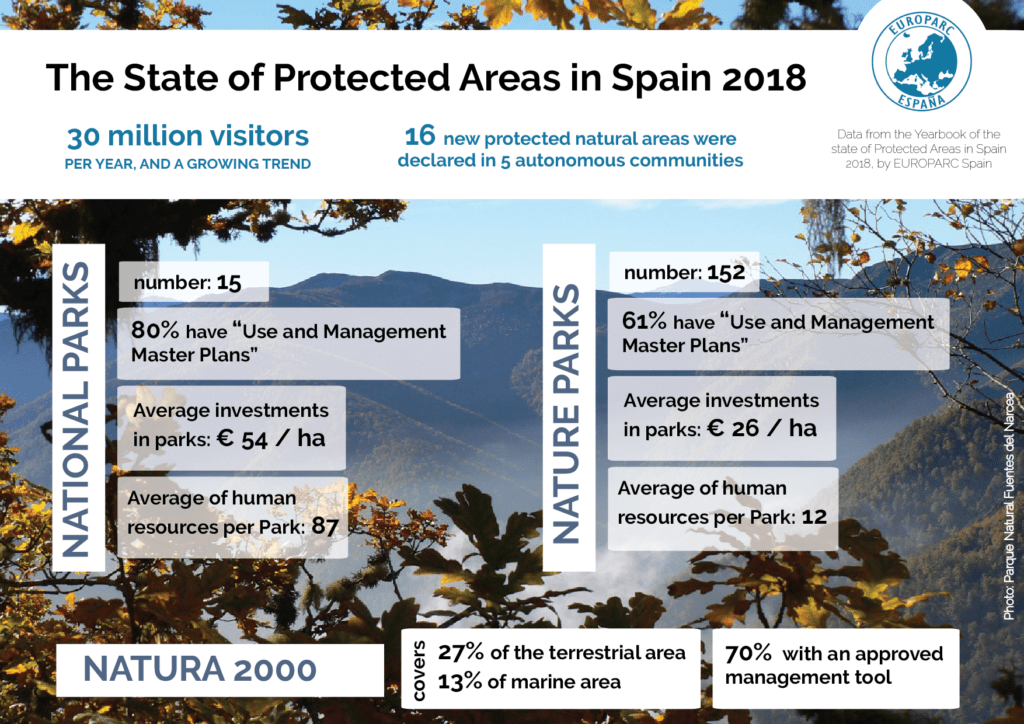
The state of Spanish protected areas in a nutshell:
1) The 27% of the protected land area has been exceeded, included in the Natura 2000 Network, and almost 13% of the marine surface has been protected. Spain has complied with the international commitment to declare at least 17% of land and 10% of the marine surface.
2) There are 15 national parks and 152 natural parks declared in Spain. There are also 291 nature reserves, 342 natural monuments, 57 protected landscapes, and more than 800 spaces, usually of small size, designated with other figures developed by the autonomous communities.
3) Between 2017 and 2018, 16 new protected natural areas have been declared in five autonomous communities. Furthermore, the large marine protected area of the Mediterranean Cetacean Migration Corridor has been also declared.
4) Among the new areas protected by international schemes, the Ponga Biosphere Reserve has been declared: Spain is the country that hosts the highest number Biosphere Reserves, with a total number of 49. Additionally, a new RAMSAR site, a new Geopark and a new UNESCO natural site have been declared.
5) Significant progress has been made in planning: 80% of national parks and 61% of natural parks have PRUGs (Use and Management Master Plans). 70% of the Natura 2000 spaces have an approved management tool.
6) Average investments in parks continue a decreasing trend: € 54 / ha in national parks (the lowest registered) and € 26 / ha in natural parks (values similar to 2010).
7) The human resources dedicated to the management of the parks follow a similar pattern since 2012: an average of 87 people in national parks and 12 in natural parks.
8) The estimated number of visitors in national and natural parks exceeds 30 million, with an increasing trend in national parks.
9) 43% of the agreements of land stewardship, a tool for involving society in conservation, have been implemented totally or partially in spaces adhered to the Network Natura 2000, covering a surface of more than 265,000 hectares.
10) The State Strategy for green infrastructure, connectivity and ecological restoration has been released to the public and it is still in the process of formal approval. Additionally, several autonomous communities have approved strategic documents.
Download the Yearbook 2018 Protected Areas in Spain_(only in Spanish)
Next Webinar: Connecting People & Nature – can technology bring us closer?
Connecting People & Nature
Nature conservation is not only a subject made of facts and scientific data. In a continent densely populated, with the largest population growth taking place in urbanised environments, we need to reconnect people with the natural processes around them. Nature is our life supporting system. When we lack quality experiences, apathy towards environmental concerns is more likely to manifest, as we are unable to see the importance of preserving it. Nature conservation is not only a subject made of facts and scientific data, it depends on people´s attitudes.
Recent publications are shedding new light on what really influences our attitudes and decision-making processes. Although our human capacity of making choices based on rational analysis, most of our decisions are instinct-driven, based on (unconscious) emotional connections.
We need to spark a deeper connection with people’s heart, and stop speaking only to their rational minds.
Can technology bring us closer?
Technology is evolving at a pace faster than ever, bringing new opportunities for nature conservation initiatives. The use of drones (unmanned aerial vehicles), for instance, is a growing trend that is helping Parks collecting useful data for mapping, monitoring vegetation or as wildfire detector. But can we combine technology to enhance people´s connection to nature?
In this webinar, we will hear how 2 entrepreneurs are using technology to reach out to new audiences. They see technology as a bridge, that allows people to experience and virtually visit places that would otherwise be impossible to reach.
Join our interactive webinar on the 6th June at 15:00 CEST to learn about the innovative social work of Restore Coral in Mexico, discover a new storytelling tool for conservation with Explorer.Land, and have the chance to directly interact with our invited guests. You will be able to join with your camera and microphone.
- 6th June, 15:00 CEST
- Register here
Art & Technology for the conservation of Mexican Coral Reefs
Restore Coral is an NGO based in Mexico that works for the restoration of coral reefs in the Mesoamerican Reef System. Through socialinnovation, art and the use of emerging technologies like virtual reality, they seek to increase public awareness about the importance of protecting coral reefs, while supporting the development of socially responsible strategies, with strong involvement of local communities and schools.

In June 2018, the White Syndrome was detected in Puerto Morelos and can currently be found throughout the entire Mexican Caribbean coast. It is a disease that has alarmingly increased in the past six months, and Restore Coral is part of the group composed of NGOs and governments, that is implementing an Action Plan to reduce the stress factors that damage the coral reef.
Roberto will also tell us about the fantastic step that has been taken in Mexico: environmental education has been included in the Constitutional Right of Education and will be a mandatory subject in all schools in Mexico.
Roberto Cerda is an action-oriented civic society leader, founder of Restore Coral. One of his big commitment has been to bring to attention to the restoration agenda of the coral reef restoration in Mexico. Today he’s a member of the Resilience Action Plan to save coral from the White Syndrome.
Explorer.Land, a new storytelling tool for Forest Conservation Projects
Open Forests is a company based in Germany dedicated to support sustainable landscape projects to thrive. They develop integrated information management systems for forestry, agroforestry and conservation projects and support organizations to acquire satellite-, drone-, and field data.

Understanding that many of the conservation projects around the globe often lack marketing resources to properly tell their successful conservation stories and show real evidence to their funders the outcomes of their activities, Open Forests recently launched the Explorer.Land.
It is a map-based online platform, designed to present forest landscape projects and to communicate their activities. Unlike other social media and presentation platforms – where content is mainly shared in a timeline -, explorer.land allows all published content, like posts, photos, videos to be shown in its geographical context on top of interactive high-resolution maps.
Patrick will guide us through the platform and share some conservation stories from across the globe.
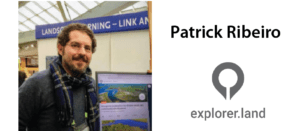
Patrick Ribeiro is founder and CEO of Open Forests. His expertise in drone imagery and image processing for forestry and landscape related projects, made him build up the idea of Explorer.Land, which he is currently managing.
How to join?
Webinars are open not only to EUROPARC members – but to everyone with an interest in Protected Areas. Participation is free but registration is necessary. Register here.
In this interactive webinar, participants will be able to join in with their own video camera, share examples from their parks and direct their questions to the invited guests.

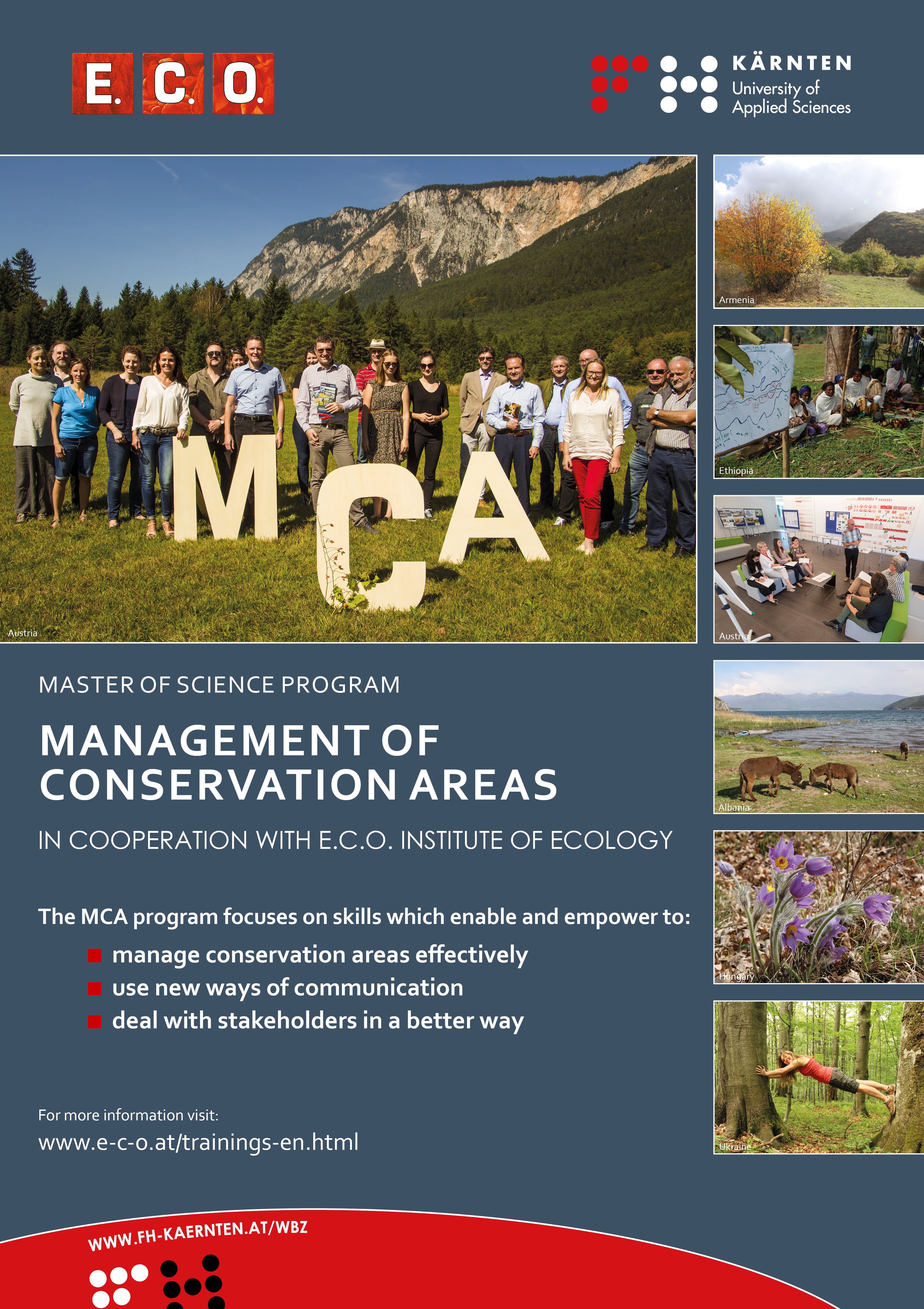
MANAGEMENT OF CONSERVATION AREAS – international master program
E.C.O.
Together with the Carinthian University of Applied Sciences, E.C.O. Institut für Ökologie offers the international master program Management of Conservation Areas.
The comprehensive academic education is unique in Europe. It allows career growth in protected areas (nature parks, national parks, biosphere reserves, world heritage sites or European protected areas), in research and education as well as in NGOs or international organizations. The key elements of skills-oriented education are international cooperation as well as transcultural learning and working.
The study program comprises 120 ECTS, culminating in a Masters degree (M.Sc.) graduation.
Start, Duration and Extent
The study program Management of Conservation Areas takes four semesters and can be completed while working full-time. In total, 64 attendance days are structured into eight modules of five to 13 days each. The courses take place at the Carinthian University of Applied Sciences as well as in selected protected areas in Central and Eastern Europe.
Next round: October 2019 – October 2021 (Application deadline: June 30, 2019)
Content
The study program Management of Conservation Areas is theory-based, practical and oriented towards the international state of the art. The students acquire:
- comprehensive overview of the tasks and functions of protected areas from a global perspective,
- comprehensive access to instruments and technologies for the management of protected areas,
- the personal competencies to analyze and solve problems that occur in the planning and managing of protected areas
- innovative learning methods, interactions with a great number of participants as well as field trips support the learning success.
Cooperation
The master program Management of Conservation Areas is embedded in a dense network of cooperation partners. An international scientific board ensures the scientific excellence of the teaching and the final theses. An Austrian experience pool is an interface to experiences and best practice examples in Austria. In the institutional board, important international organizations are represented.
Additionally, a global network of regional contact persons is available for anyone interested.
Further information is available here: