The Unbearable Lightness of Being (and the alarming results of the IPBES global biodiversity assessment)
The IPBES Global Biodiversity Assessement, launched in May 2019. https://www.ipbes.net/news/Media-Release-Global-Assessment Image from IPBES
 Article issued by Ignace Schops, President of EUROPARC Federation
The Unbearable Lightness of Being
The Intergovernmental Panel on Biodiversity and Ecosystem Services – IPBES – is very clear: we are destroying what keeps us alive. In the recently launched Global Assessment Report on Biodiversity and Ecosystem Services, hundreds of scientists from more than fifty countries sound the alarm: nature and its biodiversity have never been this bad in human history.
A million species are threatened with extinction, the rate of extinction is increasing and serious consequences for humanity are now very likely,
the scientists say. “We are affecting the fundamentals of our economies, livelihoods, food security, health and quality of life worldwide”. The impact of humanity on species and ecosystems is too heavy and we are rapidly losing our comfort zone. It is like Greta Thunberg already stated: “we need to panic”!
There are a series of alarming numbers:
- the rate at which animal and plant species are declining is tens to hundreds of times higher than in the last ten million years;
- 1 million of the roughly 8 million known species are threatened – a thinning that occurred only five times before in world history (the last time 66 million years ago, when the dinosaurs, among others, disappeared);
- 85 percent of the marshes have already disappeared;
- one-third of the corals, one-third of the marine mammals and more than forty percent of the amphibians are endangered;
- the timber harvest has increased by almost half since 1970; even of our domesticated and bred mammals, ten percent have died out in the last five centuries.
And not to forget: since 1970 the world population has doubled again. The essential, interconnected web of life on Earth is becoming smaller and more ragged, and that is a direct consequence of human activity. Those human activities are, in order of effect: more intensive use of land and sea; overexploitation of organisms, like logging, overfishing, etc.; pollution over-all. Plastic pollution has increased a tenfold since 1980; transport of invasive alien species has increased by 70% since 1970, ….
And global warming of course! There is a similarity between the fight against biodiversity loss, ecosystems degradation, and global warming: we have already set ourselves goals, and we have not achieved them. In four of the twenty objectives for 2020 of the 2010 Convention on Biodiversity, we are more or less on schedule. For six objectives we fail! Next year, in 2020, a new international biodiversity agreement should be concluded in the Chinese city of Kunming.
A Transformative change
Oh yes, there is hope. According to the report, there are still solutions. Yet, if we immediately protect all species and their essential habitats and ecosystems – half earth – and are prepared to make fundamental changes to our way of life. We had to do the latter to protect ourselves against the worst effects of global warming. Both problems are strongly intertwined. If nature deteriorates, it is because we plunder, pollute, repress and warm them up.
The scientists say that biodiversity can still be saved, but only with drastic measures. They themselves speak of “transformative” interventions. They require policy and have social and economic consequences that must also be absorbed. Exactly what policy we must pursue is a difficult choice and feed for negotiations. The report offers a wide range of possible actions and trajectories to achieve more sustainability across the different sectors: agriculture, fishing, water use, urbanization, energy, trade, energy production, economic growth.
EUROPARC Federation: safeguarding species and ecosystems is safeguarding ourselves!
Sustainable nature, valued by people. EUROPARC seeks to build a strong, united voice for Europe’s natural heritage. So we have a responsibility towards the outcome of this report!
United with all our members and allies we prove every day that it is possible to safeguard and maintain the wild while building strong, inclusive and sustainable societies.
We have a choice! If we don’t do it, who will? If we don’t do it together, how will we do it? And if we don’t do it now, when will we do it? Let’s not destroy what keeps us alive.
Think globally, act locally and change personally!
A Sustainable Journey – Best Movie Promoting Sustainability at Terres Travel Festival – Films & Creativity, Spain
Carol Ritchie, EUROPARC Federation´s Director, receiving the Terres de l´Ebre Award at Terres Travel Festival - Films & Creativity
Terres Travel Festival – Films & Creativity
The 3rd edition of the Terres Travel Festival – Films & Creativity was celebrated from April 26th to May 5th in Tortosa, a city located between the Delte de l´Ebre Natural Park and Els Ports Natural Park, in Catalonia – Spain, and included inside the Terres de l´Ebre UNESCO Biosphere Reserve. The Festival specialises in tourism films about landscape and journeys and targets both professionals from the tourism sector and the general audience alike. Furthermore, it is a member of the CIFFT – Committee International des Festivals of Films Touristiques and aims to contribute decisively to a re-balancing the attention and benefits of tourism to better the urban-rural distribution.
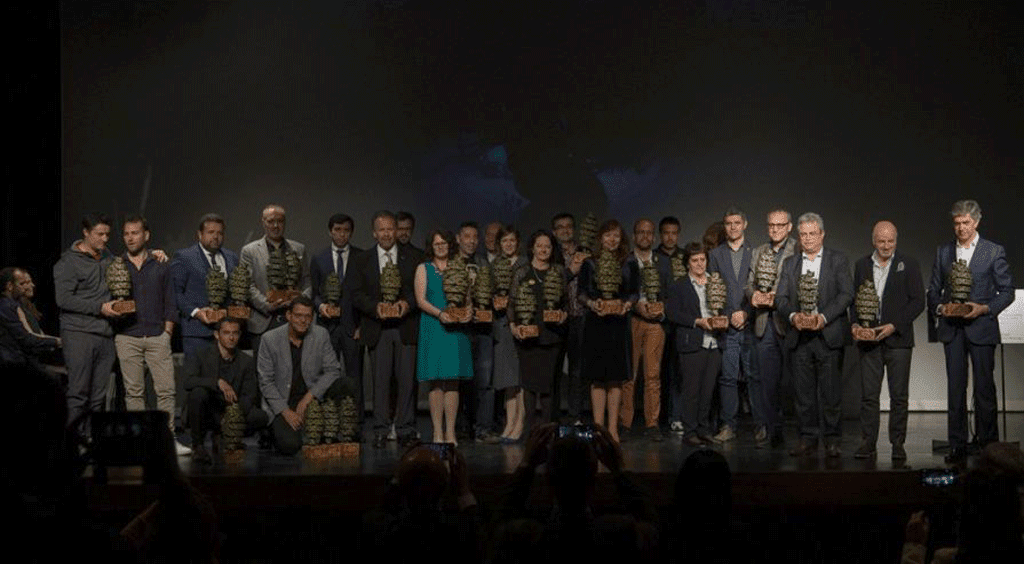
Award winners and collaborators at Terres Travel Festival – Films & Creativity 2019 – Photo by EUROPARC Federation
In this edition, 108 films from 24 countries were presented in two categories: Tourism films aiming to promote brands and touristic destinations, and Documentary films that seek to portray the relation between tourism, people and nature.
Best Movie Promoting Sustainability
The film “A Sustainable Journey” was presented within the Documentary category and was awarded with one of the two highest recognitions of the festival: the “TERRES DE L´EBRE- Best Movie Promoting Sustainability” Award.
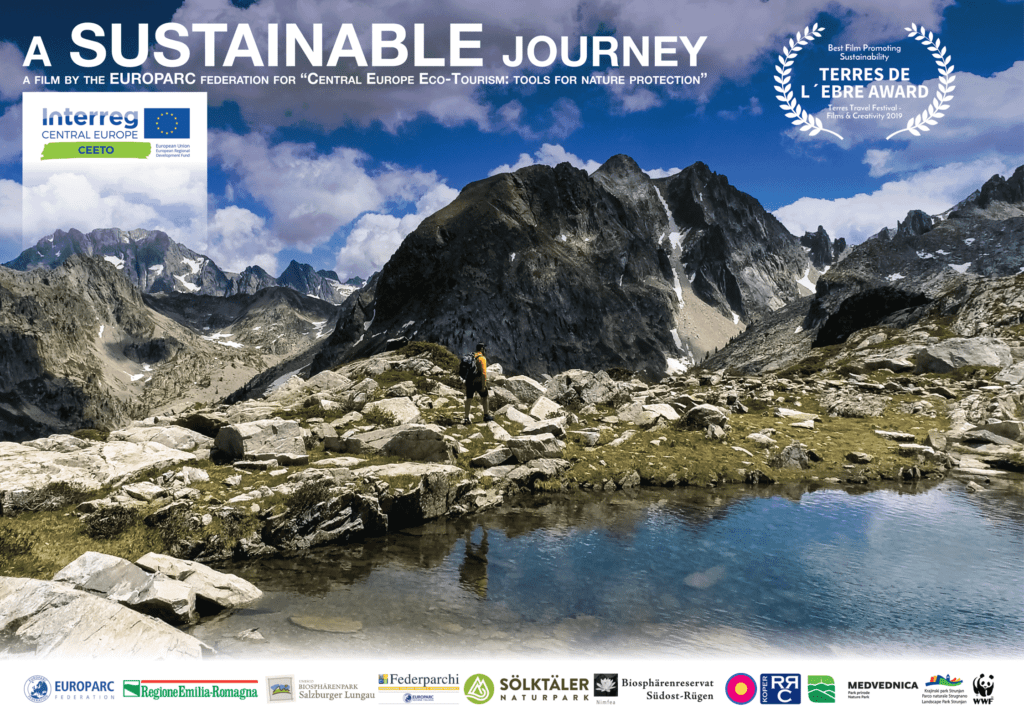
A Sustainable Journey – Best Movie Promoting Sustainability at Terres Travel Festival – Films & Creativity 2019
For the Awards Ceremony, EUROPARC representatives were invited to the Award Ceremony and Carol Ritchie, EUROPARC Federation Executive director, took the opportunity to explain the importance of choosing sustainable destinations when travelling. She also acknowledged the support provided by Interreg Central Europe, and the Park representatives where the movie was recorded for the production of this film and invited the audience to view CEETO Pilot Areas video teasers. For further information on the Awards visit Terres Travel Festival news.
About the Film
“A Sustainable Journey” depicts the story of a traveller seeking to escape every day´s pressures to a different kind of tourism that is good for nature and good for people. The traveller invites the viewers to make more sustainable holiday choices. It was produced by EUROPARC Federation in the framework of CEETO project and the support of Interreg Central Europe, filmed in place in the Alpi Marittime Natural Park and Marguareis Natural Park in Italy, and Mercantour National Park in France.
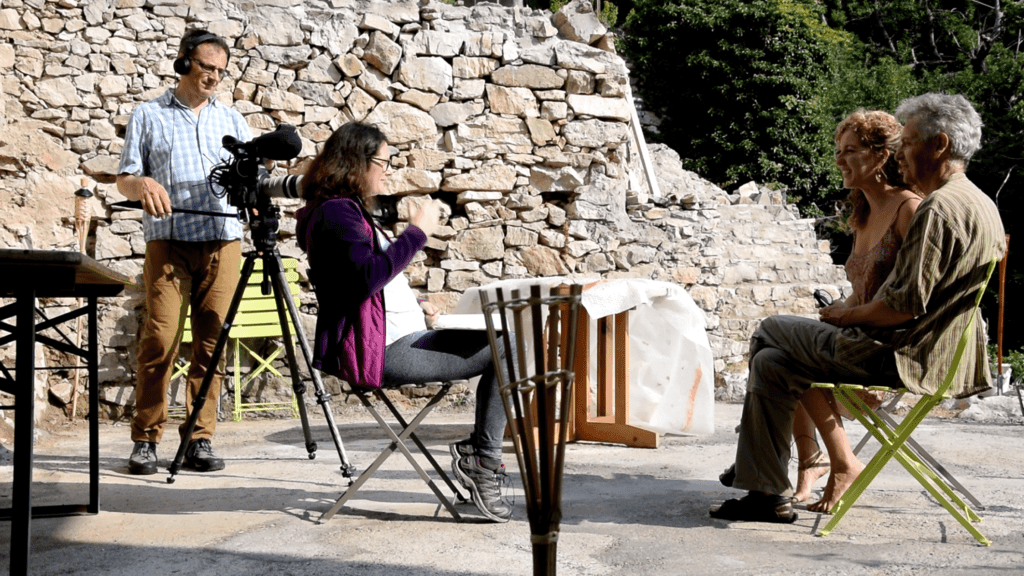
Interview to local business owners during the shooting of “A Sustainable Journey” – Photo by EUROPARC Federation
For its production, sustainable industries and local producers certified with the European Charter for Sustainable Tourism in Protected Areas were meticulously selected and recorded in order to lead with the example for future sustainable destinations. Apart from English, the movie is available in French, German, Italian and Spanish languages.
For further information about the movie, visit A Sustainable Journey – the Film webpage at CEETO website, or watch it online (English version below):
Lessons from Greece: Protected Areas are key to local economic development
Sokratis Famellos, Alternate Minister for Environment and Energy of Greece at the XI Charter Network Meeting in Greece, April 2019
The Management Bodies of Protected Areas should contribute to local economic development
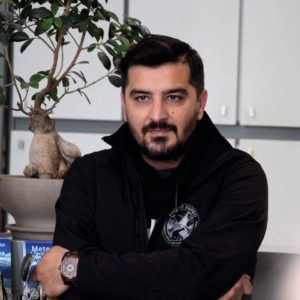
Serafeim Felekis
Article by Serafeim Felekis, President of Tzoumerka, Valley of Acheloos River, Agrafa and Meteora National Park
The Alternate Minister for Environment and Energy of Greece, Sokratis Famellos, was one of the special guests we welcomed at the 11th Charter Network Meeting. During his speech, Mr Famellos focused on the development perspective of the environment, specifically stating that
environment is life and economy.
He further highlighted the controversy between European policies that were imposed on Greece during the economic crisis: not only were these policies in full contradiction with the UN Sustainable Development Goals, creating more poverty, unemployment and limiting access to basic goods and services, but they were also opposed to environmental protection.
Past decisions
The Alternate Minister noted the former decision to close down Management Bodies responsible for the protection and management of Protected Areas in Greece, in an effort to cut down government spending. This decision was taken at the same time when the European Commission was imposing penalties to Greece because of gaps in the implementation of the European legislation for the management of Protected Areas.
‘This was the situation back in 2015’, said the Alternate Minister. ‘Now, we need to be aware that the forthcoming European elections are critical, because their result will also determine the future of the European Environmental agenda: whether progressive policies will be developed and implemented also for the environment and towards the UN Sustainable Development Goals.’
He further explained that Greece is a very rich country in terms of biodiversity, hosting many species that are unique across Europe. With Southern Europe being a biodiversity hotspot for the European Union, the European Union should, in turn, apply coherent policies that protect and conserve this unique natural capital.
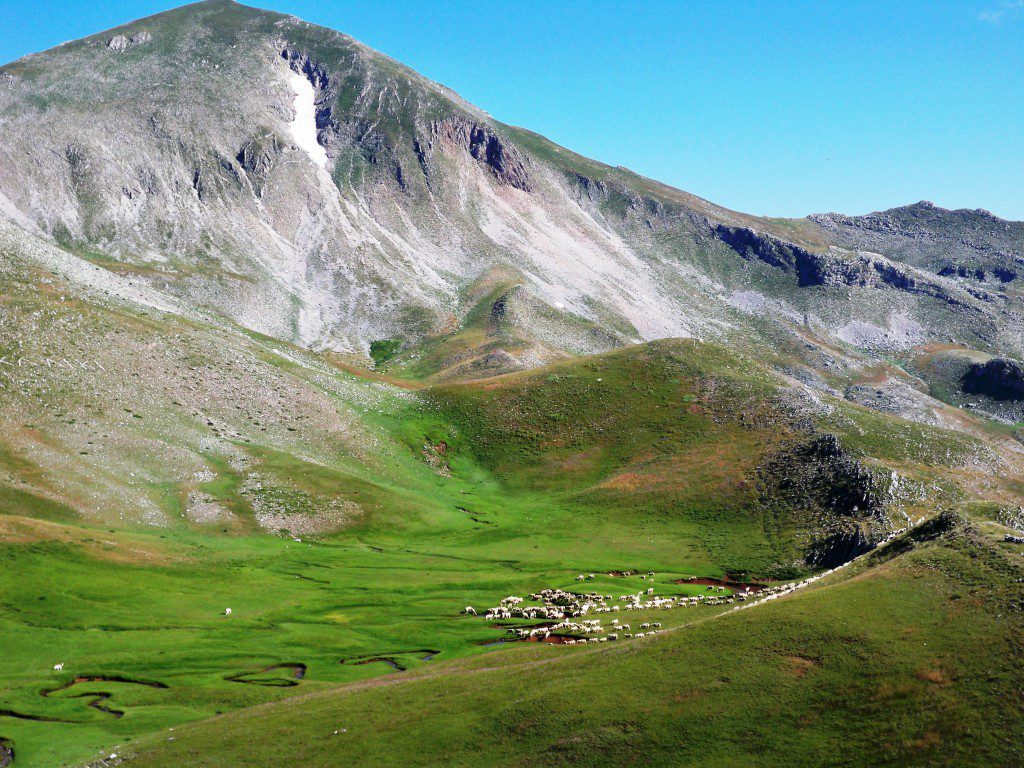
The Tzoumerka, Valley of Acheloos River, Agrafa and Meteora National Park is one of the largest Parks in Greece, providing social and economic benefits to the local communities.
The urge for action
From 2015 and onwards, Greece decided that there was no more time to lose in any environmental policy field. Major steps included:
- The implementation of integrated waste management throughout the country, enabling and motivating local authorities towards recycling and investing in modern waste management infrastructure;
- The issue of the updated and enhanced catalogue of Natura 2000 areas in December 2017;
- The institutionalization, by law, of Management Bodies for all Protected Areas across Greece, also foreseeing for the first time that these will be funded by the central government budget. As direct consequence, all employees working in Management Bodies have the opportunity, to obtain, through a transparent process managed by the Supreme Council for Civil Personnel Selection (in Greek: ASEP), a permanent employment status, in the area where they have been working all these years.
- The launch of two very important projects, for all Protected Areas:
- Specific environmental studies that map and assess the impacts of land uses and economic activities in all Natura 2000 areas, so as to develop the relevant Presidential Decrees regulating such uses/activities and the Action Plans for protected species (total budget of 17.5 MEuro)
- The 8-year LIFE Integrated Project LIFE-IP 4NATURA, which also develops specific tools for biodiversity conservation in Protected Areas (budget 17 MEuro).
The Commitment
The Alternate Minister also noted that together with biodiversity protection and implementation of the relevant International Conventions and legislation,
Management Bodies now also have to contribute to the local economy and catalyse local production growth.
‘We need local output and activities that are competitive and extrovert, bearing the designation of the areas that produce them. The evaluation of the operation of all Management Bodies will also assess their contribution to the development of the primary and secondary sectors, and also of eco-tourism and agro-tourism activities.
They will also be evaluated in terms of developing opportunities for local employment, not only for the employees of the Management Bodies themselves but also for all of the rural population in the corresponding areas.
Planning is over, now is the time to act and implement. I am thus asking everyone to contribute to the much-needed change of our paradigm for economic development, creating new development and new economic output’, committed the Alternate Minister.
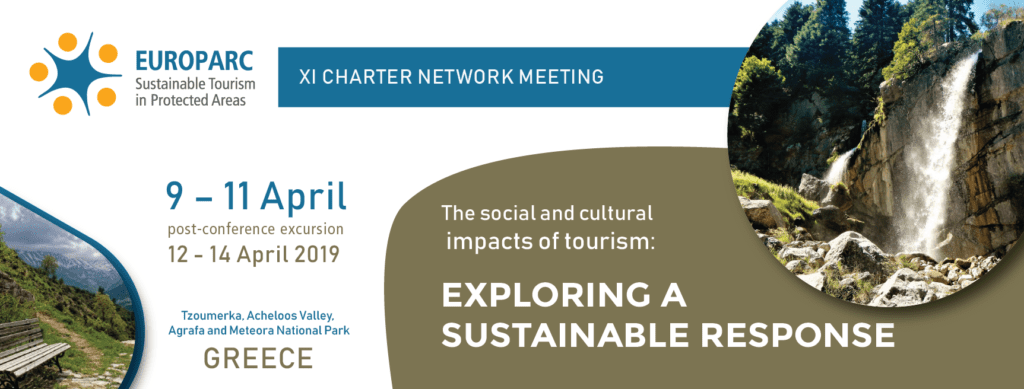
Read the outcomes of the XI Charter Network Meeting that was host by Tzoumerka National Park
A look into 2018: EUROPARC Annual Report 2018
Cairngorms National Park
EUROPARC Annual Report 2018
By Ignace Schops, EUROPARC President
Ignace Schops
Today, across Europe, Protected Areas face challenges and pressures unforeseen by our enlightened predecessors. In response, parks of today and tomorrow must see nature, people, culture and community as part of the assets of the area.
We have continued in 2018, as the representative body of Europe’s Protected Areas, to be the collective voice for all nature and landscape areas and we have continued to build a stronger, unifying, European network organisation that is better placed to support our members and to respond to these current and future challenges Europe’s nature is facing.
In particular, we have continued to engage with the European Commission, providing a valuable platform to share directly member’s management experiences, discuss policy developments whilst gaining the perspective of the Commission on the subjects relevant for Protected Areas and Natura 2000 sites. The work of regional parks and particularly of periurban Protected Areas, has been central in these discussions.
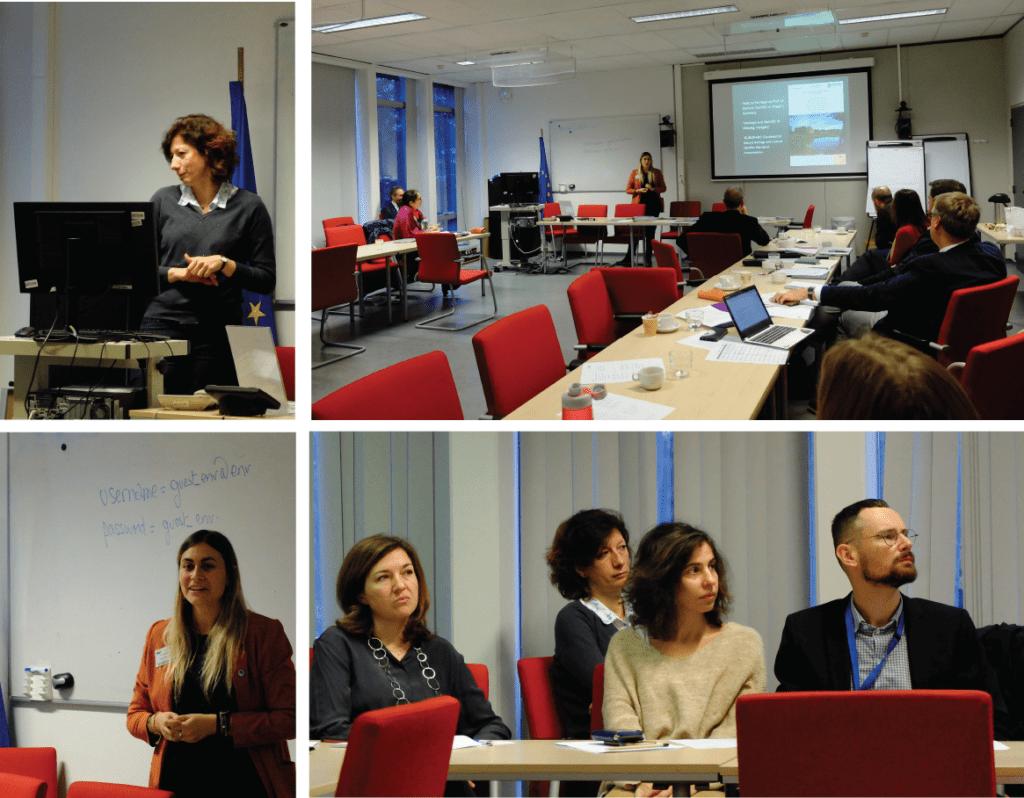
The Seminar- Dialogue on European policies, co-organised annually with the DG ENV, is an opportunity to bridge the policy and legislative work in Brussels with experience in the field from EUROPARC members. Read more about it here.
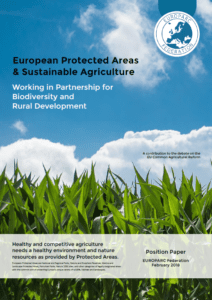
Download EUROPARC Position Paper
EUROPARC too, made a big investment over the year to contribute to the Agriculture Policy development, which would inevitably have a relevant impact for biodiversity in the coming years. The debate over the sustainability of agriculture has also been growing within the Protected Areas network over recent years.
A EUROPARC policy position on agriculture has been developed and published and we continue to develop a European tool for Protected Areas to support them in building partnerships with the farming sector and to promote good practices for a more sustainable agriculture in natural areas.
Finally, a real highlight of the year was the launch of the EUROPARC Youth Manifesto at our conference in Cairngorms National Park, Scotland. The conference itself was peppered with the passion and enthusiasm of our youth calling for Protected Areas to take action in order to ensure young people can live and work in our rural areas, ensuring we retain the living working landscapes that is our European heritage.
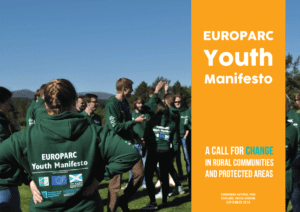
Click on the image to Download the Youth Manifesto (English Version)
The Youth Manifesto was an excellent collaboration with youth representative from across Europe. Authenticity of the Manifesto comes from expression of need, issues and solutions being identified by youth. But credibility must come from EUROPARC members developing project plans and implementing actions through adopting solutions from the Youth Manifesto.
Let us rise to the challenge to ensure a future for our youth and for Protected Areas.
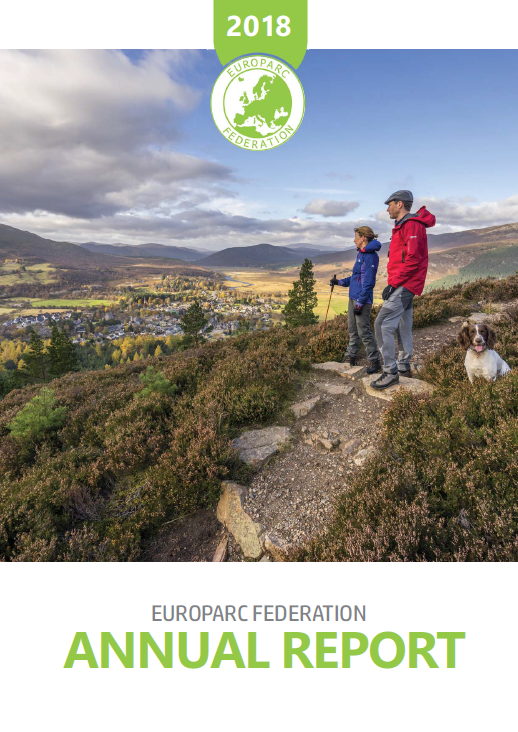
Download EUROPARC Annual Report in English, French or German
and visit this page to download EUROPARC previous Annual Reports!