Let’s thank nature this World Nature Conservation Day!
On World Nature Conservation Day 2020 let’s take a moment to appreciate all nature does for us – and what we can do for nature!
2020 seems to be a year of change. Surely by now it is clear that only if we live in harmony with nature we can guarantee a healthy and green future for everyone. This should motivate us to protect, restore and conserve our natural heritage, because a healthy environment is key to a healthy and sustainable society.
Every living thing on this planet is part of a beautiful ecosystem that supports its life. We too, are part of this system and it gives us everything we need and more, so let’s appreciate it! Who doesn’t enjoy the air we breathe, jumping in crystal clear water on a hot summer day or making a delicious meal with fresh produce? Exactly. So, in order to keep enjoying all nature has to offer us, we must take care of it the way it takes care of us.
Hence on this World Nature Conservation Day, let us thank nature for everything it does for us, by taking better care of it! You can do so through small changes to your day to day life like:
- Not using single use plastics
- Taking public transport or going by bike or foot to get around
- Buying local, seasonal produce
- Taking shorter showers
Collectively, even the smallest change makes an impact.
By living in harmony with nature, we can ensure that future generations too get to enjoy all nature has to offer.
Protected Areas and nature conservation
However important our small changes are, there would be no nature conservation without Protected Areas. The nature professionals in these places are working for nature on a daily basis. By doing so, they protect not just nature, but all of us by providing a space for nature to restore and develop in an ever-urbanised Europe. From supporting biodiversity to providing us with essential ecosystem services, Protected Areas are laying the groundwork necessary for humans to survive and nature to thrive.
EUROPARC is dedicated to supporting its members help achieve their nature conservation goals and work together on a sustainable future for Europe. Whether it is through programmes like Healthy Parks Healthy People Europe, our many webinars, transboundary cooperation or by representing our member’s interests in Brussels, we want to create sustainable nature, valued by people.
We cannot survive without nature. It is our past, present and future. During this period of change, we have the power to decide what our future will look like, so let’s shape it together! EUROPARC realises the uncertainty that these times bring, but also the many opportunities it provides us with. This is why, at the now online EUROPARC Conference 2020 “OUR NEW FUTURE: HOW READY ARE WE?” we will look at what skills and capacities Protected Areas need in order to champion these changing times. Join us and let’s create our new future, together.
About World Nature Conservation Day
World Nature Conservation Day is celebrated every year on the 28th of July. Its goal is to raise awareness about the importance of natural resources and encourage sustainable use of all that nature provides us, the so called “ecosystem services”, like:
- Clean water
- Fresh air
- Food
- Regulation services
By highlighting the connection between ourselves and nature, we are more motivated to take better care of our planet.
Find case studies, publications and news relation to ecosystem services, biodiversity, nature conservation and much more in EUROPARC’s Knowledge Hub.
Case Study: “Without Pesticides” Campaign by Nature Park Our
Photo by Kristina Paukshtite from Pexels
The “Without Pesticides” Campaign by Nature Park Our in Luxembourg is a great example of ways to promote more biodiversity in public spaces.
Imagine; a world with no more pesticides… Having trouble? Nature Park Our in Luxembourg is taking steps to achieve it! The“Without Pesticides” campaign by Nature Park Our has been advocating a total ban on pesticides nationwide in Luxembourg since 2009.
Pesticides in agricultural practices pose a big threat to our biodiversity, however their use in public green spaces tend to get overlooked in the discussion. Often these areas are expected to look “clean” and thus require a lot of upkeep, often with the use of pesticides. To ban pesticides in public green spaces was the starting point of the “Without Pesticides” campaign. Before the campaign was launched, the use of herbicides and other pesticides was common practice in the municipalities for maintaining their green spaces and public areas.
Making the switch
Often, the municipalities were looking to go pesticide-free, but it was a lack of knowledge on alternative methods that held them back. Additionally, there was a general perception that public squares and green spaces had to be “clean”, which corresponded above all to a sterile public space in which there was little room for biodiversity.
Challenges
Initially, the biggest challenge was to convince the municipalities (both councilors and staff) that it is feasible to maintain public areas without pesticides. However, this problem receded into the background with the ban on the use of pesticides in public spaces. The central problem was how to create alternatives by providing pesticide-free planting material and regional seeds, this problem is likely to be resolved in the next few years.
Solutions
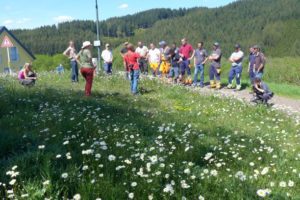
Workshop for municipalities employees – Nature Park Our
The pillars of the campaign were and are training and awareness-raising. Through training, new techniques were introduced and through awareness-raising acceptance for more “wilderness” in public spaces was fostered. Additionally, it was important to provide municipalities with materials and sources of supply. This is why a project was initiated to produce regional seeds as up until then, there was none. The following actions were taken:
- Training courses (machine demonstrations, e.g. to remove vegetation from paving cracks with steam)
- Workshops on laying out and maintaining near-natural green spaces for municipal employees
- Taking part in developing seed production for autochthonous seeds
- Help with, and organizing the supply of, pesticide-free ornamental plants for tubs and flower boxes or ornamental beds
- Sensitizing the public (press articles, exhibitions and marking the project areas with specially-designed signs)
The successful campaign resulted in the Nature Park municipalities increasingly resorting to the Nature Parks’ expertise to design their green spaces in a way that is close to nature.
Additionally, new parks and gardens are planned and laid out near-naturally right from the start.
For more information visit this website.
You can find this case study in our knowledge hub
EUROPARC Conference 2020
With the new biodiversity strategy 2030 published by the European Commission, restoring biodiversity has moved to the top of the international agenda.  Protected Areas must and will play an important role, but what will that role look like exactly?
That is what we want to find out at the online EUROPARC Conference 2020 “OUR NEW FUTURE: HOW READY ARE WE?”. Register now and join THE event for nature professionals in Europe!

IUCN Guidelines for Ecological Corridors
Oulanka River connecting Finland and Russia (c) Metsähallitus Parks & Wildlife Finland
With biodiversity loss at an all time high, it is time that we restore and reconnect nature. The International Union for Conservation of Nature & the World Commission on Protected Areas has published a new Best Practice Protected Area Guideline on “Conserving connectivity through ecological networks and corridors”.
EUROPARC has long recognized the importance of ecological corridors for effective and healthy natural areas in Europe. As nature does not stop at borders, here international cooperation is especially important. EUROPARC’s Transboundary Network is a great example of successful international cooperation supporting nature. Check out the toolkit on how transboundary cooperation supports the development of ecological corridors.
IUCN Guidelines for Ecological Corridors
Urbanisation, extensive agriculture, deforestation and other man made influences have caused natural ecosystems to be more and more fragmented, resulting in a high level of biodiversity loss. Now is the time to act. We must maintain and restore ecological connectivity to ensure biological diversity. Everyone on this planet depends on biodiversity for freshwater, food, climate regulation and pollination, underlining the importance of a strong network of green spaces throughout Europe . Additionally, green corridors will give species the opportunity to migrate, allowing them to adapt to climate change.

IUCN Ecological Corridors Guidelines – click on the image to download
The importance of well-connected green spaces was also recognized in the EU’s 2030 biodiversity strategy:
“In order to have a truly coherent and resilient Trans-European Nature Network, it will be important to set up ecological corridors to prevent genetic isolation, allow for species migration, and maintain and enhance healthy ecosystems. In this context, investments in green and blue infrastructure and cooperation across borders among Member States should be promoted and supported, including through the European Territorial Cooperation”
– From the European Union Biodiversity Strategy 2030 “Bringing nature back into our lives” under point 2.1

Ecoduct Kikbeek over the E314 (BE) (c) E. Christis. The report states that these structures “are no substitute for an intact landscape but have value in mitigating the effects of fragmentation for many species” (p. 33)
With the importance of these green corridors in mind, the Connectivity Conservation Specialist Group of IUCN’s World Commission on Protected Areas produced the “Guidelines for conserving connectivity through ecological networks and corridors”. These guidelines provide a scientific background on connectivity, as well as a range of case studies from terrestrial, freshwater and marine ecosystems, to provide practical solutions for meeting connectivity challenges.
It is imperative that the world moves toward a coherent global approach for ecological connectivity conservation, and begins to measure and monitor the effectiveness of efforts to protect connectivity and thereby achieve functional ecological networks.
– From Guidelines on conserving connectivity through ecological networks and corridors, page xxi
The time is now for countries to work together on connected green areas throughout Europe, the guidelines produced by IUCN provide a valuable basis on how to implement and restore ecological corridors.
In EUROPARC’s knowledge hub, you will find many interesting case studies and news articles on Green Infrastructure. Check it out here!
New Brochure on LIFE projects
© Thierry Fournier
In this new Brochure on LIFE projects, you can learn more about nature conservation initiatives in Europe.
Interested in learning more about nature conservation projects in Europe? Then have a look at the new brochure on LIFE projects, published by EASME.
The brochure can be found here.
There are many NGOs in Europe all working towards the same goal: nature protection. A great deal are receive funding from the EU’s LIFE programme. 3.46 billion is allocated to LIFE, making it the main funding instrument of the EU for the environment and climate action created in 1992. In the latest brochure, some of these NGO grantees and their projects are highlighted, as a reminder of the recent achievements of NGO networks in the protection and promotion of biodiversity in the EU.
EUROPARC’s projects on sustainable tourism and transboundary cooperation can also be found in the brochure. Some great initiatives, like advanced booking systems that allow authorities to minimise the number of tourists on particularly popular trails, or sustainably run restaurants are highlighted. Pasvik-Inari Trilateral Park gets a honorable mention, as EUROPARC’s only transboundary park that crosses the borders of three different countries.
Nature knows no national boundaries, so we need to come together to preserve it.
With the added pressures of tourism due to COVID, as well as the sudden closing of the borders, these programmes are more important than ever. To properly protect nature in Europe, we must come together and work on our shared goals.
Additionally, you will find articles related to saving sturgeons in the Danube, natural climate buffers in the Netherlands, the restoration of wetlands in the Rhine basin as a nature-based solution to floods and droughts and much more.

Click on the picture to download the brochure