Guardian of Europe’s Periurban Parks: Celebrating Marià Martí Viudes, 2025 Alfred Toepfer Medal Winner
Marià Martí Viudes received the Alfred Toepfer Medal from EUROPARC President Michael Hošek. Picture by Vaidas Garla
The prestigious Alfred Toepfer Medal, awarded annually by the EUROPARC Federation, honours individuals who have made outstanding contributions to the protection and management of Europe’s natural heritage. Named after EUROPARC’s founding father, it is awarded by the EUROPARC Council. In 2025, this honour is bestowed upon Marià Martí Viudes, a visionary leader whose lifelong dedication to the conservation of Collserola Natural Park and to the promotion of peri-urban nature across Europe has left an enduring mark on both landscapes and minds.
A Lifelong Commitment to Periurban Parks

Marià Martí Viudes in Collserola Natural Park
For more than 28 years, Marià Martí Viudes has been at the heart of efforts to preserve and enrich Collserola Natural Park, the vast green lung overlooking the city of Barcelona. Under his stewardship, the park developed as a space for people and nature to flourish together — balancing ecological preservation with public enjoyment.
Through his strategic management and forward-thinking vision, Collserola has become a model Periurban Park. A benchmark for how nature and urban life can coexist in harmony. Marià has successfully ensured that conservation goals go hand in hand with recreational use, providing immeasurable benefits to the well-being of Barcelona’s inhabitants.
Championing Peri-Urban Nature Across Europe
Marià Martí Viudes’s influence extends well beyond the boundaries of Collserola. As a founding member and long-serving General Secretary of FEDENATUR (the European Federation of Periurban and Metropolitan, Natural and Rural Areas), he played a central role in shaping Europe’s understanding of peri-urban conservation.
Recognising the unique pressures these natural areas face, from urbanization to habitat loss, he tirelessly advocated for their recognition within European environmental policy. His leadership helped transform FEDENATUR into a collaborative network of Park managers, scientists, and policymakers, sharing knowledge and solutions across the continent.

Marià Martí Viudes and other members of Fedenatur at the EUROPARC Conference in Montanhas Magicas, 2017.
Under his guidance, FEDENATUR later merged with the EUROPARC Federation, ensuring that Periurban Parks became an integral part of Europe’s Protected Area network. EUROPARC’s permanent Periurban Commission, as well as the Periurban Representative on the EUROPARC Council provide a unified voice for Periurban Parks within the network.
Inspiring Global Recognition
Marià Martí Viudes’s commitment also reached the international stage. Through his advocacy within the International Union for Conservation of Nature (IUCN), he successfully promoted the recognition of Periurban and metropolitan Parks as vital components of global conservation. His leadership was instrumental in the adoption of IUCN Resolution 4.128, “Setting up networks of protected urban and peri-urban natural areas.”
This landmark resolution has guided conservation initiatives worldwide, reinforcing the principle that nature conservation must extend into the spaces where people live, work, and play.
A Mentor and Visionary Leader

Long time colleagues Teresa Pastor and Nikos Pangas welcome Marià Martí Viudes to the stage. Picture by Vaidas Garla
Beyond his institutional achievements, Marià Martí Viudes has been an inspirational mentor and a tireless advocate for cooperation. He has shared his experience generously with new generations of conservationists, managers, scientists, civil servants, and practitioners alike, instilling in them a deep understanding of the value of peri-urban natural spaces.
His collaborative approach has fostered dialogue between ecology and urban planning, helping build bridges between citizens and nature and between policy and practice.
A Legacy of Balance and Vision
The Alfred Toepfer Medal 2025 celebrates Marià Martí Viudes’s exceptional contribution to the protection of Europe’s peri-urban natural areas and his enduring impact on the people who work to protect them.
His legacy lies not only in the thriving landscapes of Collserola, but in the international movement he helped build. A movement that recognises that the meeting point between city and nature is not a line of tension, but one of balance, opportunity, and hope.
Help shape the future of Protected Area Management Effectiveness!
The call for pilot sites in the LIFE PAME-Europe project is now open. This exclusive opportunity will ensure that you can help shape the future of Protected Area Management Effectiveness in Europe!
The LIFE PAME-Europe project is pleased to announce the official Call for Pilot Sites. Protected Areas across Europe are invited to apply and become part of a landmark initiative to strengthen Management Effectiveness Evaluation (MEE) for Europe’s Protected Areas. The application process is open until 12th of December 2025!
Why Become a Pilot Site?
By using and applying the Framework, Protected Areas, National Authorities and EU Member States will be enabled to better know how to improve the management of their sites, protect biodiversity, report its condition, and evaluate the effectiveness of conservation measures against conservation objectives
Pilot sites will have the unique opportunity to:
- Apply and test the LIFE PAME-Europe Framework for Management Effectiveness Evaluation between March and December 2026.
- Contribute to shaping a European-wide tool to assess, improve, and report on the management of Protected Areas.
- Join a co-learning community of PAME practitioners and benefit from tailored training, guidance, and access to the European Nature Academy (ENA).
Receive financial support for training-related and local pilot activities. - Gain visibility as leaders in Management Effectiveness: selected pilot sites will be recognised as “Protected Areas of Excellence in ME Assessment”, with 5–10 outstanding sites awarded at the end of the project.
Who Can Apply?
Eligible sites include:
- Natura 2000 sites
- National Authorities with responsibilities for designated Protected Areas reporting to the European Environment Agency (EEA)
- Sites located in the EU27 or wider Europe (e.g. Parties to the Bern Convention, pre-accession countries)
Applicants must commit to:
- Participating in the online Induction Meeting (10.30 to 12.00 CET on 29 January 2026), the Training Seminar in Prague (10–11 March 2026), and online training sessions between March & December 2026.
- Testing & applying the PAME-Europe Framework and EEA IT tool.
- Providing feedback via an online evaluation questionnaire.
- Signing a Commitment to Participate agreement, counter-signed by their organisation.
All applicants must designate at least one staff member (with B2 English proficiency or higher) to lead participation in the pilot process.
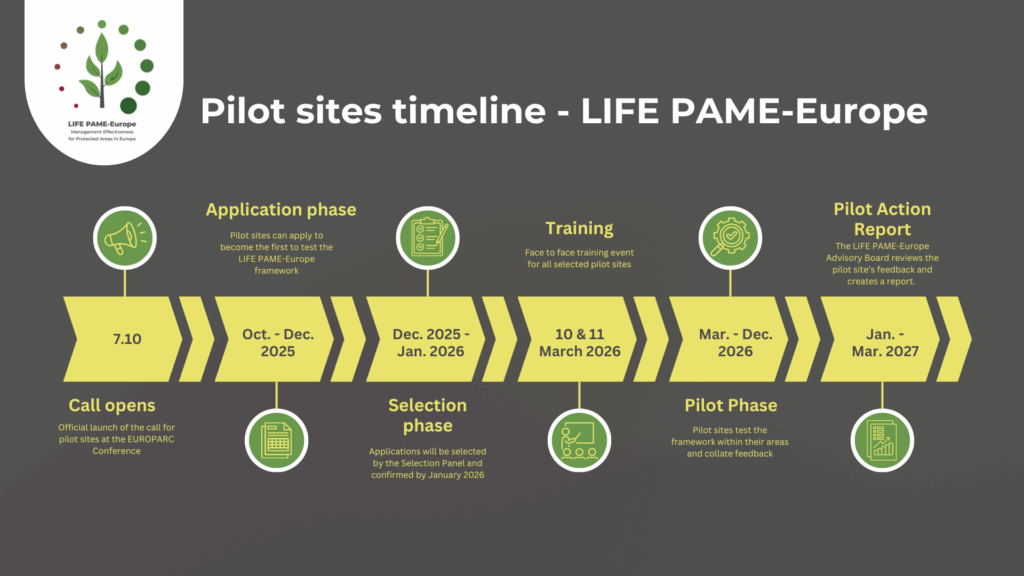
The deadline for registrations is 12th of December. Carefully read all information on the following page and apply!
All information for LIFE PAME-Europe pilot sites
Join LIFE PAME-Europe as a Pilot Site and help shape the future of management effectiveness in Europe’s Protected Areas. By participating, you will be able to self-assess how effective your management actions are to achieve progress towards your conservation objectives and outcomes. Importantly though, you will be actively contributing to building a robust, inclusive, and practical ME framework that will benefit biodiversity across Europe.
Apply now to join the EUROPARC Youth Council
Applications are open for the EUROPARC Youth Council!
Applications Now Open for the EUROPARC Youth Council 2025–2027
The EUROPARC Federation is delighted to announce that applications are now open for the second cohort of the EUROPARC Youth Council. This is an exciting opportunity for young people who are passionate about nature, protected areas, and shaping the future of Europe’s largest network of protected areas.
The Youth Council was created in 2023 as a platform for young people to have a voice within EUROPARC, contribute to decision-making, and bring new perspectives to the Federation’s work. Over the past two years, the first cohort has worked alongside EUROPARC, joining events to promote the EUROPARC programmes, inspiring actions to increase youth participation, and conrtibuting to the Healthy Parks, Healthy People Europe commission.
Now, applications are open once more and we are looking for new motivated and enthusiastic young people to carry this mission forward.
What is the EUROPARC Youth Council?
The Youth Council is a group of young representatives (aged 18–30) from across Europe who:
- Work with the EUROPARC Federation to make it more youth-inclusive and youth-relevant by supporting the Youth Representative.
- Act as ambassadors for EUROPARC and its programmes by attending events and encouraging others to join the various initiatives.
- Create opportunities to connect young people across Europe who are passionate about protected areas, sustainability, and biodiversity.
- Support the work of EUROPARC Sections, Youth+ groups, and member organisations.
What’s involved?
The position is a two-year commitment (2025–2027). It will include monthly online meetings throughout the year, with ad-hoc opportunities to participate in EUROPARC events and represent the youth council. Being on the Youth Council is a chance to gain experience in international cooperation, advocacy, and nature conservation. Check out the activities of the 2023 – 2025 youth council to learn more!
EUROPARC Youth Council Role Description
Who can apply?
We are looking for enthusiastic young people who are:
- Between 18 and 28 years old at the time of application.
- Passionate about protected areas, biodiversity, and sustainability.
- Ready to commit to volunteering their time and energy to the work of the Youth Council.
- A resident in Europe and connected to a EUROPARC member
This includes all young members of staff working for Protected Areas or other EUROPARC member organisations like NGOs, or working as freelancers together with Protected Areas. It is also open to young volunteers, Junior Ranger alumni, outdoor guides and volunteers of youth initiatives in Protected Areas. It also includes young rangers or volunteer rangers!
Still uncertain? Send us an email with your questions or write to us on Instagram @europarc.youth
How to apply
Applications are open until 28th October 23:59 CET. To apply, please fill out the application form and send a letter of support from a EUROPARC member to youtheuroparc (at) gmail . com. If you have any questions, feel free to write to EUROPARC’s youth officer.
Basic template for a letter of support

Let’s build the future of Europe’s protected areas together. Apply to the EUROPARC Youth Council today!
SOCIAT Training Course is now open!
How can we gather evidence to demonstrate the multiple benefits that nature conservation provides for people?
SOCIAT Training Course is now open!
The EUROPARC Federation and the University of Warwick are proud to launch the SOCIAT Training Course, which enables professionals to assess social outcomes of nature protection and restoration projects.
The development of SOCIAT was led by Dr Nikoleta Jones (University of Warwick) in collaboration with the EUROPARC Federation. This, along with other innovative tools, was created as part of the FIDELIO project (Forecasting Social Impacts of Biodiversity Conservation Policies in Europe), which was funded by the European Research Council (ERC) under the European Union’s Horizon 2020 research and innovation programme. Learn more on the FIDELIO project website here.
SOCIAT – Social Impact Assessment Tool for Nature Protection and Restoration projects is a structured questionnaire providing evidence-based insights to:
- Capture community perspectives
- Strengthen governance and trust
- Align conservation goals with community wellbeing
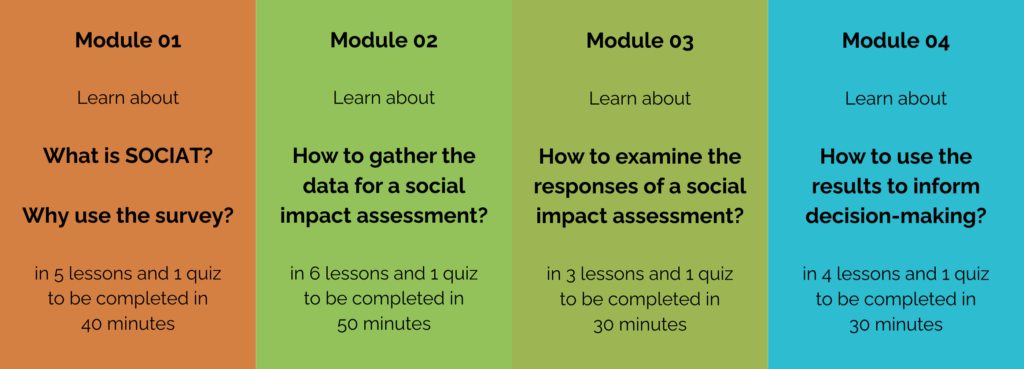
The SOCIAT Training Course provides a step-by-step guidance on the application process, explanations of the indicators, and standards for analysing the collected social data.
To help ensure that community voices are part of conservation decisions, the course is tailored for NGOs and professionals in the civil sector involved in management and decision-making. This includes Protected Areas Practitioners such as guides, rangers, administrative officers and assistants, as well as technical specialists and managers.
The online self-paced course is organised into four modules, all lessons and quizzes are in English, and the completion time for the course is approximately 2.5 hours.
By prioritising community engagement and understanding, SOCIAT helps create sustainable conservation outcomes rooted in local support and collaboration, says Dr Nikoleta Jones.