Nature as infrastructure for health: what citizen science and green spaces reveal about human well-being.
Monitoring in the Netherlands, Gabrielle Nunes
Health and nature are intrinsicly linked. This guest article details how contact with nature influences our well-being. Written by Gabrielle Nunes
Gabrielle Nunes has a PhD in Applied Ecology from the University of São Paulo, Brazil, with a sandwich period at Wageningen University and Research, the Netherlands. She is a data and science coordinator at ApplyBrasil, managing projects such as MapBiomas, and Conservation Specialist at WWF.
Nature as infrastructure for health
In an increasingly urbanised world, where daily life is often detached from ecological processes, a growing body of research is reframing nature not as a luxury, but as essential infrastructure for human health. Across different regions of the world, studies have shown that contact with natural environments can support emotional well-being, reduce stress, strengthen social connection, and even contribute to physiological health.
At the same time, Protected Areas are being asked to respond to increasingly complex challenges. Beyond biodiversity conservation, they are also becoming spaces linked to public health, education, tourism, and community engagement.
Two recent studies from my PhD research contribute to this discussion. One synthesises international evidence on the health benefits of contact with nature, while the other explores these relationships through a citizen science case study in the Netherlands. Together, they suggest a simple but important idea: when people experience nature meaningfully, both people and Protected Areas benefit.
The broader evidence: green spaces and health across regions
One of the studies[1] explored a broad international question: how does contact with nature influence human well-being across different environmental and cultural contexts?
To investigate this, the research conducted a scoping review based on an international database of 211 scientific articles focused on green spaces and mental health. After applying selection criteria related to biodiversity observation and interactions with natural environments, 67 studies from multiple countries were analysed in depth, including research conducted in Japan, the United States, the United Kingdom, Finland, Australia, China, Sweden, and other regions.
Despite the diversity of landscapes and methodologies, the findings revealed a remarkably consistent pattern. Overall, 94% of the analysed studies reported positive effects associated with contact with nature. These included reduced stress and anxiety, improvements in mood and cognitive restoration, and physiological responses linked to relaxation and overall health. Importantly, none of the reviewed studies identified negative effects resulting from interactions with natural environments.
94% of the analysed studies reported positive effects associated with contact with nature.
The review also highlighted an important distinction between passive and active interactions with nature.
Passive experiences included activities such as walking through parks or green areas without a specific focus on biodiversity. Active interactions involved intentional engagement with the environment through activities such as birdwatching, ecological interpretation, or attentive observation of landscapes and species.
Both forms of interaction were associated with positive outcomes. However, studies involving more intentional engagement with biodiversity frequently reported stronger effects related to emotional restoration, environmental awareness, and positive affect.
Monitoring in the Netherlands, Gabrielle Nunes
Some studies also identified physiological benefits, including improvements in indicators associated with cardiovascular health, such as reductions in blood pressure, cortisol levels, and heart rate. At the same time, the literature suggests that these effects are shaped by multiple interacting factors. In many cases, benefits may emerge not only from contact with nature itself, but also from physical activity, sensory immersion, attention restoration, and social interaction taking place within natural environments.
This distinction is particularly relevant for Protected Areas. It suggests that these landscapes offer more than scenic beauty or recreational opportunities. They create conditions for experiences that combine movement, attention, biodiversity, and emotional restoration in ways that are increasingly relevant for public well-being.
Protected Areas create conditions that are increasingly relevant for public well-being.
Yet access to these benefits remains uneven. In Brazil, for example, only 6.9% of urban areas are covered by vegetation, highlighting how opportunities for contact with nature are often unequally distributed.
From observation to connection: engaging people through citizen science
While the literature review revealed global patterns, a second study sought to understand how these benefits emerge in practice through direct participation with biodiversity monitoring.
In the Netherlands, a small-scale citizen science study explored how participation in plant monitoring activities could influence the emotional well-being and connection to nature of older adults[2]. The initiative focused on biodiversity observation as an accessible form of engagement with nature, encouraging participants to carefully observe and monitor plant species in their local environments.
To better understand these experiences, the research combined questionnaires and semi-structured interviews conducted before and after participation. The study examined changes in emotional well-being, vitality, and nature connectedness using standardised scales such as the Positive and Negative Affect Schedule (PANAS), the Inclusion of Nature in Self (INS), and the Nature Relatedness Scale (NRS).
Although the group was small, mostly composed of women over 60, the results revealed meaningful changes. Participants reported higher levels of positive emotions such as joy, enthusiasm, and satisfaction after engaging in the monitoring activities. At the same time, emotions associated with stress and psychological discomfort, including anxiety, irritation, and sadness, decreased significantly according to the PANAS scale. The study also identified a measurable strengthening in participants’ emotional and cognitive connection with nature.
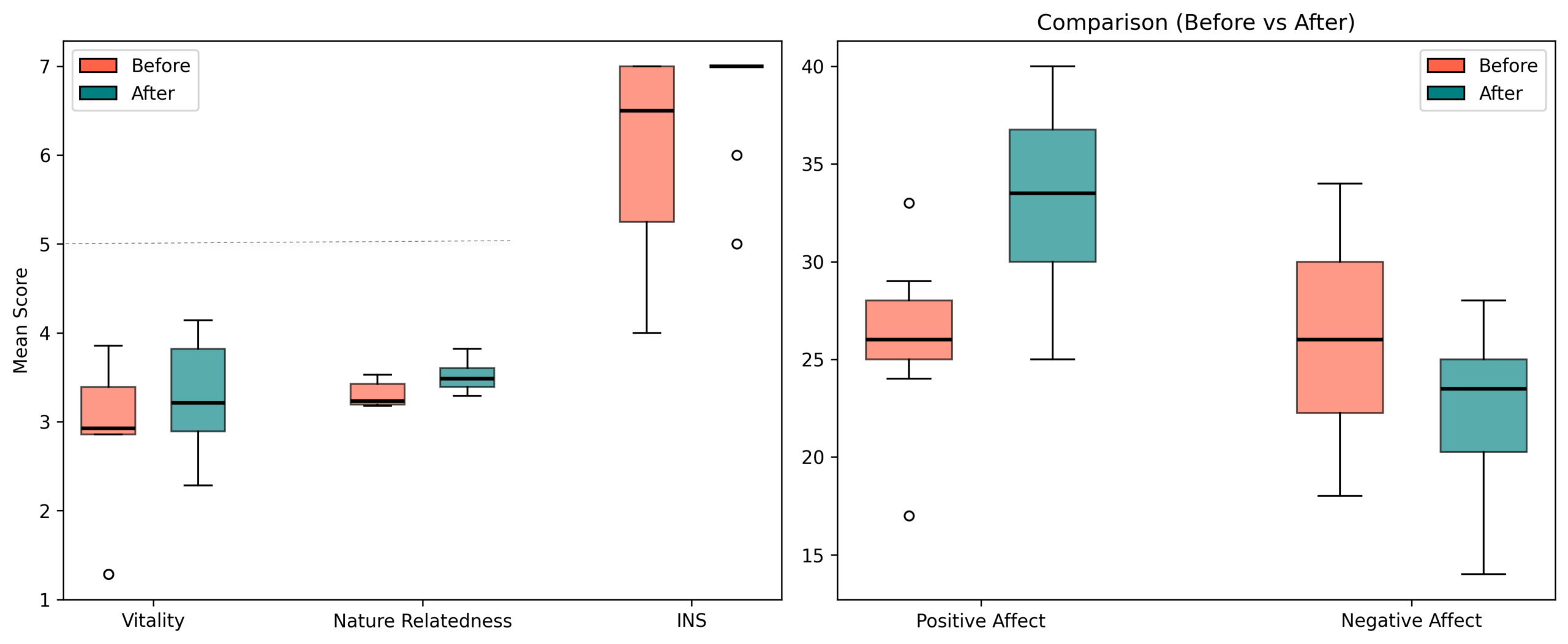
Boxplots from monitoring activities in the Netherlands. Click to enlarge.
What emerged from the interviews was equally revealing. Many participants described the experience as an opportunity not only to learn more about biodiversity, but also to reconnect with the environment in a more intentional and meaningful way. Some expressed a growing sense of contribution to conservation, while others highlighted the pleasure of paying attention to details in nature that often go unnoticed in everyday life.
These findings suggest that citizen science can offer something beyond data collection. By encouraging attentive interaction with biodiversity, participatory monitoring may help strengthen emotional bonds with nature and foster conservation awareness among participants.
Citizen science can strengthen emotional bonds with nature and foster conservation awareness among participants.
While this empirical case was conducted in Europe, it is part of a broader research agenda that also engages with Brazilian realities, where citizen science and nature-based activities are increasingly being explored as tools not only for data collection, but also for social inclusion, environmental awareness, public participation, and public health.
This dual geographical perspective highlights an important insight. Although cultural, institutional, and environmental contexts differ, the human response to meaningful interaction with nature shows remarkable consistency.
Implications for Protected Areas: a shared opportunity
For Protected Area networks such as EUROPARC, the cross-country perspective of this research offers a valuable takeaway: the role of Protected Areas extends beyond conservation boundaries and national contexts.
Whether in the Netherlands or Brazil, these spaces can function as:
- Platforms for citizen engagement and science
- Catalysts for health and well-being
- Arenas for strengthening human–nature relationships
However, realising this potential depends on moving beyond passive access. While simply being in nature already generates benefits, the research shows that active engagement, such as citizen science, deepens both well-being outcomes and environmental awareness.
From global evidence to local action
A recurring lesson across both studies is that the value of nature becomes most powerful when it is experienced, not just measured. Across continents, from European monitoring programmes to Brazilian discussions on ecotourism and urban green space, the message converges: investing in nature is also investing in people.
But the next step is more ambitious. It requires designing Protected Areas not only as places to visit, but as places to participate, learn, and connect. Because when people actively engage with nature, whether in a Dutch meadow or a Brazilian forest, they are not just observing biodiversity, they are reconnecting to it.
References:
[1] NUNES, Gabrielle Abreu; SOLDADO, Emerson Barão Rodrigues; LINDENKAMP, Teresa Cristina Magro. Can observing nature improve human well-being? Opportunities for Ecotourism. Brazilian Journal of Ecotourism, [S. l.], v. 18, n. 1, p. 83–98, 2025.
[2] Nunes, G.; Soldado, E.B.R.; Buijs, A.; Magro, T.C. Impacts of citizen science on well-being among older adults: Insights from a small-scale study. 4th World Conference on Forests and Parks for Public Health, Luxembourg, 2025.