3 billion trees to be planted in Europe by 2030?
By 2030, the European Commission wants to have planted 3 billion trees to combat climate change, improve air quality and biodiversity. In this article, Baptiste Hottekiet, Director of Parc Natural du Pays des Collines argues that Europe’s Nature Regional Landscape Parks are essential partners in reaching this goal. This article is also available in French here.

Article written by Baptiste Hottekiet, Director of Parc Naturel du Pays des Collines and member of EUROPARC’s Nature Regional Landscape Parks Taks Force.
3 billion trees: Europe’s Nature Regional Landscape Parks are essential stakeholders!
Thanks to a deep knowledge of their territories and the living forces that inhabit them, the Nature Regional Landscape (NRL) Parks of Europe have the capacity to play a major role in the sustainable development of their territories. In this context, numerous planting actions are regularly organized and each year several thousand trees are planted. Europe’s NRL Parks can thus actively contribute to the European Commission’s objective of planting 3 billion trees by 2030. Through this article, we wish to encourage not only the NRL Parks of Europe to provide information on the trees they have planted, but also encourage all Parks, Protected Areas and individuals to plant their trees and track it through the official website here.
The countless benefits of trees
We no longer need to demonstrate the many positive impacts that trees have on our environment and our well-being. Necessary for the construction of a functional ecological network, they also play a role in the fight against climate change, they improve water and air quality, support biodiversity and, as such, preserve our health. More than ever, tree plantings are essential as one of the actions (but not the only one!) necessary for the resilience of our territories.
There are numerous examples of planting projects carried out by the NRL Parks of Europe. Discover one example below!
Wallonia tree planting
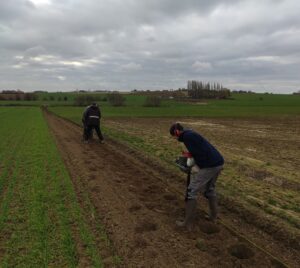
Tree planting actions in Wallonia
The project “A Tree for Picardy Wallonia” aims to mobilize stakeholders from Picardy Wallonia in Belgium to together plant 350,000 trees and shrubs between 2015 and 2025. To achieve this ambitios goal, seedling distribution operations, called “ARBRENKIT”, were organized. This is the third operation of this type. Funded by Wallonia as part of its “Yes, We Plant” programme, the project is supported by the Pays des Collines Natural Park, the Plaines de l’Escaut Natural Park and the non-profit organization Wapi 2040, in Belgium. This large-scale greening project extends over the whole of Picardy Wallonia (1,377 km2).
The principle? Distribute free hedge and small fruit kits, tall fruit trees and large trees to six target audiences: farmers, individuals, schools, businesses, associations and municipalities. Furthermore, the innitiative offers free technical support to ensure effecient planting. There are five different hedge kits to pick from: forager canteens, bird restaurant, easy fence, crop assistant, and fodder. This latest hedge kit consists of species intended to form a hedge which will be regularly eaten by livestock in summer when the meadows produce less grass. Of course, the objective is to recreate ecological connection, but also to develop the food resilience of Picardy Wallonia. Thousands of tall fruit trees have been planted, or will be planted soon. As a result, several thousand kilos of fruit will be used either fresh or processed into juice, compote, syrup, etc., within a couple of years.
A successful initiative!
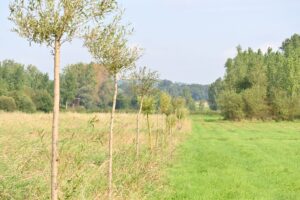
Tree planting in Pays des Collines and Plaines de L’Escaut Natural Parks
Where are we today in the results? With the last distribution of seedlings which took place on December 14, 2024, more than 395,000 trees and shrubs were distributed. The objective is therefore exceeded by around 13%, one year ahead of schedule! The prospects for progress in achieving the objectives look promising.
So, how does this all contribute to the goal of the European Commission? In December 2022, Wallonia became the first region to contribute to this European objective by providing the European Commission with a certificate of 2,653,884 trees planted in Wallonia. At that time, it was the largest contribution made by a Region. At the Belgian level, more than 4,000,000 trees have been added to the European meter. More information can be found here and here.
At the time of writing, 22,677,956 trees (0.755% of the target of 3 billion) have been registered in Europe.
Of course, this is a positive, European scale initiative that combines community engagement with nature restoration activities. However, this type of large-scale planting action should not overshadow other environmental preservation initiatives that are extremely important and have a positive effect on the climate. The preservation of ecosystems—especially existing forests and peat bogs—the fight against illegal logging and the deforestation of ancestral forests, as well as critical reflection on our production and consumption of goods, services, and energy, must not be neglected or diminished simply because we plant trees. Now more than ever, a combination of actions and a holistic approach should be central to our efforts.
EUROPARC thanks Baptiste for providing this article for our website.
Irish Protected Areas are on the path to Sustainable Tourism
Field trip in Wild Nephin National Park. Picture by Esther Bossink for EUROPARC.
The 13th edition of the ECST Network Meeting brought together over 100 people from 19 countries in Westport, Mayo County, Ireland from 29 – 31 October, 2024.
Networking in the Wild West of Ireland
Discover the event in pictures:
One year after the last network meeting, European Charter for Sustainable Tourism (ECST) network members, as well as other participants interested in Sustainable Tourism in Protected Areas, had the chance to enjoy a 3-day exchange in the ‘Wild West of Ireland’. The event focussed on visitor management in Protected Areas and provided participants with the chance to discover the West Coast of Ireland, with visits to the beautiful Connemara and Wild Nephin National Parks.
There was a numerous Irish delegation, issued from the National Parks and Wildlife Service, co-organisers of the event, and other Irish nature conservation entities, interested in learning more about sustainble tourism management in Protected Areas. Ireland is new to the ECST in Protected Areas. The Burren NP is the first Irish Park already registered to become part of the programme in 2025.
Through this event, Ireland took a further, important step towards a more sustainable form of tourism. Learn more on the dedicated page on our website:
Out now: EUROPARC Annual Report 2023!
The EUROPARC Annual Report details all the work done in the previous year to achieve our vision of “Sustainable Nature; Valued by People”. Discover what happened in our 50th Anniversary year!
50 years of EUROPARC
2023 was marked by our 50th Anniversary. As our President Michael Hošek states in his opening remark’s of the Annual Report:
It is cause for celebration, but also for reflection on our legacy and future.
The 2023 Annual Report does exactly that. On 44 pages, our members can discover everything the Federation achieved in this momentous year. From milestones in our projects, to the celebrations at our Annual Conference, and the creation of the first ever EUROPARC Youth Council – this is your chance to catch up with all of our activities.
The publication emphasises not just the work of the EUROPARC Directorate, but the overall importance of Europe’s Protected Areas for the safeguarding of our nature. Furthermore, it showcases the importance of connectivity, both between natural spaces, and amongst people.
As always, the Report ends with inputs from the EUROPARC Sections on their achievements in 2023.
Read it now! Available in English, French and German.

English – Annual Report 2023 Français – Rapport Annuel 2023
We wish happy readings!
Periurban Parks and Outdoor Sports – a match made in heaven?
Picture by Hans Stoops, IMBA Europe
At the 7th Outdoor Sports Euro’Meet 2024, EUROPARC organised the workshop “Periurban Park Challenges and Innovative Solutions”. The event took place in beautiful LECCO, Lombardia, between the 10th and 12th of September 2024. Furthermore, an exciting new award was announced…
Background of the event
Outdoor Sports are an excellent way to connect people to nature. However, conflicts arise when sports are practised unsustainably, or when different users have conflicting interests. In 2018, EUROPARC signed a memorandum of understanding with ENOS, the European Network of Outdoor Sports, to tackle these challenges together. Fruitful cooperation has been ongoing since then with the development of a common project: the ERASMUS + SEE project and active participation in our mutual conferences.
As such, our colleague and expert on Sustainable Tourism, Outdoor Sports and Periurban Parks, Teresa Pastor was invited to take part in the 7th Euro-Meet. The event followed the theme: “Innovations in Outdoor Sports. Inspiring sustainable and active citizens”. Teresa provided a “Protected Area” lens by:
1. Conducting the workshop on “Periurban Park Challenges and Innovative Solutions.”
2. Participating in a round table moderated by Benjamin Billet on “Innovative ways to integrate environmental sustainability in the outdoors,” alongside Harmut Wimmer, Thomas Knights and Manon Carpenter.
3. Joined a panel discussion on the future “Launch of the ‘European Declaration on Trails” with Harmut Wimmer, Hans Stoops, Mike McClure, and Laura Suau.
Periurban Park Challenges and Innovative Solutions Workshop.
Tackling the conflict: Navigating the Intersection of Digital Tools, Conservation, and Stakeholder Management
The participatory workshop had the following aims:
- Understanding the main differences in visit features and visitor profiles between remote Protected Areas and Periurban Parks and the associated management challenges and opportunities.
- Further the thinking on how digital tools are changing the visitation patterns: What opportunities and challenges does this bring?
To set the scene, Teresa presented the Collserola Natural Park, a highly visited Park, located at the heart of the Greater Barcelona Region. Participants were then asked to think on expected differences between visitors of remote vs. Periurban Parks in terms of preferred seasonality, time of outdoor sport practice, origin of visitors, age, outdoor sports practice and group-size. This was followed by a short presentation on how the situation is in Collserola and a discussion on challenges and opportunities that arise from these visit profiles.
In general, outdoor sports visitors in Periurban Parks tend to be locals, going to the Park all year round, in high frequency. Their visiting times cover the whole day, including evenings. This high frequency, non-stop visitation threatens the natural assets. Furthermore, in Periurban Parks, two type of outdoor users share the space: those performing high speed activities (like trail running and biking) and those practicing slow activities (like hiking and walking). Walking is mostly done by senior people and families with young children. This high contrast in users and aims of the visits results in a high likelihood of conflict. However, as visitors are often local, this also means that there is potential to engage with them and work together in putting in place innovative management solutions.
Additionally, participants had to reflect on the benefits that IT tools (GPS based and outdoor sport apps) bring for users. These benefits include, knowing where they are, discovery of new trails and that they are cheap and easy to use, and how these relate with new management challenges and opportunities.
The low cost, easy to use, apps are helping new comers – from traditionally underrepresented groups, to ‘seek adventure’ in the outdoors. This contributes towards a healthier population. However, this increases issues with visitor managers for Park Managers: more people, going everywhere, at any time. However, this new technology can also be part of the solution as it can help managers to get to know visitors better – where they go, when, in a group or alone, gender, etc. This information is essential to plan the trails and other infrastructure better.
The workshop was a perfect venue to discuss different ideas in favour of a better accommodation of Outdoor Sports in Periurban Parks.

A new award
To deepen the relationship between Outdoor Sports and Protected Areas, as well as to highlight best practices, ENOS and EUROPARC are excited to launch a new award! It will recognise outstanding initiatives in the field of outdoor sports & nature restoration. More information will follow soon, so stay tuned!
Want to know more?
If you are interested in further outcomes of the events, as well as other presentations, will be made available on the webpage here.