The Youth Participation Vision in the Yorkshire Dales National Park
The Up Skill Down Dale group attempt dry stone walling in Swaledale in August this year (c) YDNPA
Yorkshire Dales National Park approved a Youth Participation Vision
The Yorkshire Dales National Park Authority is one of the strongest champions of the EUROPARC Youth Manifeso published in 2018 at the EUROPARC Conference in the Cairngorms National Park in Scotland. Since then, they have made a significant effort to involve young people across many aspects of their work. This led to a decrease in the average age of board members and park staff, ensuring more age diversity in voices and helps with generational knowledge sharing. Below you can see the first advocacy on integrating the Youth Manifesto into the work of the National Park.
Youth Manifesto in the Yorkshire Dales – Green Deal
Recently, they launched a press release about their newly approved youth participation vision which brings together all the various youth activities and efforts into a strategic vision.
Press release
“Young people are empowered to lead and have a voice in protecting the Yorkshire Dales National Park,” the National Park Authority has agreed at a meeting.
The undertaking is set out in a “Statement on Youth Participation”, which puts into words the public body’s vision and commitment to young people.
The National Park Authority currently works with more 2000 young people each year to help deliver its purposes, including by supporting youth volunteering programmes such as Up Skill Down Dale.
At a full Authority meeting held yesterday, Members voted to agree the statement on youth participation as a means of embedding youth work in the culture of the organisation and to make sure young people are involved in all aspects of decision making.
Katie Norgate, one of the Authority’s co-opted young Members said: “This is a clear and strong commitment to youth involvement with specific, measurable targets that make the commitment feel actionable and accountable, which gives real confidence that this policy will lead to meaningful change.
Involving youth and giving them the opportunity to be co- creators will directly shape the Authority’s work.
Member Champion for Promoting Understanding, Neil Heseltine, said: “We run educational and skills-based activities for young people alongside our volunteering programmes for young people and our apprenticeships programme. We’ve also co-opted youth members to our Finance and Resources committee and involved nine young people in the drafting of the new Yorkshire Dales National Park Management Plan.
“What we didn’t have, until today, was a concise summary of our vision and commitment to young people. Our ‘Statement of Youth Participation’ is intended to inform our approach to youth engagement, encourage collaborative working with partners, inform bids for project funds to do more work with young people, and assist in advocating for enhanced roles for young people on National Park Authority boards.
“Many young people want to use their time to conserve and enhance the environment, and to be outdoors in nature. We want to harness that energy to help make the National Park and even more accessible and beautiful place.”
For more information, please contact the Yorkshire Dales National Park Authority’s Media Officer Andrew Fagg or Communications Manager Mark Sadler (name.surname@yorkshiredales.org.uk).

The Youth Mobility Workshop for European Youth in Parks Day 2024 (c) Yorkshire Dales National Park Authority
Winners of the EUROPARC Scholarship for Young Professionals
Meet the two winners of the EUROPARC Scholarship for Young Professionals 2025 – 2026.
Winners of the EUROPARC Scholarship for Young Professionals
EUROPARC strongly believes that investing in capacity building for young professionals is vital for the long term success of Europe’s Protected Areas. Like everything else, the future of Protected Areas relies on the young generation taking an active and informed role. The EUROPARC Federation, with support from the EU LIFE Programme, is awarding two Scholarship Awards to promising young conservationists, who are committed to working for the benefit of Protected Areas. The aim of the scholarships is to enhance international cooperation and to advance the quality, innovation and European dimension of Protected Area management.
The Scholarship includes a travel stipendium to visit protected areas in another country in 2026 and to delve into a topic of interest, sharing the outcomes of their learnings with the EUROPARC network at the end of next year.
The winners, Eudald Vicens Roig and Irene Mineo were invited to receive their awards at the EUROPARC Conference 2025 in Lithuania. Irene was not able to join in person and instead sent a video message for the EUROPARC members which can be seen below.
Eudald Vicens Roig
Eudald is a conservation technician at La Sorellona, an environmental consultancy based in Girona, Spain. He works on urban nature restoration projects under the EU-funded Riunatur and GiroNat initiatives, involving biodiversity monitoring, habitat restoration, and nature-based solutions in urban water systems. He also leads participatory workshops on climate adaptation and drought resilience. La Sorellona manages visitor and education services at Cap de Creus and Aiguamolls de l’Empordà Natural Parks and contributes to the LIFE Rescue Alpyr project in Alt Pirineu Natural Park, all members of EUROPARC (Generalitat de Catalunya).
His area of interest for his study visits is rewilding principles of using wild herbivores in both the Alto Tajo Natural Park (Spain) and Zuid-Kennemerland National Park (The Netherlands).

Photo credit: Vaidas Garla
Irene Mineo
Irene is a coordinator of the Scottish Marine Environmental Enhancement Fund at Nature Scot. She is responsible for managing and developing the SMEEF programme, supporting the funding and delivery of marine restoration projects across Scotland. Her activities include stakeholder engagement, coordinating grant calls, assessing project proposals, facilitating partnerships, and promoting best practices in marine enhancement and nature-based solutions. The role also involves strategic planning, communications, and contributing to national policy objectives on marine conservation and biodiversity.
The goal of her study visits is to explore and compare practical approaches to seagrass restoration and conservation in Scotland and Italy, with a focus on how community engagement, policy, and scientific methods are integrated into protected area management. By learning from different cultural and ecological contexts, she aims to identify transferable strategies that can enhance marine restoration efforts, strengthen partnerships, and support biodiversity and climate resilience in coastal ecosystems. For this she plans to visit a local seagrass restoration project in Scotland and visit Rome to learn from ISPRA and FUGRO about their efforts along the Italian coastline.
To follow both of these young professionals on their study trips, stay tuned to EUROPARC newsletters, news and social media. If you are interested in youth empowerment projects for young professionals and practitioners, consider following the EUROPARC Youth Instagram @europarc.youth which will feature the travels of both scholarship winners.
 This programme has been supported financially in the framework of the European Commission’s (Directorates General Environment and Climate Action) LIFE funding programme of operating grants for European Environmental NGOs. The content of this publication does not reflect the official opinion of the European Union. Responsibility for the information and views expressed in the publication lies entirely with the authors.
Guardian of Europe’s Periurban Parks: Celebrating Marià Martí Viudes, 2025 Alfred Toepfer Medal Winner
Marià Martí Viudes received the Alfred Toepfer Medal from EUROPARC President Michael Hošek. Picture by Vaidas Garla
The prestigious Alfred Toepfer Medal, awarded annually by the EUROPARC Federation, honours individuals who have made outstanding contributions to the protection and management of Europe’s natural heritage. Named after EUROPARC’s founding father, it is awarded by the EUROPARC Council. In 2025, this honour is bestowed upon Marià Martí Viudes, a visionary leader whose lifelong dedication to the conservation of Collserola Natural Park and to the promotion of peri-urban nature across Europe has left an enduring mark on both landscapes and minds.
A Lifelong Commitment to Periurban Parks

Marià Martí Viudes in Collserola Natural Park
For more than 28 years, Marià Martí Viudes has been at the heart of efforts to preserve and enrich Collserola Natural Park, the vast green lung overlooking the city of Barcelona. Under his stewardship, the park developed as a space for people and nature to flourish together — balancing ecological preservation with public enjoyment.
Through his strategic management and forward-thinking vision, Collserola has become a model Periurban Park. A benchmark for how nature and urban life can coexist in harmony. Marià has successfully ensured that conservation goals go hand in hand with recreational use, providing immeasurable benefits to the well-being of Barcelona’s inhabitants.
Championing Peri-Urban Nature Across Europe
Marià Martí Viudes’s influence extends well beyond the boundaries of Collserola. As a founding member and long-serving General Secretary of FEDENATUR (the European Federation of Periurban and Metropolitan, Natural and Rural Areas), he played a central role in shaping Europe’s understanding of peri-urban conservation.
Recognising the unique pressures these natural areas face, from urbanization to habitat loss, he tirelessly advocated for their recognition within European environmental policy. His leadership helped transform FEDENATUR into a collaborative network of Park managers, scientists, and policymakers, sharing knowledge and solutions across the continent.

Marià Martí Viudes and other members of Fedenatur at the EUROPARC Conference in Montanhas Magicas, 2017.
Under his guidance, FEDENATUR later merged with the EUROPARC Federation, ensuring that Periurban Parks became an integral part of Europe’s Protected Area network. EUROPARC’s permanent Periurban Commission, as well as the Periurban Representative on the EUROPARC Council provide a unified voice for Periurban Parks within the network.
Inspiring Global Recognition
Marià Martí Viudes’s commitment also reached the international stage. Through his advocacy within the International Union for Conservation of Nature (IUCN), he successfully promoted the recognition of Periurban and metropolitan Parks as vital components of global conservation. His leadership was instrumental in the adoption of IUCN Resolution 4.128, “Setting up networks of protected urban and peri-urban natural areas.”
This landmark resolution has guided conservation initiatives worldwide, reinforcing the principle that nature conservation must extend into the spaces where people live, work, and play.
A Mentor and Visionary Leader

Long time colleagues Teresa Pastor and Nikos Pangas welcome Marià Martí Viudes to the stage. Picture by Vaidas Garla
Beyond his institutional achievements, Marià Martí Viudes has been an inspirational mentor and a tireless advocate for cooperation. He has shared his experience generously with new generations of conservationists, managers, scientists, civil servants, and practitioners alike, instilling in them a deep understanding of the value of peri-urban natural spaces.
His collaborative approach has fostered dialogue between ecology and urban planning, helping build bridges between citizens and nature and between policy and practice.
A Legacy of Balance and Vision
The Alfred Toepfer Medal 2025 celebrates Marià Martí Viudes’s exceptional contribution to the protection of Europe’s peri-urban natural areas and his enduring impact on the people who work to protect them.
His legacy lies not only in the thriving landscapes of Collserola, but in the international movement he helped build. A movement that recognises that the meeting point between city and nature is not a line of tension, but one of balance, opportunity, and hope.
Help shape the future of Protected Area Management Effectiveness!
The call for pilot sites in the LIFE PAME-Europe project is now open. This exclusive opportunity will ensure that you can help shape the future of Protected Area Management Effectiveness in Europe!
The LIFE PAME-Europe project is pleased to announce the official Call for Pilot Sites. Protected Areas across Europe are invited to apply and become part of a landmark initiative to strengthen Management Effectiveness Evaluation (MEE) for Europe’s Protected Areas. The application process is open until 12th of December 2025!
Why Become a Pilot Site?
By using and applying the Framework, Protected Areas, National Authorities and EU Member States will be enabled to better know how to improve the management of their sites, protect biodiversity, report its condition, and evaluate the effectiveness of conservation measures against conservation objectives
Pilot sites will have the unique opportunity to:
- Apply and test the LIFE PAME-Europe Framework for Management Effectiveness Evaluation between March and December 2026.
- Contribute to shaping a European-wide tool to assess, improve, and report on the management of Protected Areas.
- Join a co-learning community of PAME practitioners and benefit from tailored training, guidance, and access to the European Nature Academy (ENA).
Receive financial support for training-related and local pilot activities. - Gain visibility as leaders in Management Effectiveness: selected pilot sites will be recognised as “Protected Areas of Excellence in ME Assessment”, with 5–10 outstanding sites awarded at the end of the project.
Who Can Apply?
Eligible sites include:
- Natura 2000 sites
- National Authorities with responsibilities for designated Protected Areas reporting to the European Environment Agency (EEA)
- Sites located in the EU27 or wider Europe (e.g. Parties to the Bern Convention, pre-accession countries)
Applicants must commit to:
- Participating in the online Induction Meeting (10.30 to 12.00 CET on 29 January 2026), the Training Seminar in Prague (10–11 March 2026), and online training sessions between March & December 2026.
- Testing & applying the PAME-Europe Framework and EEA IT tool.
- Providing feedback via an online evaluation questionnaire.
- Signing a Commitment to Participate agreement, counter-signed by their organisation.
All applicants must designate at least one staff member (with B2 English proficiency or higher) to lead participation in the pilot process.
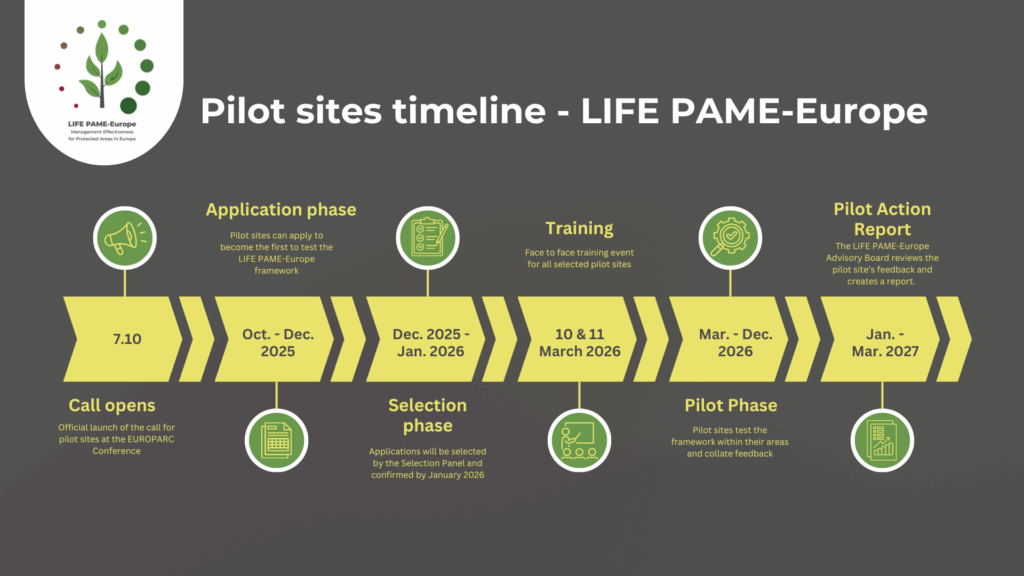
The deadline for registrations is 12th of December. Carefully read all information on the following page and apply!
All information for LIFE PAME-Europe pilot sites
Join LIFE PAME-Europe as a Pilot Site and help shape the future of management effectiveness in Europe’s Protected Areas. By participating, you will be able to self-assess how effective your management actions are to achieve progress towards your conservation objectives and outcomes. Importantly though, you will be actively contributing to building a robust, inclusive, and practical ME framework that will benefit biodiversity across Europe.