Periurban Parks: nature closer than you imagine
Collserola Nature Park, aperurban Park in the doors of Barcelona Photo by Caminar BCN 12 blog ( http://caminarbcn12-13t.blogspot.de/2012/12/collserola-un-parque-aislado-para-la.html)
How would it feel to relax in nature after a long day of work? Trekking in a forest, running through a meadow, or simply wandering along a river, just nearby your town?
Periurban parks bring us these possibilities and much more: they protect us! They refresh city temperatures; absorb air pollutants and decrease traffic noise. They look after our physical and mental health. They are outdoors gym, nature-schools and a green place to meet with family and friends. In some areas, Periurban parks are also places where one can grow and buy fresh and organic vegetables!
Besides, periurban parks are essential components of Green Infrastructure – a new way to provide landscape connectivity and to preserve the territory and its ecosystem services. Periurban parks can adopt very different forms: they can be forests, rivers, green rings, agro-ecological spaces and re-naturalised landscapes. All located at the city doors!
But life in a city can be harsh; for periurban parks as well. They receive a lot of pressure: visitors overflow, unwanted city equipment, exotic species and vandalism. These are threats that managers have to deal with, while trying to protect biodiversity.
Today, with over 80% of the European population living in urban and suburban areas, the conservation of this natural non-urbanized areas on the outskirts of cities urges to be addressed.
We are close to cities
In the tutorial We are close to cities at EUROPARC Conference 2016, we will exchange good practices, ideas, thoughts and learn from Periurban parks with a long experience in this matter!
In the tutorial we will showcase:
- The Collserola Natural Park, a well-preserved 8,000-hectare forest located at the heart of the Barcelona metropolitan area. Protected since 1987, Collserola is a much-loved place, an immensely valuable natural area for the huge population that lives around.
- The Parco Nord and Parco agricolo Sud Milano, the two main natural areas composing the greenbelt of Milan city. The Parco Nord is a re-naturalised greenspace, built from scratch 40 years ago. It is today’s green place for Milano citizens. The Parco agricolo Sud Milano is a vast agro-ecological space, which combines productive activity with the ever higher social demand of open space.
Further Readings
FEDENATUR – the European Federation of Natural and Rural Metropolitan and Periurban Spaces – now forms part of the EUROPARC family! If you want to know more about Periurban Parks, visit the website www.fedenatur.org.
How are “Friends of Parks” giving a helping hand?
When we think the value that Friends are bringing to our personal lives, life would be quite empty without friends. But what makes a good friend? Good friends are honest, loyal, have common interests. It is not different from Friends of Parks. Generally, these groups are made of highly-motivated individuals who are willing to give a contribution to the Park within their region. They want to come together with like-minded people to make a difference.
The “Friends of Parks” differ from region to region, country to country. Some Friends are made up by local supporters who organise regular activities within the Park. Some are very independent but co-operating with park managers on nature conservation activities or helping maintain visitor centres. Some are lobbyists and organising campaigns. Therefore, Friends can either have a legal body or a very short and informal structure. But they all touch the same point: members of the community coming together for the sake of their Park.
But how to “get a little help” from our Friends? What kind of partnership is more beneficial to the park? What can be done when relationships are not good?
On the workshop “We are Friends”, at EUROPARC Conference, we will be sharing thoughts on how Friends of Park Groups can be an asset for Parks and learn from experiences of Friends groups within our network.
To showcase different operating models, we invited 3 organisations. From the very active bottom-up type of Friends, to the Groups created to better engage the local community:
– Friends of Parks of Ukko-Koli National Park, Finland, will be sharing their 17 years of experience working with the Park. Since 1999, they have been supporting park in a wide range of activities, such as environmental education, applying to EU projects, monitoring visitor payback schemes, developing new visitor services and cohesion policy, and much more.
– Friends of Schwarzwald National park, Germany, a younger group operating since 2014 to promote acceptance of the national park within the local community.
– Charte des habitants of the Parc Jura vaudois, Switzerland, aims to engage the civil society on respecting 6 main principles of environmental responsibility.
Further Readings
Last year, the Friends of Parks of Ukko-Koli organised an interesting seminar where the Federation participated. If you are curious about the subject, give a look on the presentations that were shared there.
About EUROPARC Conference
The EUROPARC Conference is the biggest annual gathering of Protected area professionals. This year, the Conference is host by Parc Jura Vaudois, in Switzerland, between the 18th-22nd October. Under the theme “We are Parks”, we will be exploring the human dimension of our European Parks.
Make sure you reserve your place and get the chance to network, learn and share experiences with like-minded professionals.
Do you stand with rangers on World Ranger Day?
Rangers are in the first line safeguarding our Nature and wildlife.
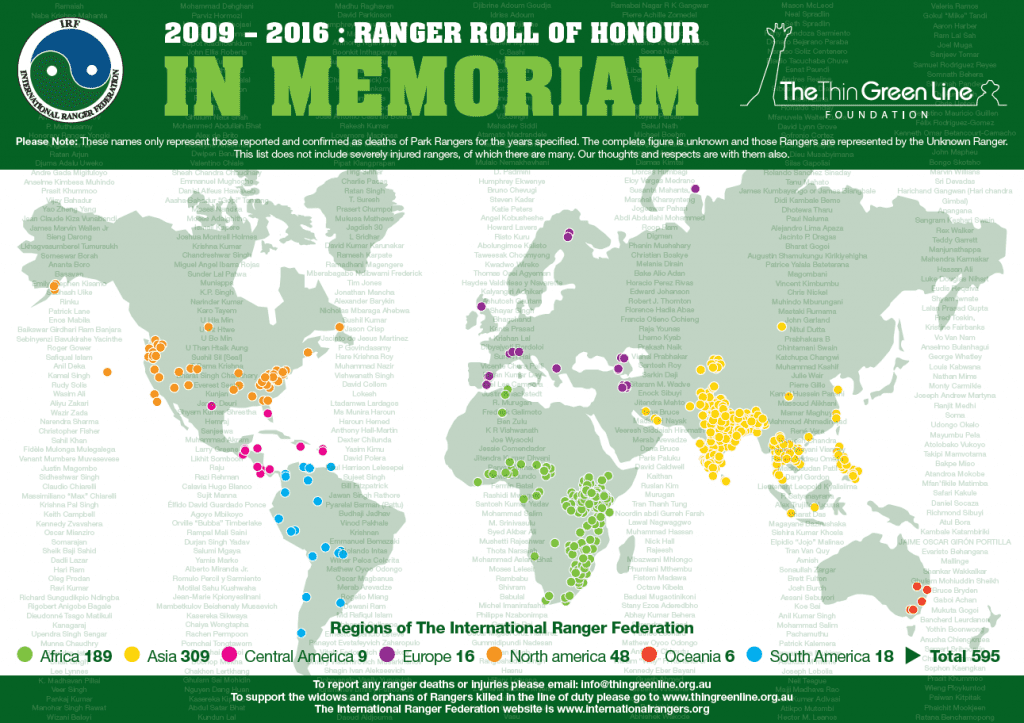
All over the World, Rangers dare their lives to protect our biodiversity. Unfortunately, in the last 12 months, 108 rangers lost their lives in the hands of poachers (42%), in work related accidents (41%) and 17% by the same animals rangers protect.
On the World Ranger Day, this Sunday, 31st July, pause for a moment and reflect on these rangers and their sacrifice. The celebration of the World Ranger Day 2016 aims to honour them and their colleagues that are still bravely undertaking their role in the field.
Stand with the rangers
 Print the poster “Stand with the Rangers”, and show you stand with Park Rangers of the world in their fight to protect wildlife! Take a picture of you holding the poster and share it on your facebook, twitter and instagram with the #tags:
#worldrangerday #standwithrangers #naturesprotectors #thingreenlinefoundation #internationalrangerfederation
You can also share it directly ion the facebook pages of the International Ranger Federation and the Thin Green Line Foundation.
How to celebrate?
Apart from your social media shares, there are several ways of celebrating this special day:
- If you are a Park, why don’t organising a small excursion?
- Light a candle and observe a minute’s silence for Rangers who have died in the line of duty.
- Plant a tree as a living tribute to Rangers around the world.
- Host a screening of the international Ranger documentary The Thin Green Line.
- Talk with park visitors and partners about the work of Rangers around the world.
- Host a public event dedicated to the work of Rangers around the world.
- Make a presentation to local communities about supporting Rangers and protected areas.
- Visit a school to engage young people in the future of world parks, biodiversity, and conservation.
- Invite a Ranger from another park to join you and your co-workers for a week in your park.
- Seek donors interested in supporting and sustaining the work of your protected area and the IRF.
- Write an article for your local newspaper about Rangers and the significance of World Ranger Day.
- Award Rangers in your association who have made a special contribution to protected areas.
- Lobby your state or national government to establish a National Ranger Day.
Have fun! Celebrate your role in protecting the world’s natural and cultural treasures.
Below you can find all the resources you need to celebrate the day. For more information about the World Ranger Day go to:
Bioenergy and Protected Areas – mind the gap
Forest © Stefan Stefancik
Five European Parks (in Austria, Hungary, Slovenia, Italy and Greece) showcased how protected areas can play a leading role in finding solutions for bioenergy production at local-scale, that simultaneously ensure biodiversity conservation. The BioEUParks project, co-funded by the Intelligent Energy Europe Programme of the European Union, introduces a wealth of possibilities for Parks to boost circular bioeconomy within their regions. During 3 years, parks developed and implemented 7 models of small-scale supply chains for solid biomass, harvested from sustainably managed forests within the Parks’ area and working with the local authorities, entrepreneurs and forest owners.
Bioenergy in Europe
The success of the European Union’s renewable energy policies during the past decade is unquestionable, with an increase of over 50% share on renewable energy. Bioenergy makes up to 60% of EU’s current renewable energy use and more than 90% of the renewables in the transport sector, as biofuels.
According to the EU Staff working document (State of play on the sustainability of solid and gaseous biomass used for electricity, heating and cooling in the EU), biomass has an important role in meeting EU renewable energy targets. The possibility of storage and ability to be converted in the highest peeks of energy demand makes it an attractive source of energy. Biomass is especially important in countries where other renewable energy sources are not strong enough.
Despite the policy focus on “a sustainable use of biomass for energy purposes”, the current situation is leading to unsustainable changes in land and forest management. Earlier this year, 10 environmental NGOs have introduced relevant policy recommendations for bioenergy policy – “Pitfalls and Potentials – The role of bioenergy in the EU Climate and energy policy post 2020”, and they refer that
it is crucial to consider that bioenergy is also a source of carbon emissions and can cause a number of other undesirable environmental and social impacts, such as biodiversity loss.
María Gafo Gómez Zamalloa, from the EU DG Environment and Rural Development, referred during the BioEUParks International Conference that “it is important to remember two important numbers: 50% of Natura 2000 is forest (so it’s the most important land use in Natura 2000) and over 50% of the total renewable energy sources is bioenergy. So, how is it possible to combine these two numbers? I think that the BioEUParks project is a good example of winwin situations that could lead to fulfil these two objectives”.

Bioenergy in Protected Areas
Protected Areas overlap most of the Natura 2000 network. They are the main guardians of Europe’s nature and have already implemented (in some cases) forestry management actions, especially in areas where there was an active land use in the past. According to Petter Loffler, from the DG Environment, Unit Agriculture, Forest and Soil, “1/5 of European forests are Natura 2000 sites, and half of Natura 2000 is forests”. During the BioEUParks International Conference, Mr. Loffler referred the need to “not undertake activities that deteriorate the protection purposes or work against them (…) and yes, you can manage forests and you can extract biomass to some degree from many Natura 2000 areas forests.”
BioEUParks project borns to answer to a crucial question: how to match nature and biodiversity conservation with sustainable exploitation of woody biomass for energy purpose?
The starting point is to change perspective when looking at the bioenergy policy: nature conservation and the preservation of ecosystems and biodiversity must come first. At the same time, this choice implies a new way to see the Parks’ role, not only as the body in charge of managing natural areas, but also as a key actor in trigger new ways of local development, that can match nature conservation with social and economic growth.
The development of supply chain models were based in 4 clear characteristics:
1) Short Range from the place where the biomass is harvested to the final user, in order both to minimise the carbon emissions and ensure the quality of the biomass used for energy production;
2) Small-scale and domestic plants
Promote local investment in local plants under 1 MW of power for thermal energy production, or the investment in biomass boilers installed in public buildings (parks and municipalities’ premises, schools, gyms or other leisure time facilities) or private houses. This represents a key element for protecting both ecosystem and landscape.
3) Local engagement
The building of a biomass plant, in particular in areas of high natural value, represents a critical element. It concerns local inhabitant for the impact of the plant in terms of air and soil pollution and landscape degradation. The engagement of local inhabitants, economic actors and policy makers in the process represents the only way to build consensus. Local actors must be the first priority of the process: raising their awareness on the opportunity deriving from the sustainable exploitation of the solid biomass and agreeing with them sustainability criteria and social-economic commitment of the supply chain.
4) Sustainable Forest Management
Sustainable Forest Management and sustainable biomass exploitation criteria should be mandatory assets for the establishment of supply chains. Forest management for biomass production can also reduce fire risks, as the amount of waste being landfilled will decrease, and it opens a possibility to use subproducts of conservation activities, such as the removal of invasive species.
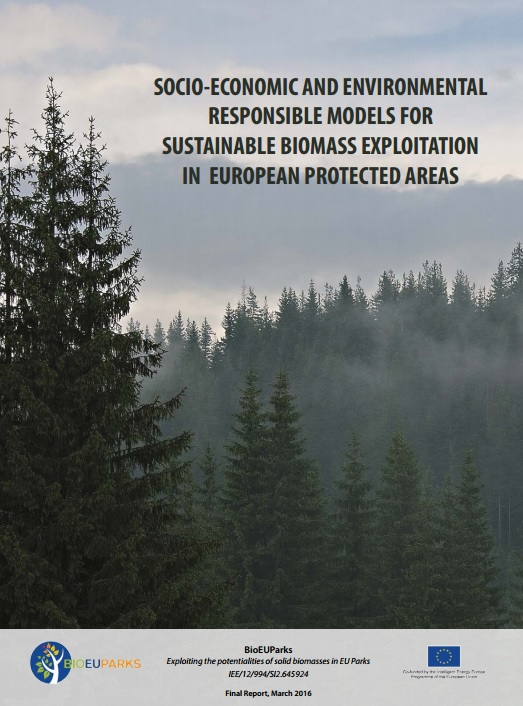 The report Socio-Economic and Environmental Responsible Models for Sustainable Biomass Exploitation in European Protected Areas is a comprehensive resume of the project, covering the main challenges, results and the models developed by the 5 parks- Download it here.
For technical procedures on how to develop and implement a sustainable supply-chain download the document Steps in setting up wood biomass production chains in protected areas.
Learn more about BioEuParks mainstreaming International Conference, that took place in Brussels on the 3rd March 2016. The Conference gathered representatives of the EU Institutions, Environment NGOs and Business sector and further contributed to the debate on Bioenergy policy. Presentations and a final report can be found there.