Periurban Agricultural Parks for climate change mitigation in the Mediterranean
Parc Agrari Baix Llobregat, Barcelona, Spain
EUROPARC was in Palermo, Italy, at the 3rd Edition of the Mediterranean Environmental Festival “festAmbiente Mediterraneo”, organised by Legambiente – the largest environmental NGO in Italy.
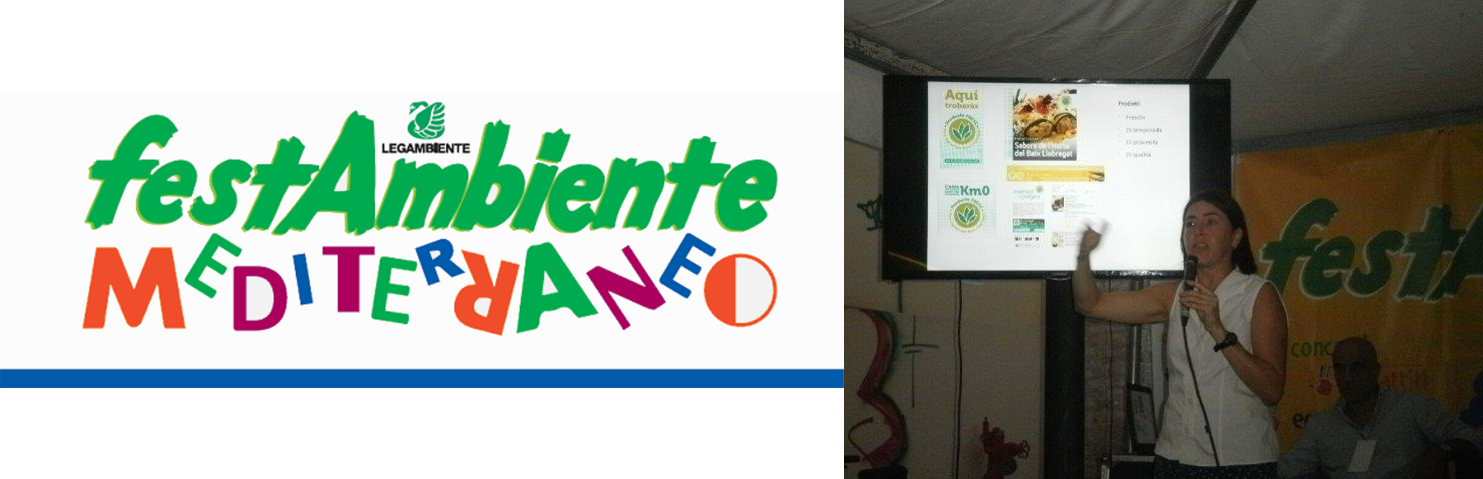
Teresa Pastor, EUROPARC Project and Policy Development Manager, participated in the debate “The Mediterranean and the challenge of an agriculture able to adapt to climate change and to strengthen local communities and jobs”. Teresa talked about the important role played by the typical Mediterranean agro-forestry mosaic in biodiversity conservation and introduced the concept of Periurban Agricultural Parks, as a means of preservation of productive agriculture in metropolitan areas, where agricultural land is vanishing in favour of urbanisation.
The debate, that took place on the 17th September, was conducted by Giuseppe Barbera, professor at the University of Palermo and the conclusions were drawn by Mimmo Fontana, coordinator of Legambiente Southern section. Other interesting keynote speakers showed perspectives from across the Mediterranean area:
– Ali Abaab from Alternatives Tunisia highlighted the important social role played by agriculture in Tunisia (10% of the active population) and showed his concern about the lack of water, a resource that is further diminishing with climate change.
– Camile Derioz, from France Nature Environnement, thinks that cooperation is needed between the North and South Mediterranean shores. Countries in the South already know how to adapt to global warming. In the North, agriculture land should be reorganised into multifunctional areas and turn into sustainable production.
– Khalifa El Ksseyer, from Assocation Eau et Energie pour Tous – Marroc, pointed to the lack of (clean) water as one of the more pressing problems, which is exacerbated by climate change. Due to lack of rain, there is a deficit in cereal crops.
Legambiente has promoted the constitution of the Environmental Alliance for the Mediterranean , an alliance between non-profit environmental organisations from Mediterranean countries. The act was closed by an interview to Antonello Cracolici, Agricultural Councellor of the Sicilian Region.
 On Saturday 17th September morning, within the same Festival framework, it also took place a Meeting of Federparchi – EUROPARC Italy, chaired by Giampero Sammuri.
Fitness Check of Birds and Habitats Directives – Findings and Report.
The Fitness Check Process
At beginning of the year, the European Commission started an evaluation process of the current Birds (1979) and Habitats (1992) Directives, known as Fitness Check. These two directives constitute the basis of European Conservation Policy and, after several decades since their adoption, it is paramount to know if they are still “fit for purpose”.
The Fitness Check is then a retrospective evaluation developed within the Regulatory Fitness and Performance Programme (REFIT). Its specific objective was to assess through a broad consultation process the Effectiveness, Efficiency, Relevance, Coherence and the Added Value of the Birds and Habitats Directives.
Main Findings
Today, the study has been finished, and the general conclusion is that the Directives have generated many important benefits for nature conservation and sustainable development. Furthermore the costs of implementation are reasonable, and outweighed by the benefits, although they do impact some stakeholders more than others. To end with, the evaluation shows that the Directives are “fit for purpose”, and the slower progress made is not caused by the legislation itself but by its implementation.
Effectiveness
Although considerable progress has been made, the measures taken are not yet sufficient to meet the overall aims of the Directives. Nonetheless, the Directives have reduced pressure on biodiversity, slowed declines and led to some recoveries of habitats and species. On the other hand, it seems that the Directives alone cannot deliver the EU’s biodiversity targets without complementary action at EU and national level, and the availability of funding seems to be the strongest factor that conditions their implementation.
Efficiency
The Directives have enhanced funding for nature conservation in the EU. However, these funding remains been insufficient across the EU and constitutes a major barrier for achieving the Directives objectives.
Relevance
The Directives provide an efficient framework to address the key problems faced by habitats and species in Europe. The most frequent pressures on European protected habitats and species are linked to habitat loss, fragmentation and degradation resulting from land use change, especially from agriculture. On the other hand, stakeholders agree that the Directives’ aims and overall approach are still valid and appropriate, and that the Annexes should be further updated.
Coherence
Both Directives are internally coherent and with each other, although some differences in scope and wording of specific and operational measures exist. Furthermore, the integration of nature and biodiversity within various EU funding programmes seems to not to be clear, especially those referring to Common Agricultural Policy (CAP) and Cohesion Policy. The causes for this rely on the priorities set at national and regional levels and on the fund-raising capacity of the stakeholders.
EU added value
Due to the transnational character of nature, actions taken at EU level are considered as the most effective way to achieve the conservation objectives of the Directives. Likewise, it has been proved that the Directives have introduced innovative changes and have harmonised standards of protection and requirements within Europe in a way that could have not been done by implementing a patchwork of differing regulations across the continent.
For extended information, read the Evaluation Study to support the Fitness Check of the Birds and Habitats Directives.
The Health and Social Benefits of Nature and Biodiversity Protection
Social and health benefits of Nature
Life in the city
With seven out of ten people living in urban areas, a big part of our society is exposed to different impacts derived from the high population density and technology use. These impacts affect to our health at physical and psychological level alike, leading to an important expenditure on healthcare resources. However, scientific evidences exist on the role that nature can have in palliating the negative effects related with urban life style. Away from being the solution to these problems, interaction with nature is an effective way of preventing diseases derived from them.
How Nature can help?
Air and noise pollution, are the foremost causes of illness in our society. Whilst air pollutants induce respirational and cardiovascular diseases, excessive noise level causes sleep disturbance and stress. Likewise, low physical activity levels, mental diseases, social exclusion and inequalities are matters of great concern in urban areas that affect a significant part of the population. In this regard, the interaction with nature has been pr0ved to be benefitial both in the recovery of certain diseases and on improving the overall health status of city inhabitants. This way, green infrastructures reduce the exposure to air pollutants and reduce noise propagation, and natural areas provide citizens with places to reduce their obesity, improve their mental health and develop social inclusion opportunities through volunteering programs and jobs.
Workshop on The Health and Social Benefits of Biodiversity and Nature Protection
Last January, EUROPARC representatives participated in the Workshop on Health and Social Benefits of Biodiversity and Nature Protection, providing case studies and advise. The objective of this study, which was promoted by the Institute for European Environmental Policy, was to analyse and document the scientific evidence behind the benefits of nature protection and biodiversity conservation.
The report of this study is already available, and includes extended information on the health and social benefits of nature along with recommendations on how the EU can contribute to promote them. Read the whole report here.
A new partnership for Sustainable Tourism
Sustainable Tourism
Sustainable tourism is one of the core areas of the EUROPARC Federation and we are proud to announce that a new partnership agreement has just been signed with the Tourism for Tomorrow Awards. The Tourism for Tomorrow Awards is an initiative led by the World Travel & Tourism Council that annually recognises organisations who “ensure the long-term sustainable growth of the tourism industry”.
EUROPARC President, Ignace Schops, emphasises that
EUROPARC and the Tourism for Tomorrow Awards share a common view for tourism in Europe: green, sustainable and with positive impacts in the local livelihoods. More than that, we both know that working in partnership is the best way to develop tourism sustainably.
With this agreement, EUROPARC strengthened its relation with the World Travel & Tourism Council and enlarge the visibility of both awarding schemes for sustainable destinations. In other hand, all the Sustainable Destinations and respective Partners that have been following the European Charter for Sustainable Tourism in Protected Areas standards, have here a good opportunity to have world wide recognition of their work!
Sustainable Tourism in Protected Areas: a 20 years journey
Tourism is a booming business and Parks are, more than ever, epicentres of touristic activities. EUROPARC has long recognised the need to take care of both the land and the people who live and work there, and make tourism an opportunity that is “Good for Parks, Good for People”.
When, in 1993, the Federation published the ground breaking report “Loving Them to Death”, was far to imagine that, 23 years after, there would be over 150 sustainable destinations in Europe awarded with the European Charter for Sustainable Tourism in Protected Areas (ECSTPA). The ECSTPA is a practical management tool that enables Protected Areas to develop tourism sustainably, by working in partnership with all local relevant stakeholders. During the process, the local community, enterprises and Park authorities develop a common vision for the territory and implement an action plan towards achieving higher quality and sustainability in their touristic offer. The award, given by EUROPARC, recognises not just a commitment to sustainable tourism but also the implementation of practical sustainable actions by public and private partners.
To learn more about the European CharterforSustainable Tourism read the manual “Good forParks, Good for People”.
Good for Parks, Good for People – ECST benefits, conditions and guidelines
Tourism for Tomorrow Awards
The WTTC Tourism for Tomorrow Awards is aimed at recognising best practices in sustainable tourism within the industry globally, based upon the principles of environmentally friendly operations; support for the protection of cultural and natural heritage; and direct benefits to the social and economic well-being of local people in travel destinations around the world.
Candidates can apply to one of the 5 categories: Community, Destination, Environment, Innovation and People. Applications are open until the 14th November and are free of charge. Both profit and non-profit organisation can apply. Read here the Rules and Guidelines to apply and some useful information here.
EUROPARC encourages all Sustainable Destinations and Partners working with the ECSTPA to apply and get world wide recognition!