“Periurban Parks, their place in EU policies”: EUROPARC presented its position paper
A position paper highlighting the importance of Periurban Parks in a large variety of different EU policies has been presented at the last EUROPARC General Assembly, during EUROPARC Conference 2019 in Latvia.
At the EUROPARC General Assembly during the Conference 2019 in Latvia, the Periurban Commission launched a position paper highlighting the important role that Periurban Parks play in a large variety of different EU policies – not only on the most obvious environmental ones such as biodiversity and green infrastructure, but also on climate, agriculture, health, urban, sports and culture.
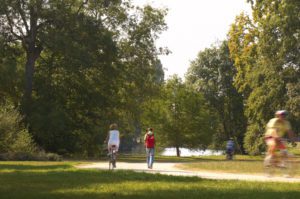
Arche de la Nature, Le Mans
This position paper will be disseminated among the recently elected EU Parliament and among different DGs of the newly appointed EU Commission – DGENV, DG CLIMA, DG AGRI, DG SANTE, DG EAC, DG RTD, DG REGIO.
The aim of this position paper is:
- To make policy-makers and the general public realise that Periurban parks can help in dealing with many of the different challenges faced today by cities, such as climate change, mental and physical health and social issues.
- To make local authorities actively involved in the protection of the remaining valuable nature in the city’s vicinity and so derive the many benefits Periurban Parks can bring.
- To make the EU and national and regional authorities recognise the contribution of Periurban Parks to biodiversity protection, ecosystem services, agriculture, health, urban and cultural agendas with appropriate financial, legal and political engagement.
Periurban Parks are Protected Areas – including Natura 2000 sites – located in the vicinity of cities. They are wilder, substantially larger and with more biodiversity than most common urban parks. This is why they can deliver multiple services like clean air and temperature control, fresh water, food and timber production, and habitats for biodiversity, while at the same time they provide citizens with cultural green spaces for recreation, education and outdoor sports in a healthy natural environment.
EUROPARC currently gathers several Periurban Parks serving some medium and large European cities:
The full position paper can be downloaded here: Periurban Parks and EU policies_EUROPARC Position Paper
This position paper has been prepared by Teresa Pastor, EUROPARC staff member coordinating the Periurban Commission and Carole Ritchie, the executive director. The Periurban Commission was formed right after the integration of FEDENATUR within EUROPARC Federation. It is currently formed by Marià Martí, managing director of the Collserola Natural Park in Barcelona; Riccardo Gini, managing director of the North Milan Park in Milano; Alberto Girani, managing director of the Parco di Portofino in Santa Margaritha de Ligure; Fernando Louro Alves, counsellor of the Monsanto Forest Park in Lisbon; and Anne Huger, managing director of the Arche de la Nature in Le Mans.
10 Good Principles for Outdoor Sports in Protected Areas
On the occasion of the 2019 European Week of Sports, the EUROPARC Federation and the European Network of Outdoor Sports (ENOS) launched simultaneously the 10 Good Principles for Outdoor Sports in Protected Areas (PAs) during their respective Conferences. These Principles aim to promote good conduct among outdoor sports practitioners.
This is the result of a fruitful cooperation of both associations and the first outcome of the Memorandum of Understanding signed last year by EUROPARC and ENOS.
10 Good Principles for Outdoor Sports in Protected Areas
The exponential growth of sport activities in protected natural spaces brings the necessity to structure the way these activities are carried out. At a time when preserving our ecosystems is vital to guarantee a healthy future of nature and people, the Principles aim mainly to lower the impact of outdoor sports on the environment.
Furthermore, these 10 Principles for Outdoor Sports guarantee the maintenance of quality and bring added value to the activities, an aspect that benefits all stakeholders in the sports sector.
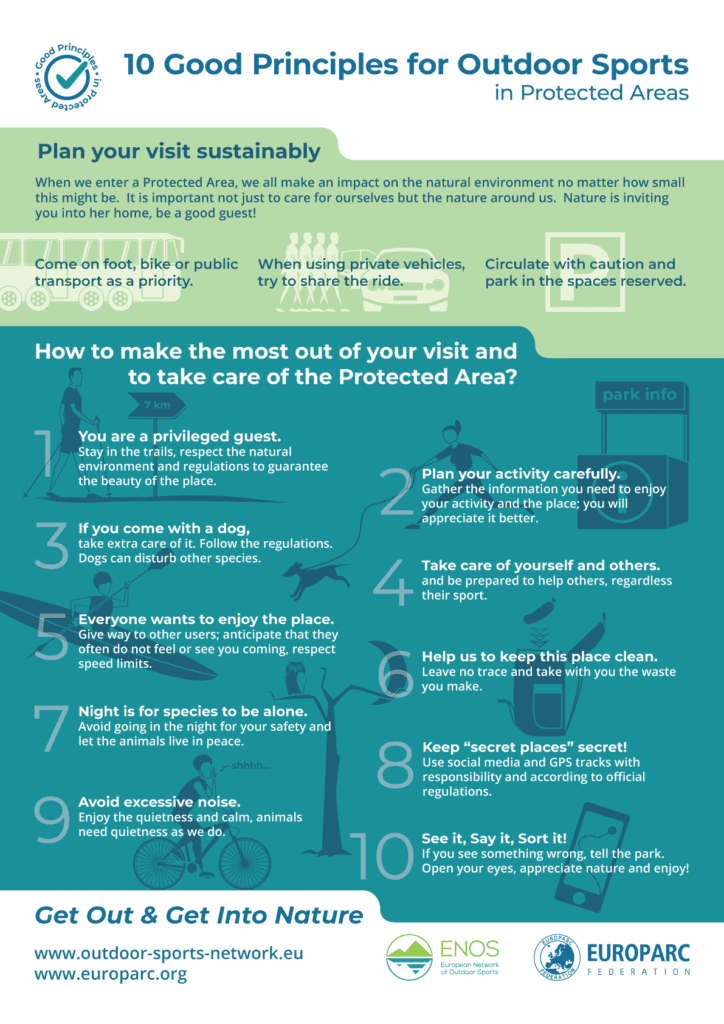
The principles encompass the entire process – from getting to the Protected Area to the delivery of the sport activity itself. Therefore, the interpretation of these principles needs to be carried out in an integral way.
As guests in these natural spaces, we will inevitably create an impact. It is our responsibility to minimise harmful effects, so that we can continue enjoying nature in a harmonious way.
These 10 Good Principles for Outdoor Sports in Protected Areas are the first joint outcome of cooperation between two organisations after they signed the Memorandum of Understanding during the EUROPARC Conference 2018 at Cairngorms National Park in Scotland. More actions will follow to implement the ENOS Charter through a Task Force that integrates the work of both organisations.
Endorse the 10 Good Principles
Now that you know how the principles work, the next step is to back them up. How? It’s very simple! Here are a few examples:
- Show the 10 Good Principles on your website. Visitors who prepare their trips will be better informed.
- Disseminate information on social media. Use your network to spread the word!
- Use your visitor centre to show and talk about the principles during the visits.
- If you organise or participate in an outdoor sports event, make sure participants know the principles before the activity starts.
- When working with young people, teach them and highlight the importance of respecting these principles. Five minutes of teaching can develop into many years of good practice.
- Talk and spread the word to anyone interested, in any way. All diffusion is important!
Remember that although it may be obvious, this behavior when practicing outdoor sports is not so widespread. Any collaboration from your part is very important to treasure our natural heritage.
The 10 Good Principles for Outdoor Sports will soon be launched in different digital formats and languages so that they can be better adapted to the context of each Protected Area. We will also prepare communications material that you can personalise with your Park’s photos and share with your visitors.
The next step in the project will be to go deeper into each sports discipline in order to create principles that are more related and applicable to each activity.
Now it is your turn! Let us know which sports you find the most interesting and important to focus on. Or, contact us with any other suggestion! You can send us your suggestions to a.robles @ europarc.org
Download the 10 Good Principles as a leaflet or a poster
Friends of Protected Areas throw a youth environmental festival
Environmental education Centre “Zapovedniks” organizes the International Forum of the Friends of Protected Areas. It will take place in Russia, Petrozavodsk, between 23 and 26 September 2019.
International Forum as an environmental festival
For the first time, Friends of Protected Areas (FPA), EUROPARC’s youth member association uniting over 600 000 participants from all over Russia, holds their International Forum in the form of an environmental festival. The gathering takes place in Petrozavodsk, the capital of Karelia region bordering Finland, from 23 to 26 September 2019. Running simultaneously to EUROPARC Conference, the General Assembly in Latvia will organize a live video call to get to know their youth counterparts and wish them a fruitful rally.
 The Forum, organized by the Environmental Education Centre “Zapovedniks”, aims to foster environmental education of children, youth and adults, and to build public awareness on Protected Areas (PA) system. One of the main objectives of the event is to build a common platform for cooperation, share environmental information and experience, and encourage youth to actively lead the way to a sustainable future.
Involving the youth
In the same spirit as EUROPARC’s Youth Manisfesto, the FPA sees the importance of scaling up environmental education and giving youth a voice in tackling environmental issues. This year, the Forum will be held in the framework of the “Decade of Childhood”, declared by the President of the Russian Federation for the years 2018-2027.
The FPA movement aims to educate young and adult people through their involvement in the nature conservation and awareness on Protected Areas.
This year’s special and massmedia guests include, among others, Arctic and Antarctic explorer Dr. Artur Chilingarov, or astronaut Sergey Ryazansky.
Since 2001, the team has organized 6 FPA forums on different places in Russia. The forum is a large-scale environmental education event that gathers active youth, their mentors, protected areas educators and many others who care about nature of our Planet, friends of PAs, including PA volunteers, representatives of responsible business, and others.
For more information and the full programme, visit http://slet.wildnet.ru/.

The Bern Convention celebrates its 40th anniversary
Today, the Bern Convention turns 40 years old. To celebrate this remarkable date, a new campaign was launched to highlight the most inspiring results of 4 decades working for the preservation of nature.
Healthy nature for healthy Europeans
The Bern Convention, first signed on 19th September 1979, was the first international treaty to protect both species and habitats. Today, it celebrates its 40th anniversary with a slogan “Healthy nature for healthy Europeans” and a big awareness campaign.
The initiative reviews the achievements of the Convention through 40 inspiring stories which highlight the essential value this treaty brings for the conservation of our natural heritage.
40 inspiring stories of nature conservation
From helping save the few remaining leopards in the Caucasus to fighting invasive alien species or actively involving citizens in the protection of the environment, the actions of the convention have been turned into engaging stories that are available through the interactive website www.bernconvention40years.com. This initiative highlights the wide reach and long-term objectives of the convention, which has 51 Contracting Parties in 2019.
The campaign encompasses four main pillars of action:
- Protecting biodiversity to maintain the delicate balance between the species in our ecosystems. This is exemplified by results such as the Plan for the Conservation and Recovery of the Osprey, which is helping to bring back this bird to the skies of Southern Europe.
- Tackling environmental challenges such as climate change, invasive species and harmful human activities. The Convention contributes to this ambitious mission with initiatives like Not Alone, a campaign to raise awareness about the key role of biodiversity in counteracting climate change.
- Raising public awareness and actively involving citizens in the protection of our natural heritage. An example of this is the complaint system of the Convention that allows every citizen to raise their voice and report harmful actions against the environment. Since the implementation of this system in 1984, nearly 200 signals and complaints have been processed.
- Preserving our natural habitats and their vital role in hosting numerous species of animals and plants. As a remarkable example, the Emerald Network is an ecological network put forward by the Convention that includes over 3200 areas of special conservation interest in fifteen countries.