Empowering Youth through UNESCO’s MAB Programme by Marla Schulz
Empowering Youth through UNESCO’s MAB Programme
The article below is written by Marla Schulz, EUROPARC Youth Council Member from 2023 – 2025. Her engagement with EUROPARC began at the 2023 Conference in Leeuwarden while she was an intern at Nationale Naturlandschaften (EUROPARC Germany). During this time, she was active in setting up a Youth+ group for young people interested in biosphere reserves in Germany and running peer-to-peer capacity building workshops. She recently took on a full-time position at NNL and helped select the next cohort for the Youth Council.
My Perspective on the Hangzhou Strategic Action Plan and its relevance for other young people
My name is Marla Schulz, I am 28 and from Germany, and I have been actively involved in the UNESCO Man and Biosphere (MAB) Programme for several years. This programme is an interdisciplinary, intergovernmental programme with the overarching goal of sustainable use of the biosphere’s natural resources. I work to strengthen youth engagement both nationally, through Germany’s Jugendnetzwerk Biosphäre e.V. (Youth Network Biosphere), and across Europe, via the EuroMAB Youth Network.
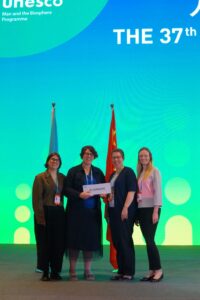
The German MAB delegation attending the 37th World Congress of Biosphere Reserves in Hangzhou, China
Last year, I had the unique opportunity, through my position as youth representative on the MAB National Committee Germany, to participate in the World Congress of Biosphere Reserves in Hangzhou, China. This once-in-a-decade gathering brings together the World Network of Biosphere Reserves (WNBR) to set priorities for the next ten years. At Hangzhou, the new Hangzhou Strategic Action Plan was adopted, defining how the WNBR will operate until 2035. What excites me most is Action Target 20, which specifically focuses on youth.
Action Target 20 aims to strengthen youth networks at national, regional and global levels, secure funding for youth activities, and create opportunities for young people to actively participate in decision-making at all levels of the MAB programme – from local Biosphere Reserves to international advisory bodies. By 2030, the plan envisions youth networks across all continents and 150 youth trained annually in skills that allow them to contribute meaningfully. By 2035, it aims for young people to have a stable voice in all MAB structures, ensuring our perspectives shape the future of biosphere reserves.
Youth networks in the MAB Programme are structured nationally and regionally. In Europe, we have the EuroMAB Youth Network; in other regions, networks include AfroMAB Youth, AsiaPacificMAB Youth, IberoMAB, and the ArabMAB Youth Network. Since September 2025, UNESCO has called on every country to appoint a National Youth Focal Point. Many countries have already implemented this, for example, Germany now has me as a National Youth Focal Point, a young person officially linking national youth activities to UNESCO. The aim is that these focal points, together with biosphere reserve youth representatives, are building strong networks for collaboration, learning, and action within their country.
Biosphere reserves can support Action Target 20 by creating spaces for young people to participate in committees and thematic networks, fostering skills, and ensuring that youth voices influence local management decisions.
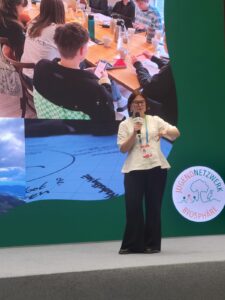
Marla Schulz speaking at side events throughout the event
This is not only vital for participation but also helps retain young talent in the region and nurtures future leaders. National committees can further integrate youth representatives into international meetings, such as the MAB ICC or regional conferences like EuroMAB conference 2026 in Canada. Strong support from UNESCO, tailored capacity-building programs, and inclusive opportunities at all levels are essential to make this work.
Looking ahead, 2026 brings the 3rd Global MAB Youth Forum in Italy. Here, young people from across the world will come together to exchange experiences, build skills, and plan collaborative actions. For me, Action Target 20 represents an incredible opportunity: young people must take initiative, learn from each other, and shape their networks – while biosphere reserves, national committees, and UNESCO provide guidance and support. Together, we can ensure youth are a driving force in the future of the MAB Programme.
For those biosphere reserves in the EUROPARC network, we hope you are inspired empower young people within your areas and connect them with the EUROPARC Youth Community. Any questions can be directed to our youth officer, Jessica Micklem-Kolenić.