Master’s Programme Management of Conservation Areas: Applications Now Open!
Lake Weissensee in Carinthia © FH Kärnten, CUAS
The prestigious “Management of Conservation Areas (MCA)” master degree programme is now open for applications again at Carinthia University of Applied Science in Austria. Starting September 2024, 22 coveted openings are available for students worldwide. This successful programme promises inspiring learning experiences in 21st-century nature conservation. EUROPARC is a long-standing member of the Advisory Board of the Master’s programme.
About the Master Programme
Conservation areas, such as national parks, heritage sites and biosphere reserves, represent Earth’s most beautiful and valuable landscapes. In this international master degree program, students learn to effectively plan and manage such areas, harmonizing biodiversity protection with local interests. The curriculum imparts extensive expertise and diverse personal and technical skills.
Most students already have years of experience in the sector, whether in park management, administration, NGOs, or consulting firms. Through engagement with international peers, outstanding trainers, teachers, and researchers, students reflect on, and develop their experiences. This allows graduates to apply acquired skills to exciting career paths.
The programme, offered at the UNESCO Chair for Conservation Area Management at Carinthia University of Applied Sciences, emphasizes applied research and technology. Close collaboration with UNESCO, international conventions, institutions, universities, and various conservation areas ensures a cutting-edge curriculum. The concept of research-based teaching provides students with the latest scientific insights.
Tailored to the needs of international professionals, the programme blends intensive on-site courses, including visits to various conservation areas, with flexible online elements.
Further information about the programme and registration can be found on the webpage here.
Take the opportunity to find out more about the MCA in a personal discussion with the scientific director, CUAS Prof. Dr Michael Jungmeier. The virtual info sessions will take place on:
- Tuesday, 27th February, 05.00 PM CET ONLINE via MS Teams
- Tuesday, 19th March, 05.00 PM CET ONLINE via MS Teams
- Tuesday, 23rd April, 05.00 PM CET ONLINE via MS Teams
- Tuesday, 28th May, 05.00 PM CET ONLINE via MS Teams
- Tuesday, 25th June, 05.00 PM CET ONLINE via MS Teams
Please register for this by emailing Melina Hierländer:

You can also follow the UNESCO Chair on Sustainable Management of Conservation Areas on LinkedIn here.
New EUROPARC Podcast on Dynamic Dune management in The Netherlands!
In this podcast, EUROPARC’s Communciations Manager Esther Bossink is joined by Myrthe Fonck of PWN. Together they explore an innovative project in The Netherlands that revitalised the dune landscape in National Park Zuid-Kennemerland, The Netherlands. The podcast was recorded end of 2023.
Making dunes mobile again!
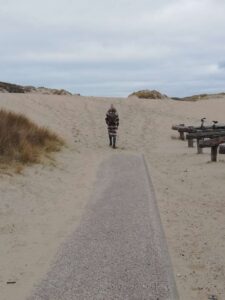
Myrthe Fonck on a sand covered bicycle lane, Zuid-Kennemerland. By Neil McIntosh
Over 10 years ago, the Dutch Dune Revival project set out to bring natural dynamics back into the dunes. These coastal areas in The Netherlands are unique. Typically, the dunes are very broad and stretch almost along the entire coastal line. Furthermore, the Dutch dunes are of great importance for the grey dune habitat — also on a European scale.
However, as the main function of dunes became coastal defence, dunes were ‘fixed’ by the planting of marram grass. This prevented wind, sand, and salt to shape the dunes and create dynamic, natural processes. As a result, the dune areas degraded and biodiversity suffered.
So, how to solve this in a country that has 26% of its land located below sea level, without risking the coastal safety? Ecologists in National Park Zuid-Kennemerland came up with a seemingly contradictory plan: create five large openings within the first row of dunes. Opening up the dunes this way allowed sand to blow into the dune system and allowed for natural processes to take place again and rejuvenate the area.
Over 10 years later, the results are in: healthy, resilient and ‘moving’ dunes, where biodiversity thrives. Recreating these natural processes even helped combat the nitrogen deposition in the area, which is one of the main threats to nature in The Netherlands.
Learn more about this Nature-based Solution where different actors came together to create a better result for nature and for people, in this new episode of EUROPARC’s podcast “Voices from the Parks”.
You can also find us on Spotify!
Future-proofing the Dutch dune area
In National Park Zuid-Kennermerland, PWN strives to create natural spaces that are future-proof. The dynamic dune management improves biodiversity, but also supports the area in adapting to climate change. If you want to learn more about climate change adaptation s methods in the Dutch dunes, check out this Climate Talks episode, created within the LIFE Natur’Adapt project.
 EUROPARC Podcasts ‘Voices from the Parks’ is funded by the European Union. Views and opinions expressed are however those of the author(s) only and do not necessarily reflect those of the European Union or CINEA. Neither the European Union nor CINEA can be held responsible for them.
Out now: EUROPARC’s Protected Areas In-Sight Vol. 15!
The Protected Areas In-Sight is EUROPARC’s annual journal, which follows the theme of the EUROPARC Conference. Discover the latest edition now! Available in English, French and German.
50 years of nature superpowers
The Protected Areas In-Sight, aims to inspire its readers with success stories from across the EUROPARC Network. Collating these stories, connecting the people behind them, and showcasing Protected Areas as centres of excellence to the wider public is something that EUROPARC has been doing for 50 years.
What has become apparent having reflected upon the 50 years of EUROPARC’s work, are the latent Superpowers within the Protected Area community

Carol Ritchie
writes EUROPARC’s Executive Director Carol Ritchie in the Magazine’s editorial.
The 2023 edition of our Protected Areas In-Sight explores many of the Superpowers that our network holds. Guided by the Conference theme “Tribute to our Landscape: Where nature and people meet in Harmony”, over 14 articles from guest authors across Europe showcase how Protected Areas are building trusting relationships within their communities, creating change and sharing a vision for a sustainable future.
Powered by the EUROPARC Community
As always, the Protected Areas In-Sight would not exist without the dedication of our network! In this edition, you will find articles from:
- Rewilding Europe on the ‘Wilder Parks’ initiative;
- National Park Weerribben-Wieden on their new national campaign;
- Youth voices, and their experience at the EUROPARC Conference;
- Foreste Casentinesi National park on restoring forests between history, landscape, ethics and nature;
- NORRØN Architects, on developing destinations through co-creation;
- Pasvik-Inari Transboundary Area, on the lessons learned from their 30+ year cooperation;
- The UNESCO Chair for Sustainable Management of Conservation Areas at the Carinthia University of Applied Sciences, on Nature for Peace.
- The Nature Regional Landscape Parks Task Force, on their declaration on Climate Change Adaptation and Mitigation.
Furthermore, interesting insights from the LIFE ENABLE and Horizon Europe NaturaConnect projects explore what is needed for nature conservation that is future-ready.
Of course, we could not let our 50th Anniversary pass by silently! In the magazine, you will also find special articles detailing our history, the interactive EUROPARC Storybook and much, much more.
Discover it yourself! You can flip through all three versions here:
If you’d prefer to download the Protected Areas In-Sight, we invite you to check out our digital library, where you can also find all previous editions.
EUROPARC members will receive a physical copy of the Protected Areas In-Sight in the upcoming weeks.
The publication of the Protected Areas In-Sight is co-funded by the European Commission. Views and opinions expressed are however those of the author(s) only and do not necessarily reflect those of the European Union or CINEA. Neither the European Union nor CINEA can be held responsible for them.
EUROPARC Podcast: Young people involved in nature restoration
In this podcast, EUROPARC’s Youth Officer, Jessica Micklem-Kolenic interviews three young people involved in Nature Restoration: Livia Wright from the North York Moors National Park Young Rangers and Youth Voice Committee, Søren Thomsen from the European Young Rewilders, and Giulia Testa from the youth coalition which led the youth advocacy efforts on the EU Nature Restoration Law. Listen to their experiences in the episode below