SoilSparks – Mobilising our Youth+ Community to create a new educational campaign
A short introduction and update of the SoilSparks Project run by Bantani Education and the EUROPARC Federation.
SoilSparks – Mobilising our Youth+ Community to create a new educational campaign
Why Soil, and why Citizens?
Soil represents the very foundation of life as we know it. Its rich diversity is mirrored in the various ecosystems it nurtures, ranging from lush primary forests to resilient Mediterranean coastal flora. Soil plays a crucial role in sustaining human existence by providing essential resources for agriculture, serving as grazing land, and enabling the growth of food and other vital materials. Yet, it rarely features in public environmental debate in the way that air or water quality do.
SoilSparks treats this gap as a citizenship issue rather than only a scientific one: if soil health is to improve, people need to understand, think and act in their own communities. Young people are best placed to create momentum for change.
Furthermore, soil is an intricate world in its own right, housing a complex web of inorganic and organic elements. It plays a critical yet frequently underestimated role in the natural cycle of life, facilitating decomposition and the recycling of nutrients that are essential for the health of our planet.
What is SoilSparks?
SoilSparks is about young people co-creating the SoilSparks initiative, to mobilise 1,000+ young Europeans to become SoilSparks Champions – taking real world action for soil. This project is empowering youth from across Europe to co-create a campaign and learning programme transforming soil science into engaging bite-sized challenges – leading young people into innovative digital micro-learning and real-world actions. Led by EUROPARC and involving its junior ranger and Youth+ network, alongside Bantani Education, specialists in entrepreneurial learning, SoilSparks will run for 18 months and is part of the Horizon Europe SOILSCAPE project to build bridges between soil science and society through artistic means.
What has been done so far?
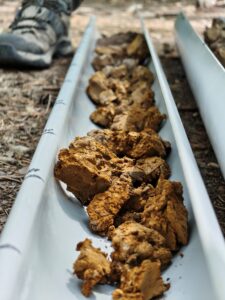
Photo credit: Alberto Madrassi
The first stage of the project has just completed, with young people active in the EUROPARC Federation’s youth networks actively consulted and included in the project. In March, 30 young people from 23 countries were invited to be upskilled on soil science through an online, self-paced summer school programme. This group included almost 30% neurodivergent youth, with ages spanning 18 – 30 years old, and with backgrounds from soil scientists to art students and everything in between.
The young people completed a series of 8 self-paced modules covering the EU Mission Soil and Co-creation processes accessed through a youth-friendly digital learning platform called Learncast. This tool allowed on-the-go learning and each module included audio bits, quizzes, writing tasks and sent the students out to do a hands-on activity. In addition, the students had an online space to introduce themselves, access resources and post their own learning journeys. They also come together once a week for an online session where guest experts were invited to share a snippet of their experience and spark discussion in the group.
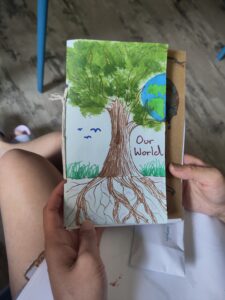
Photo credit: Anna-Sophie Kloppe
After a month of learning, 28 young people came together in Reims, France, for a 5-day co-creation camp. The aim of this camp was to continue to strengthen relationships already formed, learn about current conservation methods with a field trip to Montagne de Reims regional park, explore their creative expressions, and co-design challenges to be included in the final educational campaign. This was a resounding success with participants sharing the roles of learning and teaching, shaping the direction of the work rather than responding to a fixed brief. Young people worked hard to transport the project team into the minds of the current youth generations.
Photo AlbumHow does this translate expertise into public engagement?
The project deliberately routes scientific and institutional knowledge through young people rather than delivering it to the public directly. Soil scientists, EUROPARC staff and Bantani Education, supported by University of Hohenheim and EIT Food, provide the underlying expertise and validate content for accuracy, while the young participants translate this into messaging and challenges designed to work for their peers. This process is intended to keep the science sound while making the final content genuinely usable and valuable for a non-specialist audience.
What is in the planning for the next stages?
The second stage of the project is to design the final educational campaign. The young people are invited to continue working on the project by joining the Youth Panel, and the experts from the summer school and more are joining a Science Panel, assessing the educational components and ensuring it is easy to understand and the latest up-to-date knowledge.
The campaign will launch on World Soil Day on the 5th December 2026 and the young people will help with its promotion, as almost each of them is connected to a volunteer youth group active in a Protected Area or with interests in nature conservation, geology or art. An educational toolkit will be produced alongside the campaign and shared with teacher networks connected to EIT Food, a collaborating partner.
The final educational campaign will be designed for young people aged 16 – 30 years old, in line with EU GDPR and digital safety, and will not only increase awareness on soil and its context in Europe, but will also drive actions that inspire discussions leading to changes in behaviour. Added value comes from mapping the micro-challenges to GreenComp and EntreComp, and using these competences as evidence within SoilSparks digital credentials to recognise the actions taken by SoilSpark Champions.
What is the impact beyond the project?
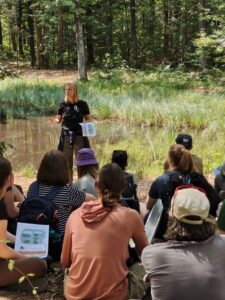
Photo credit: Alberto Madrassi
The project has clear goals in terms of inclusive co-creation as well as a list of outputs ranging from teacher toolkits, the educational campaign platform and a non-formal educator training for Protected Area staff and other youth educators. All education outputs will be fully mapped to GreenComp and EntreComp. More widely, there are also many intangible outcomes of the project.
The 30 young people participating in the design of the campaign have all undergone an intensive training on the topic of soil, as well as developed friendships across countries. Almost each of them is connected with a youth group actively volunteering in a Protected Area.
Going forward, they are going to share these experiences with their youth groups and strengthen ties between groups leading to a more empowered and connected international community. They will continue to inspire new young people to volunteer, actively engage and participate in such opportunities. However, these are also young people who are highly likely to enter green careers. Considering that the topic of soil conservation is often overlooked in the Protected Area sector, this project will be the spark of new discussions and upskilled young professionals entering this sector and pushing for increased efforts to safeguard this important system.
This project is part of the broader Horizon project SOILSCAPES and is funded by the European Union and the Swiss Confederation.

Binational Junior Ranger Olympics at the Wiese Landscape Park in Switzerland
Group Photo of the 10th Swiss Junior Ranger Olympics. Photo: Jocelyne Bernet.
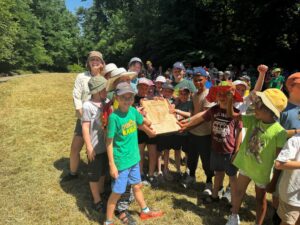
The winning Junior Rangers team from the Black Forest Biosphere Reserve with the challenge cup. Photo: Wiese Landscape Park Ranger Service.
In glorious weather on the 20th June, around 200 Junior Rangers from Germany and Switzerland put their knowledge and skills to the test at the 10th Swiss Junior Ranger Olympics in the Wiese Landscape Park. For the first time – and entirely in keeping with the spirit of the cross-border Wiese Landscape Park – the event was organised as a binational competition. The Junior Rangers from the Black Forest Biosphere Reserve secured a narrow victory
Once a year, the Swiss groups meet for the nationwide Junior Ranger Olympics to tackle various challenges in teams and complete tasks in the great outdoors. At this year’s tenth edition of the event, 18 groups were out and about in the Wiese Landscape Park, tracking animal trails, building drinking water filters, solving tricky tasks in the forest and decorating the landscape park with land art installations. A unique feature of this year’s event was the participation of Junior Ranger teams from Baden-Württemberg.
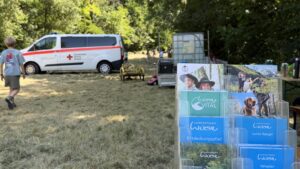
Essential: water supplies and the German Red Cross. Photo: Silvan Aemisegger
The entire ranger team at the Wiese Landscape Park was involved in preparing and running the event. Martha Koelbing, a ranger at the Wiese Landscape Park, says: “Due to the high temperatures, we had to move the locations of individual checkpoints into the woods or into the shade at short notice. With temperatures soaring to 33 degrees, we also had to ensure there was plenty of drinking water and ways to cool down. Otherwise, the event would not have been feasible. In addition, a team from the Weil am Rhein-Haltingen branch of the German Red Cross was on standby at the venue.”
Johann Thieme, a ranger at the Wiese Landscape Park and responsible for the Junior Ranger programme, is very pleased with how the day went: “What stood out in particular was the high level of motivation among the Junior Ranger teams. We also succeeded in integrating site-specific topics, such as drinking water production and the praying mantis, into the scavenger hunt, thereby giving the participating teams an insight into our day-to-day work in the Landscape Park.”
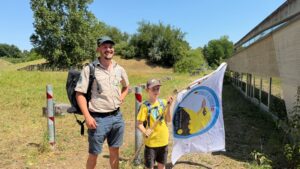
Johann Thieme, Head of the Junior Ranger Programme at Wiese Landscape Park. Photo: Silvan Aemisegger.
Through the ‘Junior Ranger Programme’, ranger services in Germany and Switzerland offer a nature-based environmental education programme for children aged between 7 and 15. This helps to inspire children and young people’s enthusiasm for nature and raises their awareness of its conservation and value. Junior Rangers meet ten to twelve times a year in fixed small groups on afternoons when school is out to explore nature in the protected areas, accompanied by a trained ranger. In doing so, they learn about the interconnections in nature and experience exciting adventures. They thus become ambassadors for landscapes, habitats and protected areas in their region.
The Landschaftspark Wiese Junior Ranger programme has been a member of the EUROPARC Junior Ranger network since 2022 and is run by the Swiss Ranger Service. For more information about the happenings of the Swiss Junior Rangers and Young Rangers, check out their website which hosts blogs and more!
Podyjí and Thayatal National Parks Undergo Transboundary Re-evaluation
National Park Thayatal, picture by Claudia Ebner
How does transboundary cooperation work in practice? For Podyjí National Park in Czechia and Thayatal National Park in Austria, this question was at the heart of a three-day EUROPARC Transboundary Parks re-evaluation visit in July 2026.
A closer look at transboundary cooperation
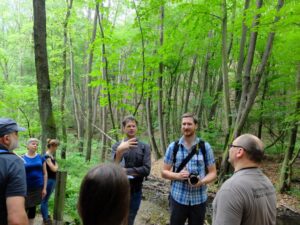
Picture by S. Petrosillo
The EUROPARC Transboundary Parks Programme recognises Protected Areas that work together across national borders to conserve shared landscapes and ecosystems. Re-evaluation is an important part of this process, which happens after five years.
During a re-evaluation, an independent verifier reviews the progress made since the previous assessment. The process looks at the Programme’s Basic Standards and considers both the structures supporting cooperation and the practical work carried out by the partner Protected Areas.
Podyjí National Park and Thayatal National Park have worked together across the Czech-Austrian border for more than 25 years. Their cooperation covers nature conservation, research, environmental education, visitor management and many other areas. The re-evaluation provided an opportunity to look at how this cooperation has developed and how it is being implemented on the ground.
For Podyjí and Thayatal, the 2026 verification visit took place from 6 to 8 July 2026. It brought together representatives of both National Parks, the verifier and local stakeholders.
Meeting & field visits
The verification combined discussions with direct observation in the Protected Area.
The first day focused on presentations and discussions with park staff about transboundary cooperation. This was followed by a field visit in Thayatal National Park, including the Umlaufblick viewpoint and cross-border visitor infrastructure. A stakeholder meeting then brought together representatives from both sides of the border, including local authorities, scientists and representatives of civil society.
The second day moved to Podyjí National Park. The programme included field visits focusing on landscape management, visitor pressure and practical conservation measures. These included prescribed burning, semi-natural grazing and coppice forest management. The visit concluded with a discussion between the verifier and representatives of both parks.
This combination of meetings, stakeholder discussions and field observations is an important part of the re-evaluation process. It allows the verifier to consider not only what is described in documents, but also how cooperation works in practice.
Cooperation across one shared landscape
Podyjí and Thayatal are separated by an international border, but they form part of the same ecological landscape. Their cooperation is supported by a Joint Management Plan for 2021–2030 and an agreement setting out common goals, management principles and the framework for cooperation.
During the visit, the parks presented examples of cooperation in several areas.
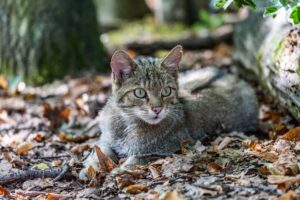
Wild cat. Picture by C. Ebner
Joint biodiversity research and monitoring are an important part of their work. The BioReMo project, for example, aims to improve monitoring, data exchange and cooperation between the two parks. Other projects address habitat restoration, connectivity and invasive alien species.
Cooperation also extends to ranger services. The parks organise joint ranger activities each year, creating opportunities for staff from both countries to work together in the field and communicate with visitors across the border.
Environmental education and public engagement are another important element. School groups, adult groups and visitors can take part in activities involving both sides of the Protected Area, supported by multilingual information and shared educational materials.
Listening to partners and stakeholders
Transboundary cooperation goes beyond the two park administrations.
Stakeholder participation is built into the management structures of both National Parks. During the re-evaluation, representatives of municipalities, scientific institutions, civil society and the National Parks met to discuss the partnership and its future.
The discussion also looked beyond current activities. Participants were invited to consider what transboundary cooperation could look like in ten years. Ideas included stronger joint research, harmonised data systems, closer cooperation between staff and continued efforts to reduce language barriers.
Such discussions are valuable because transboundary cooperation is not only about today’s management priorities. It is also about building a shared vision for the future.
What happens after the verification visit?
The site visits are one element of the larger verification process.
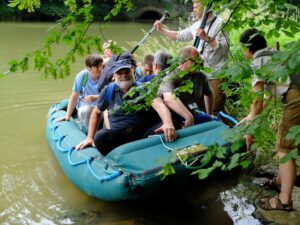
Picture by S. Petrosillo
Following the visit, the verifier prepares a report assessing progress against the EUROPARC Basic Standards. The report is then part of the wider EUROPARC assessment process, with the relevant bodies considering the outcome before a final decision on the award.
For this reason, the detailed conclusions of the 2026 re-evaluation will be communicated only once the formal process has been completed.
What can already be highlighted is the value of the re-evaluation itself: it provides an opportunity for both Protected Areas to reflect on their cooperation, discuss achievements and challenges, and consider how their partnership can continue to develop.
For Podyjí and Thayatal, more than two decades of cooperation provide a strong foundation for looking ahead.
The international border may divide the two National Parks administratively, but their cooperation demonstrates the importance of managing shared ecosystems together.
The next step will be the formal consideration of the re-evaluation within the EUROPARC process.
Nature as infrastructure for health: what citizen science and green spaces reveal about human well-being.
Monitoring in the Netherlands, Gabrielle Nunes
Health and nature are intrinsicly linked. This guest article details how contact with nature influences our well-being. Written by Gabrielle Nunes
Gabrielle Nunes has a PhD in Applied Ecology from the University of São Paulo, Brazil, with a sandwich period at Wageningen University and Research, the Netherlands. She is a data and science coordinator at ApplyBrasil, managing projects such as MapBiomas, and Conservation Specialist at WWF.
Nature as infrastructure for health
In an increasingly urbanised world, where daily life is often detached from ecological processes, a growing body of research is reframing nature not as a luxury, but as essential infrastructure for human health. Across different regions of the world, studies have shown that contact with natural environments can support emotional well-being, reduce stress, strengthen social connection, and even contribute to physiological health.
At the same time, Protected Areas are being asked to respond to increasingly complex challenges. Beyond biodiversity conservation, they are also becoming spaces linked to public health, education, tourism, and community engagement.
Two recent studies from my PhD research contribute to this discussion. One synthesises international evidence on the health benefits of contact with nature, while the other explores these relationships through a citizen science case study in the Netherlands. Together, they suggest a simple but important idea: when people experience nature meaningfully, both people and Protected Areas benefit.
The broader evidence: green spaces and health across regions
One of the studies[1] explored a broad international question: how does contact with nature influence human well-being across different environmental and cultural contexts?
To investigate this, the research conducted a scoping review based on an international database of 211 scientific articles focused on green spaces and mental health. After applying selection criteria related to biodiversity observation and interactions with natural environments, 67 studies from multiple countries were analysed in depth, including research conducted in Japan, the United States, the United Kingdom, Finland, Australia, China, Sweden, and other regions.
Despite the diversity of landscapes and methodologies, the findings revealed a remarkably consistent pattern. Overall, 94% of the analysed studies reported positive effects associated with contact with nature. These included reduced stress and anxiety, improvements in mood and cognitive restoration, and physiological responses linked to relaxation and overall health. Importantly, none of the reviewed studies identified negative effects resulting from interactions with natural environments.
94% of the analysed studies reported positive effects associated with contact with nature.
The review also highlighted an important distinction between passive and active interactions with nature.
Passive experiences included activities such as walking through parks or green areas without a specific focus on biodiversity. Active interactions involved intentional engagement with the environment through activities such as birdwatching, ecological interpretation, or attentive observation of landscapes and species.
Both forms of interaction were associated with positive outcomes. However, studies involving more intentional engagement with biodiversity frequently reported stronger effects related to emotional restoration, environmental awareness, and positive affect.
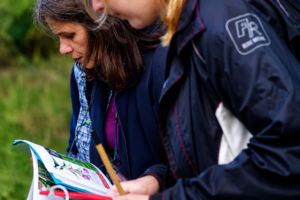
Monitoring in the Netherlands, Gabrielle Nunes
Some studies also identified physiological benefits, including improvements in indicators associated with cardiovascular health, such as reductions in blood pressure, cortisol levels, and heart rate. At the same time, the literature suggests that these effects are shaped by multiple interacting factors. In many cases, benefits may emerge not only from contact with nature itself, but also from physical activity, sensory immersion, attention restoration, and social interaction taking place within natural environments.
This distinction is particularly relevant for Protected Areas. It suggests that these landscapes offer more than scenic beauty or recreational opportunities. They create conditions for experiences that combine movement, attention, biodiversity, and emotional restoration in ways that are increasingly relevant for public well-being.
Protected Areas create conditions that are increasingly relevant for public well-being.
Yet access to these benefits remains uneven. In Brazil, for example, only 6.9% of urban areas are covered by vegetation, highlighting how opportunities for contact with nature are often unequally distributed.
From observation to connection: engaging people through citizen science
While the literature review revealed global patterns, a second study sought to understand how these benefits emerge in practice through direct participation with biodiversity monitoring.
In the Netherlands, a small-scale citizen science study explored how participation in plant monitoring activities could influence the emotional well-being and connection to nature of older adults[2]. The initiative focused on biodiversity observation as an accessible form of engagement with nature, encouraging participants to carefully observe and monitor plant species in their local environments.
To better understand these experiences, the research combined questionnaires and semi-structured interviews conducted before and after participation. The study examined changes in emotional well-being, vitality, and nature connectedness using standardised scales such as the Positive and Negative Affect Schedule (PANAS), the Inclusion of Nature in Self (INS), and the Nature Relatedness Scale (NRS).
Although the group was small, mostly composed of women over 60, the results revealed meaningful changes. Participants reported higher levels of positive emotions such as joy, enthusiasm, and satisfaction after engaging in the monitoring activities. At the same time, emotions associated with stress and psychological discomfort, including anxiety, irritation, and sadness, decreased significantly according to the PANAS scale. The study also identified a measurable strengthening in participants’ emotional and cognitive connection with nature.
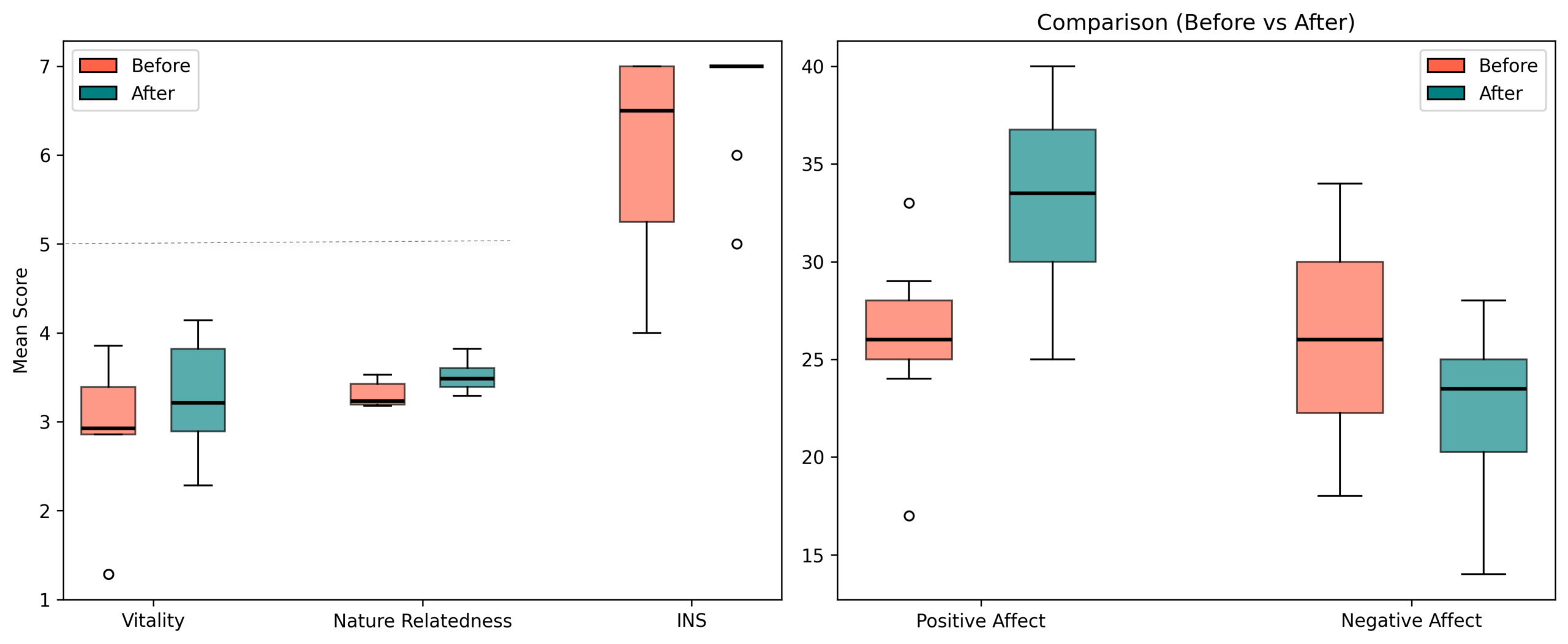
Boxplots from monitoring activities in the Netherlands. Click to enlarge.
What emerged from the interviews was equally revealing. Many participants described the experience as an opportunity not only to learn more about biodiversity, but also to reconnect with the environment in a more intentional and meaningful way. Some expressed a growing sense of contribution to conservation, while others highlighted the pleasure of paying attention to details in nature that often go unnoticed in everyday life.
These findings suggest that citizen science can offer something beyond data collection. By encouraging attentive interaction with biodiversity, participatory monitoring may help strengthen emotional bonds with nature and foster conservation awareness among participants.
Citizen science can strengthen emotional bonds with nature and foster conservation awareness among participants.
While this empirical case was conducted in Europe, it is part of a broader research agenda that also engages with Brazilian realities, where citizen science and nature-based activities are increasingly being explored as tools not only for data collection, but also for social inclusion, environmental awareness, public participation, and public health.
This dual geographical perspective highlights an important insight. Although cultural, institutional, and environmental contexts differ, the human response to meaningful interaction with nature shows remarkable consistency.
Implications for Protected Areas: a shared opportunity
For Protected Area networks such as EUROPARC, the cross-country perspective of this research offers a valuable takeaway: the role of Protected Areas extends beyond conservation boundaries and national contexts.
Whether in the Netherlands or Brazil, these spaces can function as:
- Platforms for citizen engagement and science
- Catalysts for health and well-being
- Arenas for strengthening human–nature relationships
However, realising this potential depends on moving beyond passive access. While simply being in nature already generates benefits, the research shows that active engagement, such as citizen science, deepens both well-being outcomes and environmental awareness.
From global evidence to local action
A recurring lesson across both studies is that the value of nature becomes most powerful when it is experienced, not just measured. Across continents, from European monitoring programmes to Brazilian discussions on ecotourism and urban green space, the message converges: investing in nature is also investing in people.
But the next step is more ambitious. It requires designing Protected Areas not only as places to visit, but as places to participate, learn, and connect. Because when people actively engage with nature, whether in a Dutch meadow or a Brazilian forest, they are not just observing biodiversity, they are reconnecting to it.
References:
[1] NUNES, Gabrielle Abreu; SOLDADO, Emerson Barão Rodrigues; LINDENKAMP, Teresa Cristina Magro. Can observing nature improve human well-being? Opportunities for Ecotourism. Brazilian Journal of Ecotourism, [S. l.], v. 18, n. 1, p. 83–98, 2025.
[2] Nunes, G.; Soldado, E.B.R.; Buijs, A.; Magro, T.C. Impacts of citizen science on well-being among older adults: Insights from a small-scale study. 4th World Conference on Forests and Parks for Public Health, Luxembourg, 2025.