Climate change, nature recovery and collaboration on the agenda of AONB’s Annual Conference
Credit: Suffolk Coast Destination Management Organisation
On July 11th, EUROPARC was warmly welcomed by the National Association for Areas of Outstanding National Beauty during the AONB’s Annual Conference: Landscapes for Life, in Colchester, United Kingdom. EUROPARC was invited to facilitate a workshop and present the work done in the LIFE Natur’Adapt project on climate change and protected area management. It was a collaboration opportunity that the EUROPARC Federation was more than happy to seize.
Landscapes for Life and climate change adaption
EUROPARC project manager, Olivier de Sadeleer, presented the preliminary results of the LIFE Natur’Adapt survey. This survey helped defining the baseline of the Natur’Adapt project, which is a 5-year experiment aiming at integrating climate change into protected area management practices as a collective process. It was well received by AONB managers as they could take inspiration from what was being done in terms of climate change adaptation across Europe. The discussion also highlighted the potential benefits of developing a climate change adaptation approach for protected areas and nature.
On top of sharing the first results of the LIFE Natur’Adapt project, attending this conference was an opportunity for EUROPARC to learn more about AONB Network’s work and ambitions. Through a number of discussions and exchanges with participants, keynote speeches and the collaborative drafting of the Colchester Declaration, we could feel the energy and willingness that is shared by the EUROPARC Federation, to move forward boldly to tackle the global challenges underlying species mass extinction and climate change.
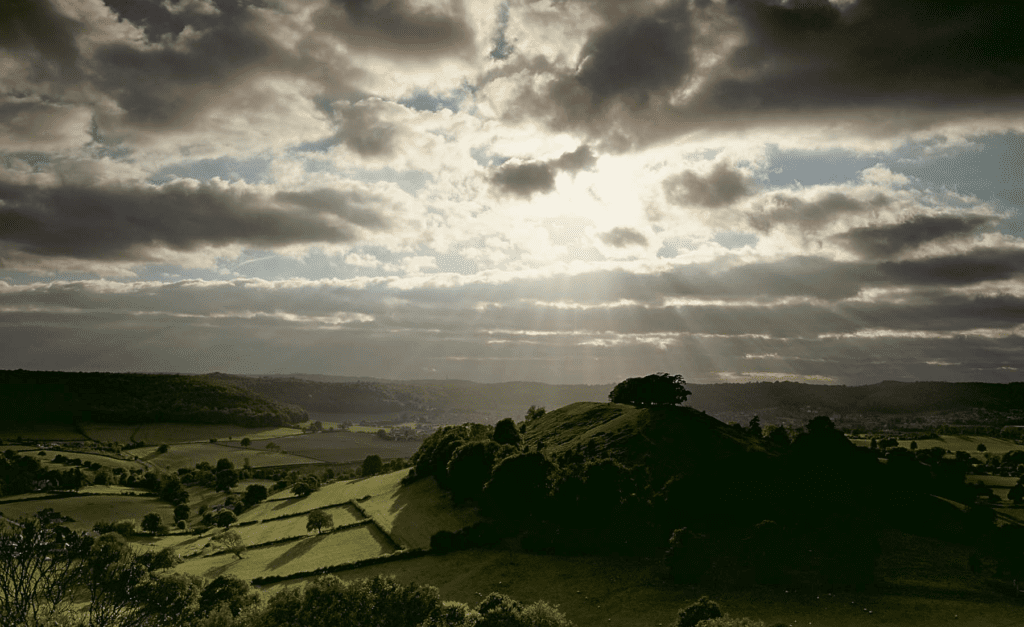
The UK Areas of Outstanding Natural Beauty (AONB) are exactly what it says they are: outstanding landscapes whose distinctive character and natural beauty are so precious that it is safeguarded in the national interest. Credits: Costwolds AONB, photo by the Countryside Agency ©Nick Turner
Thoughts from AONB’s Annual Conference 2019
Among others, Nigel Dudley, Co-Founder of Equilibrium Research reminded us of the importance of integrating and publicising protected area’s contribution to meeting the objectives of international agreements such as United Nations Convention to Combat Desertification or the Paris Agreement.
Jules Pretty, Professor of Environment and Society at the University of Essex shared enthusiastically the latest results of his research, which measured the concrete benefits that nature and protected areas have on people’s health.
Craig Bennett, Chief Executive Officer at Friends of the Earth added
conservation professionals need to step up in the fight against climate change – as nature loss and climate change are actually two symptoms of the same global systemic crisis.
EUROPARC was honoured to witness and give its contribution to this collaborative effort. This chance to support the development of pan-european exchanges and potential future collaborations for area-based conservation was very energising.
As Howard Davies, Chief Executive Officer of NAAONB puts it: “Now is the time to harness our collaborative skills and knowledge and our technical understanding of landscape, our power to convene, and our ambition to deliver. This conference and the coming Colchester Declaration are major milestones to accelerate nature conservation and recovery in the UK and in Europe”.
Useful Links
- About National Association of Areas of Outstanding Natural Beauty:
https://landscapesforlife.org.uk/ - Landscape for Life 2019 conference::
https://landscapesforlife.org.uk/events/l4l-conference-2019/introduction - About EUROPARC:
https://www.europarc.org - LIFE Natur’Adapt:
https://www.europarc.org/about-us/europarc-projects/naturadapt/
What do you know about “Biological Field Stations”? – The OBFS Conference for the 1st time in Europe
CMK. Center For Environmental Sciences - Photo: Hasselt University
Get to know about the Organisation of Biological Field Stations (OBFS) a non-profit international network with more than 50 years of experience supporting their members maximizing diversity, inclusiveness, sustainability, and transparency, in a special conference host by EUROPARC member Hoge Kempen National Park in Belgium.
For the first time in Europe…
From the 9th to the 13th of September, the Hoge Kempen National Park (Belgium) will host the yearly conference of the Organisation of Biological Field Stations (OBFS), organised by the Field Research Centre Hasselt University. OBFS has the mission to help member stations increase their effectiveness in supporting critical research, education, and outreach programs and their annual Conference is a gathering of field stations managers and researchers,
- What? Yearly Conference of the Organisation of Biological Field Stations (OBFS)
- When? 9-13 September 2019
- Host: Field Research Centre Hasselt University
- Where? Maasmechelen, Zetellaan 52 (and Home Fabiola Maasmechelen)! Group accommodation in a Field Station setting.
- Who? Field station directors and managers (and researchers)
- Expected number of participants: 130 pp (70% USA; 30% Europe, South-America, and Africa)
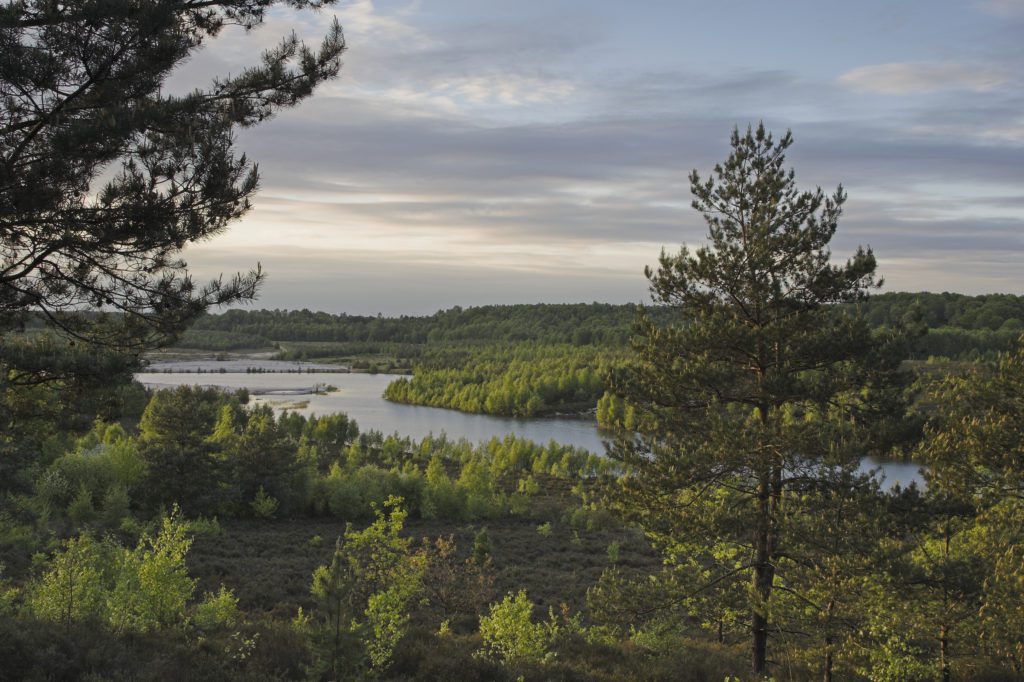
Kikbeek Valley – Hoge Kempen National Park
But what are “Biological Field Stations”?
Spread throughout the world, the Field Stations serve as living libraries or outdoor laboratories aiming to understand natural processes at every scale, from the molecular to the global, from milliseconds to eons. They depend upon the support and involvement of the community- formed by students, researchers, and the general public interested in the environment.
Field stations are places where we can read the book of life in the language in which it was written.
– James Kirchner, UC Berkeley
Biological Field Stations_brochure
They vary greatly in heir form, extension, and even purpose, but they all share the same commitment to advancing our understanding of the Earth by supporting research, teaching, and public education. The range goes from marine laboratories whose focus is offshore, to terrestrial reserves dedicated to protecting key ecosystems. They serve not only as a research center but also as a scientific education resource.
Field stations play a vital role in the local communities, both encouraging staff, and researchers in taking part in local and regional decisions to make sure the environment is taking into account. And providing facilities and useful scientific data to improve the local knowledge about the environment, supporting governmental and other stakeholders address environmental-related issues.
Don’t miss the date and discover the workshops, field trip and more of this conference in the official Website of the OBFS
Call for applications: Climate Change Task Force
Photo by NASA
CALL FOR APPLICATIONS IS NOW OPEN
Would you like to get involved? By joining this participatory expert group, you will contribute actively to innovating in the field of protected area management, meet other experienced conservation professionals from across Europe and help to tackle climate change challenges both on the ground and in the policies.
If you are interested, please APPLY HERE by September 5, 2019
It will only take a minute and you do not commit to anything for now.
Climate Change Task Force: BACKGROUND
Climate is changing. Should protected area management change too? To address this thorny question, EUROPARC, Réserves Naturelles de France, and eight other partners have come together in a LIFE Climate Action project called “Natur’Adapt”. The vision is that it is possible to transform this challenge into an opportunity to innovate and support positively nature conservation practice.
Natur’Adapt aims at triggering a transition towards the adaptive management of protected areas, while laying the foundations of a dynamic collective learning process.
This 5-year project [LIFE17 CCA/FR/000089] is developed with the support of the LIFE program, the French Agency for Biodiversity and the French Ministry for Ecological Transition. Read more about Natur’Adapt
What is the EUROPARC Climate Change Task Force?
In the framework of Natur’Adapt, we have foreseen the creation of a task force to provide advice during the course of the project and support the emergence of a debate on climate change adaptation at a European level and within EUROPARC’s network.
The Climate Change task force will help Natur’Adapt project team to translate technical needs into a strategic vision for European and national policy makers.
The task force will also provide the baseline for a wider dissemination of results and practical actions for a successful implementation of project outcomes in other European countries.
The task force will be composed of up to 8 participants namely, protected area managers and experts from across Europe, a representative from Reserves Naturelles de France and EUROPARC project manager take care of the coordination.
Why do we do it? [mission]
This Task Force is established as part of the project Natur’Adapt. It is in line with the priorities identified in the EUROPARC Strategy 2015-2021 contributing to achieve the objectives set in priority area 3.4 Climate Change in Protected Areas ( Actions 3.4a and 3.4b).
The main reason to set up this group of expert is:
- To provide advice and bring further expertise within the Natur’Adapt project;
- To contribute to raising awareness among decision makers and EU institutions about Climate Change impact on biodiversity and needs for adaptation strategies;
- To provide guidance and promote action for Climate Change Adaptation within the European network of protected areas.
How do we do it? [workplan]
To achieve these objectives, the Climate Change task force, a participatory expert group, will review and advise the project team at specific stages of the project development and participate to produce a number of communication tools adapted to a European audience.
Practically the task force is planned to meet annually for a 1-day face-to-face working session and to meet virtually when necessary.
Note: Participation to this task force is on a voluntary basis. No financial compensations have been foreseen for the time spent and work done. Travel expenses to and from face-to-face meetings will be covered.
What do we do concretely? [Planned outputs & indicators]
Previous experiences show that setting concrete deliverables and schedule is a must. Here is a working proposal to start with. Deliverables and schedule will be revised with the members of the group once they have been identified.
(Yearly) Produce and publish internally a yearly review of the project deliverables (Exact timing to be aligned with key project’s milestones.
(October 2020) Produce a draft white paper for decision makers (at EU level and local? National?) on how to support nature conservation in a changing climate in Europe, and disseminate it to EU institutions, national MEP and ministers of environment.
(March 2021) Develop the structure and key features of a Climate Change Adaptation toolkit for European protected area managers. The content will be produced and published by the project team and EUROPARC.
(October 2021) Organise and participate in a seminar dialogue with European Institutions (Member European Parliament, DG Envi, DG Clima, DG Agri, DG Growth, Council of Europe)
(Ad hoc) Contribute to Technical Workshops at EUROPARC Annual Conference.
Who is participating? [potential members]
– Up to 6 Protected Area managers and/or conservation/climate change experts
– RNF representative and Natur’Apdapt Project coordinator
– EUROPARC’s project manager who will coordinate the task force (meeting planning, facilitation, reporting, …)
The ideal participant should:
– Be enthusiastic about turning the climate change challenge into an opportunity to innovate and support conservation and restoration of ecosystems in Europe.
– Have experience in or knowledge about: Climate change and protected areas management and/or in climate change vulnerability assessment and/or adaptation planning and/or adaptation measures implementation and/or policy-making at EU or Local Level
– Originate from a European country. Diversity of perspectives is important.
– Be proficient in English is a must.
Note:
– While constituting this expert group priority could be given to EUROPARC and RNF Members
– CVs of group members should be submitted when the request for the establishment of the task force is submitted or soon thereafter.
Frequently Asked Questions
Why does EUROPARC have commissions and other participatory groups?
The EUROPARC Federation is a membership organisation. It exists to serve the needs of its members as they have been identified in the statutes of the organisation and its recently approved strategy.
As part of the Federation governance and structure, we have selected participatory task forces as a powerful tool to involve members, leverage existing knowledge, good practices and networks.
What makes a good group?
Groups working together with a common purpose, are good for people in that they can provide members with important social interaction, support and enriched opportunities for learning.
A well-functioning participation group: can be good at finding problems; promoting innovation; can make better decisions than individuals on some kinds of tasks; can be good tools for implementation, in that group decisions to which members are committed will be carried out willingly; can also help fend off the negative consequences of large organisational size, by keeping communication lines short and hierarchies relatively flat.
How do task forces usually work?
The Chair and the Directorate will agree on specific work plan. This plan would include:
– Strategic theme addressed by the task force & objectives,
– planned outputs over 2 years
– indicators
– potential members if the proposal comes from a group of members,
– resources, and potential sources
– Plan of meetings, schedule of work will be agreed with the Directorate and the group.
How will financial expenses be compensated?
Procedures for eligible expenses and reimbursements will be provided. The Climate Change Task Force activities will be supported with travel and subsistence expense costs within a given agreed allocation, according to with the project budget and LIFE program rules and procedures.
If you are interested, please APPLY HERE by September 5, 2019
It will only take a minute and you do not commit to anything for now.
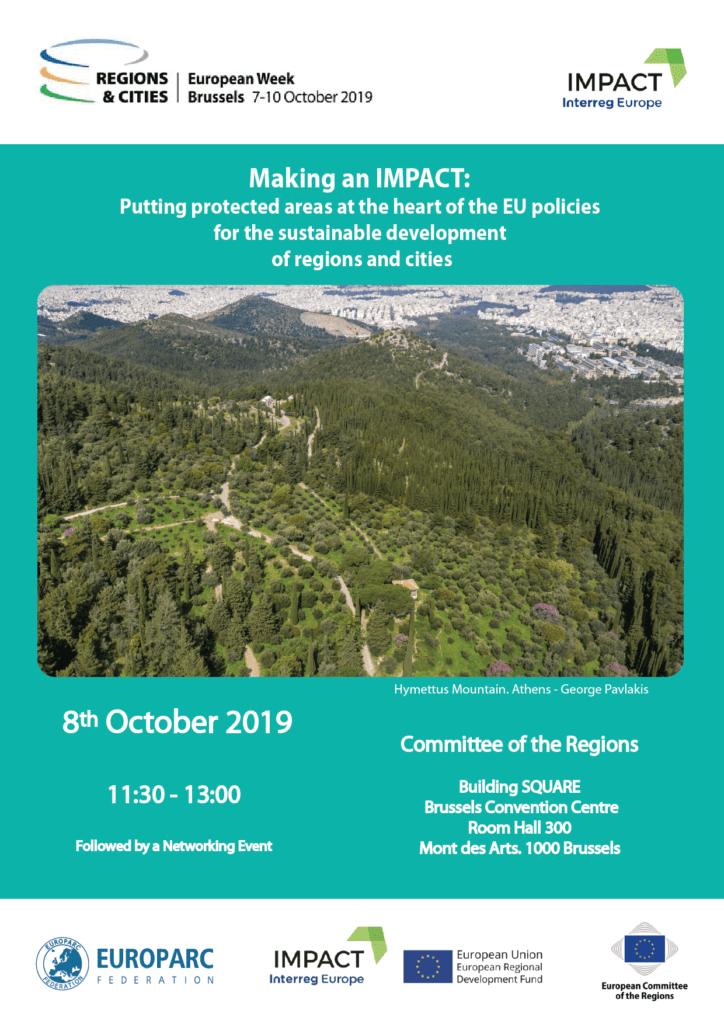
Making an IMPACT: a workshop you can’t miss @ the EU Week of Regions & Cities 2019
Workshop “Making an Impact: Putting protected areas at the heart of EU policies for the sustainable development of regions and cities”
Protected Areas were established to protect and preserve biodiversity and the ecosystem services they provide us, however, that doesn’t make Protected Areas places where human activities are not allowed, in fact, during our whole history, those
human activities have created and shaped the landscapes and ecosystems we see, enjoy and that still today provide us with food, freshwater, and spaces to relax and reconnect with nature.
There are so many human activities that if well-managed can grant benefits for both ecosystems and society: such as creation of green-jobs. That is the aim of the project IMPACT #InterregEurope. To create innovative models for Protected Areas. Thank to the project, many examples of good practices on sustainable development have yet been recorded.
For the European Week of Regions and Cities, we will answer to the question…
What can protected areas do to promote sustainable development in both regions and cities?
During this workshop, we will share the best good practices of IMPACT #Interreg Europe, putting Protected Areas as engines of regional sustainable development. We will hear about innovative ways to involve local stakeholders in socioeconomic activities. We will also learn about a successful protocol to promote sustainable tourism in protected areas. Lastly, we will discover how a Periurban Protected Area can play a decisive role in several EU policies to promote sustainability in urban regions.
The workshop will be followed by a networking session during which the IMPACT partners will share their best good practices and we will further discuss this topic.
Speakers: Jean-Marc Dujardin, Teresa Pastor, Stefania Petrosillo, Javier Soto Vázquez
Partner/s: EUCC – Baltic office, EUROPARC Federation, Espaces Naturels Régionaux, National Institute for Research and Development in Tourism of Romania, Regione Molise
Don’t miss the date, Free registrations are open!
8th of October 2019 – Building SQUARE – Brussels Convention Centre, Room Hall 300
Workshop web here, registrations and further information about the European Week of Regions and Cities also available in the official Website.