EUROPARC Federation and Rewilding Europe to promote wilder parks
Europe’s extensive network of Protected Areas play a vital role in conserving the continent’s natural beauty, flora and fauna. An exciting new partnership between Rewilding Europe and the EUROPARC Federation will help many to create the enabling conditions for wilder nature, delivering essential benefits for people, biodiversity and climate.
Protection and restoration
Protected areas are the backbone of European nature. With more than 120,000 sites designated across Europe, including the 27,000 sites of the Natura 2000 network, such areas cover nearly 1.2 million square kilometres, equating to an area the size of France and Spain combined.
Many of Europe’s protected areas contain unique and frequently awe-inspiring repositories of biodiversity. Yet, simply protecting the nature they currently contain isn’t enough. It’s not enough to halt and reverse biodiversity decline, and it’s not enough to slow and stop climate change. With the geographical extent of such areas so large, there is now a fantastic opportunity to build on the conservation efforts being carried out within them, enhancing the invaluable nature they already contain through rewilding. By focusing on the restoration of natural processes, and working to support and scale up the comeback of European wildlife species that is already happening in many parts of the continent, we can really amplify the benefits such areas deliver, such as clean air, fresh water, and the locking up of atmospheric carbon.
Towards wilder parks

Frans Schepers
In fantastic news for European nature, and for Europeans, a new partnership agreement entitled “Wilder Parks” has just been signed between Rewilding Europe and the EUROPARC Federation – the largest network of European Protected Areas. It will enable Rewilding Europe and the EUROPARC Federation to work together to support and showcase the work of Protected Areas that are already making great progress in restoring nature, and to inspire others, in the wider landscape, to follow their lead. The initiative will help to make the protected areas of the EUROPARC membership, which account for around 40% of the Natura 2000 network, wilder.
“This new partnership has hugely exciting potential,” says Rewilding Europe Executive Director Frans Schepers, who co-signed the agreement with Michael Hošek, EUROPARC President, at our annual Conference celebrating on October 4. “Many European protected areas are already doing a great job in rewilding, but there is wide-ranging scope for others to follow suit. This is where Rewilding Europe can help.”
“I’m delighted to establish this professional cooperation with Rewilding Europe,” adds Michael Hošek.
Michael Hošek
EUROPARC, thanks to its broad and diverse membership base, has significant experience in Protected Area management. We always aim to support our members, and to use measures that are best for protected areas, in collaboration with communities and stakeholders, to enable natural processes to thrive. The cooperation and exchange of experience with Rewilding Europe will benefit both parties.
Letting nature lead
There are a wide range of rewilding measures that Europe’s Protected Areas can employ to create the right conditions for nature recovery. These include allowing forests to naturally regenerate, removing dams and restoring natural water regimes, more natural wildlife management, enhancing natural grazing, leaving carcasses in nature, improving connectivity, reintroducing keystone species, and many more – all with the aim of restoring natural processes and food webs. In conjunction, these measures help to enhance the health, connectivity, functionality and resilience of natural ecosystems. Working with communities and stakeholders across such areas.
The work carried out under the new agreement will include learning from EUROPARC members that are already carrying out rewilding measures, and enabling them to share their knowledge with others. Additional Protected Areas which are keen to apply rewilding principles will be identified, with Rewilding Europe offering them training, resources, and opportunities for knowledge exchange. Access to Rewilding Europe’s European Wildlife Comeback Fund, for example, could help some to start or scale up the reintroduction of keystone species, where appropriate.
Specific activities will be agreed and laid out in a shared work plan which will be finalised next year. These will include the development of joint fundraising proposals, which will aim to secure additional funding for the Wilder Parks initiative.
Meeting commitments
In December 2022, leaders of European countries agreed to adopt the historic Kunming-Montreal Global Biodiversity Framework, which includes a global target to restore 30% of degraded ecosystems globally by 2030. This commitment will contribute to the EU’s own restoration agenda, and obligations of EU Member States under the new Nature Restoration Law, which was approved by the European Parliament in July and is currently in the final negotiation stage.
It’s clear that Protected Areas play an important role in fulfilling the commitments nations made to nature in 2022
says Rewilding Europe’s Head of Upscaling Amy Duthie. “This new partnership, with Rewilding Europe and EUROPARC working together to enable the development of wilder parks, will help to realise a wilder Europe where each country fulfils its biodiversity and climate commitments, for the benefit of both people and nature.”
Want to know more?
European Nature Academy: Apply now!
ARE YOU READY TO BE ENABLED?
Get the skills and training you need to become more effective, competent and confident nature managers!
About LIFE ENABLE & the European Nature Academy (ENA)
Natura 2000 and Protected Area managers work in a wide variety of roles, in multidisciplinary settings. Where you work is likely to be dynamic, constantly evolving and complex.
You routinely face challenges and opportunities in your daily work, which require you to apply a special mix of knowledge, skills and attitudes. In almost all cases, as well as technical conservation skills, you need to work inclusively, in cooperation with local communities and other organisations: in this, you need to be able to communicate what you are doing and why. The management choices you make and the ways in which you work are critical to achieving progress towards your objectives for nature.
LIFE ENABLE is designed to meet Natura 2000 and Protected Area managers’ training needs. It is creating the new European Nature Academy (ENA) to provide tailor-made training and support your professional development.
The goal is to contribute to ensuring progress towards the realisation of the objectives and ambitions of the EU Biodiversity Strategy 2030 and underpinning policies.
To achieve this, the ENA’s cost-free training courses focus on the competencies required to manage Natura 2000 and Protected Areas more effectively.
Who should apply?
At this stage, we are looking for 100 individuals working currently in Protected Areas across Europe. Once selected, you will become part of the ENA and enroll as participants to the courses.
The courses focus on core competencies, including stakeholder engagement, communication tools and techniques and management planning. Specific attention is also given to management of forest and marine ecosystems, so we are giving priority to managers of these habitat types, especially in Natura 2000 sites. When you apply, simply let us know which habitat type is of more interest to you – either forest or marine, but you can’t pick both!
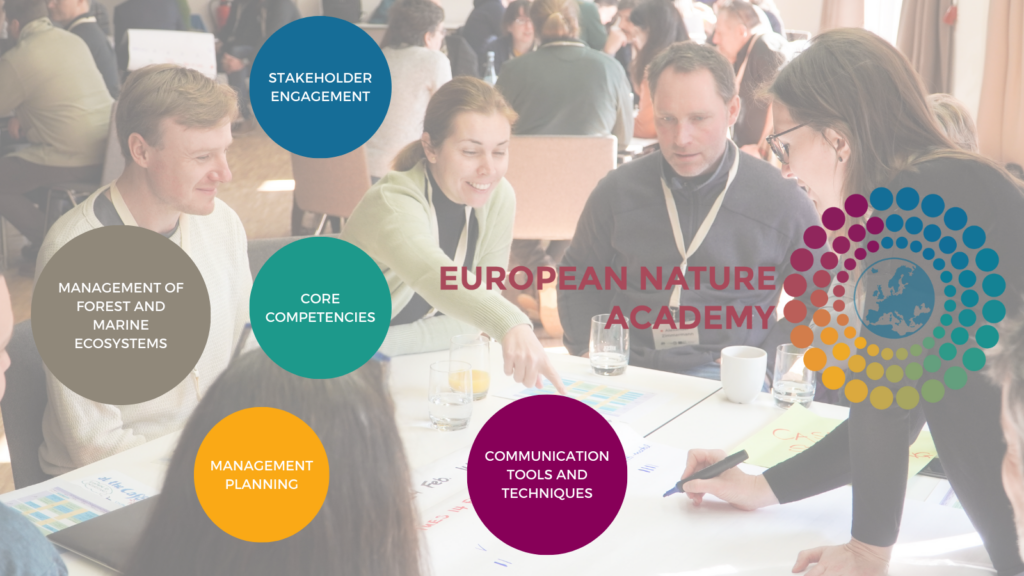
Whatever your area of work, we will welcome your application. People of all ages and backgrounds, working in diverse roles in a Natura 2000 site or Protected Area can apply – for example:
- Managers in either governmental or non- governmental organisations.
- People working in national, regional or natural parks (which also include Natura 2000 sites), for example Rangers.
- Individuals working for a local authority or public administration with responsibilities for nature conservation and protection.
- Individuals working as a specialist ecologist or in nature conservation policy.
- People working with local communities – for example, as environmental educators, communication specialists, volunteer or visitor managers, or individuals with responsibilities for interpretation, nature-based sustainable development, legal advisors, land stewardship etc.
- Private landowners of a Natura 2000 site or other entrepreneurs in a Protected Area – for example, with farming, forestry, fishing or tourism interests.
How the European Nature Academy works…
The new European Nature Academy is a training hub and provides access to a series of practical capacity building courses for nature’s managers. The courses are designed specifically to equip individuals and their organisations with the competencies they require to meet the challenges and opportunities of nature management in the coming decade.
Delivered in a series of online modules and networking events, the emphasis is on applied learning to improve management practices and ways of working for Natura 2000 & Protected Areas across Europe. The modules focus on the core skills, knowledge & attitudes you need in your daily work.
The competence-based modules cover the following subjects:
- Tools for participative and inclusive governance
- Design of communication strategies, tools, techniques and approaches
- Management planning as a technical process for biodiversity conservation & a process for social engagement
- Strategies for engagement, collaborative working, conflict management, resolution & mediation
The courses are free!
There is no fee for the training.
APPLY NOW!State of the EU 2023 from a Protected Areas perspective
The “2023 State of the European Union: ANSWERING THE CALL OF HISTORY”, Ursula von der Leyen’s speech analysed from a Protected Areas perspective.
On 13 September, in front of the Members of the European Parliament (MEPs) in Strasbourg, the President of the Commission Ursula von der Leyen presented the annual speech about the State of Union. This year it was especially important because the last one before the end of this Commission’s mandate. As we know, in June 2024 the European citizens will vote for the elections for the new European Parliament, and then a new Commission and a new President will be appointed.
Here EUROPARC underlines the aspects that refer to Protected Areas, analysing what Mrs von der Leyen said, and also what was missing in her speech, in order to offer more knowledge, and food for thought, about the Brussels’s current political debates directly connected to our work.
The speech, pronounced by Ursula von der Leyen, touched several points, among which the Ukraine war, digitalisation and artificial intelligence, immigration, economy, NextGenerationEU, future EU enlargement to the Balkans countries, and others.
The European Green Deal was of course one of the key themes.
Without any doubts, EUROPARC considers the launch of the Green Deal is the most important achievement of the current European Commission, and strongly appreciates that the President of the Commission stated: “We now have a European Green Deal as the centrepiece of our economy and unmatched in ambition”.
Presenting the results achieved and future actions about climate change and green transition, Mrs von der Leyen focused essentially on the industry sector, speaking about the EU’s support and related package of measures for energy transitions, competitiveness against not-European markets, job market and growth strategy, clean steel factories, investment in clean hydrogen.
Of course, without a strong acceptance of the green ambitions by the industrial sector, the Green Deal cannot reach its goals. But, speaking about industrial policies, Mrs von der Leyen says that “this is the strength of Europe’s response to climate change”. Inside of this crucial part of the discourse, EUROPARC, instead, would have much appreciated a strong declaration that climate change is not only a matter of industry but also strongly a matter of management of territories and landscapes focusing on protection and sustainable use of biodiversity and nature. The results of the two United Nations Conferences in 2022, on Climate Change (COP27) and on Biodiversity (COP15), clearly put in evidence.
Nevertheless, some of these considerations are mentioned later in the following part of the talk about nature protection that Mrs von der Leyen addressed to MEPs. Together with the cultural diversity, that makes the ”Europe of the Regions”, the President reminds us that Europe is a continent of unique biological diversity. She mentioned the Wadden Sea and the Baltic Sea, as well as the European Plain of moorland and wetland, as important allies against climate change and to secure regional water cycles, and unique for biodiversity. In EUROPARC’s eyes, this list of examples seems very limited but at least they refer to important ongoing discussions. For example, the Baltic Sea remains the most polluted sea in Europe and the European Commission is organising a high-level conference with the presence of the Commissioner for Environment, Oceans and Fisheries Virginijus Sinkevičius (“Our Baltic Conference” in Palanga, Lithuania, on 29 September 2023).
Then, Mrs von der Leyen spoke about woodland: coniferous forests of the North and East forests, cork oak forests of southern Europe, and last remnants of virgin oak and beech forest in central Europe are “irreplaceable source of goods and services”.
EUROPARC could not agree more when Mrs von der Leyen concluded:
Biodiversity and ecosystem services are vital for all of us in Europe. Loss of nature destroys not only the foundations of our life, but also our feeling of what constitutes home. We must protect it.
Immediately after, the speech continues about food security and farming. “At the same time, food security, in harmony with nature, remains an essential task”. It is clear that this part of the discourse aims to reinsure farmers that their work is appreciated and that the Commission takes into account their concerns. Indeed the speech touches at this point on one of the most sensitive topics, especially in the recent and current debates about the nature restoration law and about large carnivores: the relation between agriculture and nature conservation. About this theme, Mrs von der Leyen underlined that: “For us in Europe, this task of agriculture – producing healthy food – is the foundation of our agricultural policy. And self-sufficiency in food is also important for us.” Reminding all about the consequences of Ukraine war, droughts, fires, and flooding, as well new obligations for farmers, the President admonishes that they “are all having a growing impact on farmers’ work and incomes. We must bear that in mind.”
Only after this premise, the speech mentions the efforts done by a part of the farming sector towards a more sustainable form of agriculture. About that: “We must work together with the men and women in farming to tackle these new challenges. That is the only way to secure the supply of food for the future.” Then, with a clear reference to the last hot debates inside the European Parliament and outside between farming and environmental sectors, Mrs von der Leyen made a strong invitation: “We need more dialogue and less polarisation”, and a proposal for the next future: “That is why we want to launch a strategic dialogue on the future of agriculture in the EU.” “Dialogue” is the crucial word that EUROPARC uses about the need to reinforce partnership between farmers and Protected Areas, so we are very willing to know more about how this proposal will be implemented.
The President concluded this part of the speech with a statement that EUROPARC shares totally: “I am and remain convinced that agriculture and protection of the natural world can go hand in hand. We need both.”
What was missing in this speech?
According to EUROPARC, some very crucial topics. For instance: the Restoration Law. Probably it is too sensitive at this moment because the Commission, Parliament and Council are working in the “trialogue” to conclude the process. However, definitely, we regret the total lack of references to the importance of the law, and in general to the Biodiversity Strategy. The same for all other important Strategies (soil, forests) approved during this Commission’s mandate and ignored in the speech. Speaking about agriculture: no mention on pesticides, or other crucial and complex themes; and no mention of the large carnivores (about that the President launched recently a personal initiative about wolf that is considered quite divisive). Other big absent: marine (only rapidly mentioned with the two examples of nature diversity) and ocean conservation, and dialogue with fishermen (probably assimilated with farmers). Moreover, as said above, not enough strong message that nature protection should be a key part of Europe’s response to climate change. And last but not least for us, no mention of the role of Protected Areas and Natura2000 as key actors and key allies for the Green Deal.
EUROPARC has always been supportive of the European Commission in its efforts for the European Green Deal (see letter here) and we are ready and willing to continue in the future as it benefits our members (see webpage here). The European elections in 2024 will be crucial for the future of the Green Deal. We strongly hope that the new Parliament and the new Commission will continue, improve and reinforce the commitments towards more sustainability, more nature protection, and also more recognition of the role of key actors, such as the Protected Areas, to reach these objectives. That will be necessary if we really want to ANSWER THE CALL OF HISTORY.
The text of the speech is available here in all languages, and here in the original version.
The records of the speech, and the following interesting debate with the interventions of Members of the European Parliament from all political groups, are available here.
Measuring the Environmental Impact of EcoTourism: Learnings and Tools for a Greener Future
Sustainable Tourism is an ever relevant topic for EUROPARC and Protected Areas. Accurately assessing environment impacts is essential if we want truly sustainable tourism. In this article, discover tools developed by the MEET Network that support this process.
Today is World Tourism Day. It is a good day to celebrate that Protected Areas are among the most visited places in Europe.
 The European Charter for Sustainable Tourism (ECST) in Protected Areas is one of EUROPARC main programmes that helps Protected Areas to plan and manage tourism sustainably.
It has three phases. Phase 1 is addressed to Protected Areas. Phase 2 is addressed to Tourism Business and Phase 3 to Travel Agencies and Tour Operators.
Measuring environmental impact is essential to understand and address any potential damage to the environment. It is one of the key topics that Protected Areas need to work on to obtain their ECST award.
However, accurately measuring environmental impacts and ecological footprint is not easy. The MEET Network provides a new tool to measure environmental impact of ecotourism that could be very useful for ECST Protected Areas, Business and Travel Agencies.
This tool has been already tested in two ECST Parks: Garrotxa Natural Park and Colline Metallifere National Park
Keep on reading to learn more. Plus, mark your calendars for our next webinar on this topic: 2 November 10:00 CET.
This article is written by Arnau Teixidor Costa, Ecosystem Resilience & Spatial Planning Programme and Lucía Prieto Fustes Ecosystem Programme Assistant. Arnau and Lucía both work at IUCN Centre for Mediterranean Cooperation
Measuring the Environmental Impact of EcoTourism: Learnings and Tools for a Greener Future
Ecotourism holds the promise of delivering positive benefits to the conservation of protected areas and local communities by supporting the sustainable development of destinations. However, measuring and evidencing these benefits is challenging. As a result, the different impacts of (eco)tourism are not consistently measured. To address this, the MEET Network and the DestiMED PLUS project partnership have developed a comprehensive approach. This includes a standard, indicators and tools, to assess the enabling conditions for ecotourism to be developed in the protected area destination, and the sustainability and quality of the ecotourism itineraries.
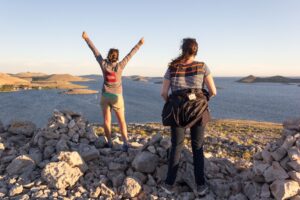
Ecotourists hiking in Kornati National Park © MEET Network (Author: Vicki Brown)
The MEET Network gathers tourism and environmental organizations along protected areas to transform the Mediterranean into a leading ecotourism destination.
MEET was born out of several Euro-Mediterranean initiatives, such as ENI CBC MED Programme MEET project, and its Secretariat is based at the International Union for the Conservation of Nature (IUCN) Centre for Mediterranean Cooperation. Its primary mission is to craft top-tier ecotourism experiences that benefit both environmental conservation and local communities. In the recent DestiMED PLUS project, MEET has perfected its model and its tools for measuring ecotourism impacts.
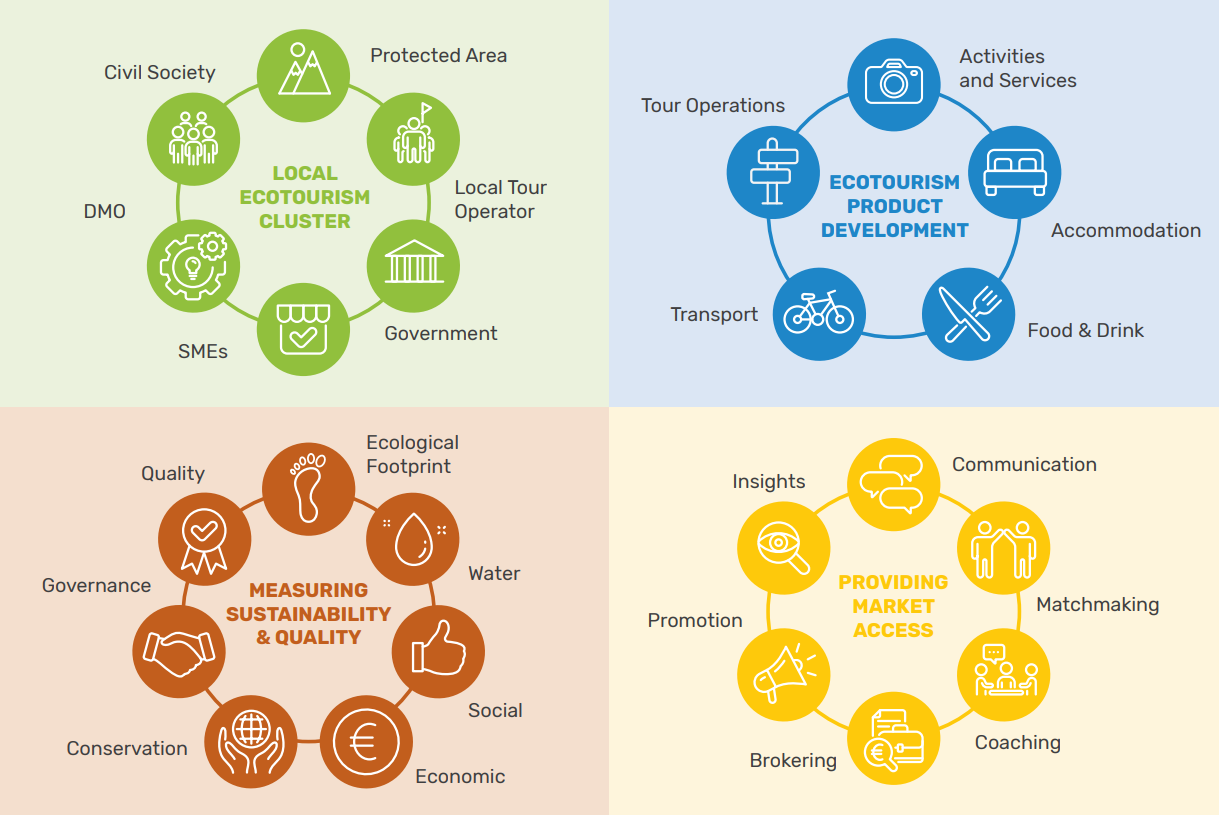
The 4-step MEET Model. The bottom-left step indicates the approach to measuring the impact of the tourism experiences © MEET Network. Click to enlarge
The MEET model is based on a 4-step process (see the image to the right) which ensures that the itinerary created complies with the promise of ecotourism.
Understanding the impact on Earth’s resources
In the context of global change, a main feature of the MEET approach for measuring impact is understanding the environmental footprint of ecotourism itineraries. This builds on work by the Global Footprint Network in developing a robust methodology for measuring the ecological footprint of ecotourism itineraries, tested by measuring 13 ecotourism itineraries across the Mediterranean. The DestiMED PLUS project allowed not just to refine the understanding of the ecological footprint of 9 new ecotourism itineraries, but also to compare it with the footprint of travel to the destination and the average footprint of travellers and residents. Additionally, it allowed to explore the carbon and water footprints in some destinations, while exploring the capacity of the different environmental foot print methodologies to measure the impact of the tourism sector.
Over the past years, we have been developing, through the MEET Network and its various projects, a participatory process based on data and monitoring processes to develop a sustainable alternative for tourism activities in and around Mediterranean protected areas, which work for the benefit of both people/communities and the planet. Looking forward to the possibility of bringing this approach to other protected areas in the region.
Says Alessandro Galli, President of the MEET Network.
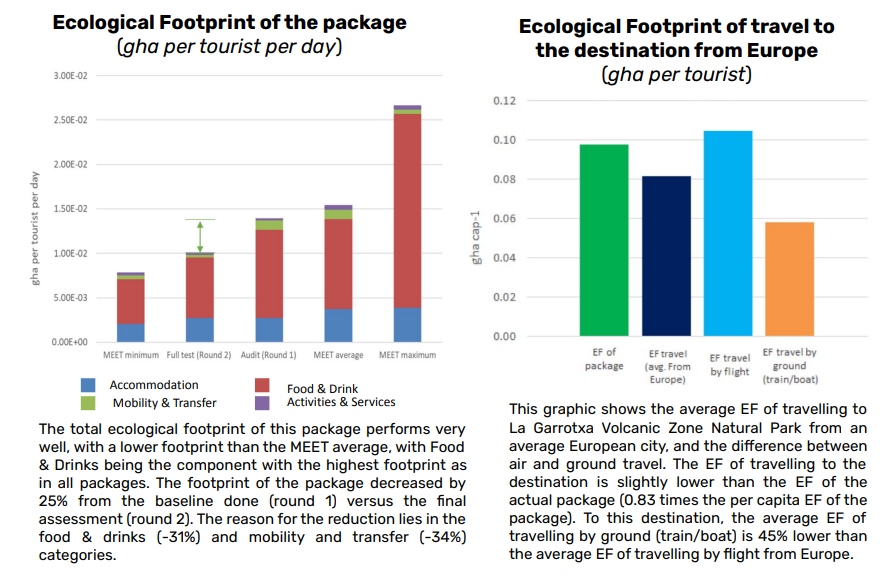
Ecological footprint results in La Garrotxa Volcanic Zone Natural Park © MEET Network. Click to enlarge.
The assessment of the ecological footprint has allowed to draw interesting lessons for ecotourism operators, destination and protected area managers:
- Food & Drinks represented the major footprint driver in all itineraries analysed, contributing on average to 63% of the total.
- On average, the Ecological Footprint of a tourist travelling from Europe to a norther-Mediterranean ecotourism destination is 43% higher than the per capita Ecological Footprint of the average entire stay at destination.
- It is challenging to establish an ideal or maximum ecological footprint per ecotourist per day, as this needs to be assessed along social, cultural and economic impacts in the destination, as well as origin, length of stay, means of travel, etc.
What MEET measuring and monitoring tools can you use?
For protected and conserved area managers to be able to assess and manage different impacts and ensure the enabling conditions for ecotourism to flourish under the MEET Standard, a set of tools has been developed and compiled in an online ecotourism indicator monitoring platform. The platform offers a summary assessment of the environmental and social results for each destination and itinerary, allowing managers to make informed decisions. It also proposes resources and guidelines to streamline the required data collection and analysis. The platform comprises four main tools:
- The Ecological Footprint Calculator: As seen above, it measures tourism services in a package/itinerary across four key categories: accommodation, food & drinks, mobility, and activities & services. It assists tourism stakeholders in analyzing the environmental impact of ecotourism experiences within protected areas. Users gather data through surveys conducted in collaboration with local service providers. The tool harmonizes this data with existing statistics to yield a quantitative ecological footprint and generic recommendations to enhance the sustainability of ecotourism.
- The Social Impact Assessment of Ecotourism Suppliers tool quantifies the social impact generated by diverse ecotourism service providers, suppliers, and facilities included in an itinerary. More importantly, it examines the perspectives of four key stakeholder groups: workers, local communities, value chains, and visitors. This assessment can be understood as an evaluation of the different socio-economic dimensions linked to the ecotourism product and offers a deeper understanding of its social implications.
- In contrast to the preceding tools, which examine the social and environmental impacts of tourism products, the Enabling Conditions Assessment of the Destination introduces a set of criteria that destinations are encouraged to embrace to establish the necessary foundations for sustainable tourism practices. They aim to safeguard natural resources, bolster local communities, and advocate for responsible ecotourism development. The tool is based on IUCN’s Best Practice Guidelines for the Governance of Protected Areas to establish an evaluation framework, incorporating a simplified version of the IUCN Green List Global Standard for Protected Areas.
- In a similar fashion, the Product Quality Assessment of an Ecotourism Itinerary tool delves into crucial aspects related to product and itinerary design, safety protocols, supplier selection, and more. This assessment is conducted through a survey process that harnesses existing data already available to the Inbound Tour Operator.
Looking ahead
Ecotourist in Vlorë, Albania © MEET Network (Author: Vicki Brown)
There are many challenges and opportunities for ecotourism to deliver its promise as it navigates the delicate balance between economic development and environmental conservation. In a context of overvisitation in many protected and conserved areas, supporting a tourism officer that is delivering positive impacts is needed. For this, a comprehensive approach for measuring the impacts of ecotourism is essential, championing ecotourism as an important piece upon which the tourism sector changes in the face of the climate and biodiversity crisis and the call for regenerative and responsible tourism. And this message cannot stay in the Protected Areas, it needs to reach destination managers and marketers , industry and travellers.
Interested in learning more? Have a look at the MEET website and manual!