Where Sports and Nature meet | International Networking & Learning Symposium of the SEE Project
The partners of the Sustainability and Environmental Education in Outdoor Sports project (SEE) invite you to attend the final Project Learning Symposium in Munich from the 13th – to the 15th of November 2023. The main program is scheduled for the 14th of November.
The SEE Project aims to enhance the protection of natural landscapes through education in and through sport with special focus on responsible outdoor behaviour and skills development for outdoor sports leaders, trainers, guides, or instructors.
During the SEE Learning Symposium, hosted at the beautiful Burg Schwaneck just outside of Munich, attendees will learn about current challenges and opportunities of outdoor sports practiced in (Protected) Natural Areas and how to address these through newly developed training methodologies in Outdoor Sports education.
The programme
The symposium is an opportunity to bring together an international audience from both the outdoor sports sector and the environmental protection sector to share ideas, transfer knowledge and work on future collaborations. The program will include ample opportunities to learn and network from one another through various facilitated networking sessions with project partners and experts, interactive activities, and demonstrations of the SEE Educational Toolkit.
The learning symposium will be a full-day programme (Tuesday) which includes practical workshop sessions where partner organisations of the project will demonstrate several toolkit activities. In addition to the toolkit demonstration, the program will include inspirational speeches from leaders in environmental activism, networking activities, dinner, and social program in the evening.
Extend your stay and join the SEE project partners for an early bird outdoor activity on Wednesday morning followed by a workshop session and a deep dive networking session which will focus on specific topics related to different environments and sport types.
Download the Programme now!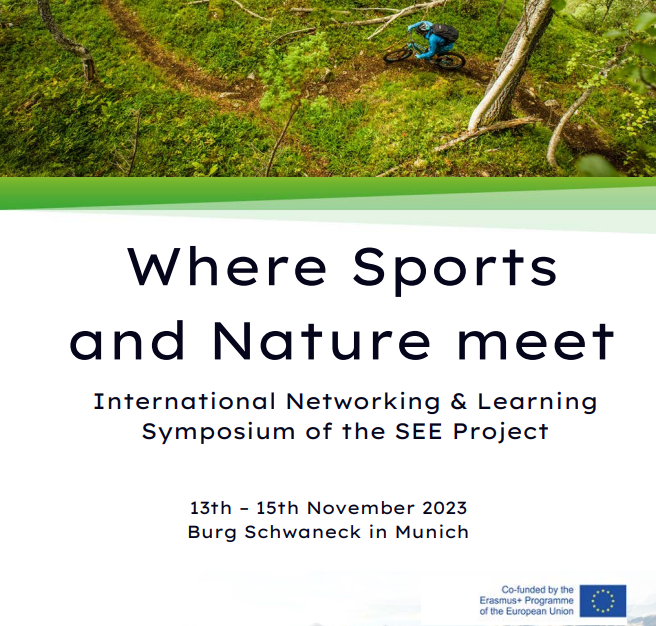
Is this event for me?
If you are working in the outdoor sports sector as trainer, tutor, or any other educational role (eg. at a Sports University, sports federation, outdoor training centre, VET provider in the field of OS), or in the outdoor sports / adventure travel tourism sector, then this Learning symposium is the best opportunity to gain new insights in the latest developments of sustainability and environmental education in outdoor sports.
Are you working for a National Park or Protected Area (e.g. member of the EUROPARC Federation) or working with guiding companies, travel agencies in your capacity as land manager, outdoor recreation manager, forestry manager etc.? Then this learning symposium will have valuable insights for you as well and provide great opportunities to have a dialogue to strengthen the relationship between nature and the outdoor sport sector.
Ticket fee
Registration for the event includes lunch, coffee breaks and dinner on Tuesday (other meals /drinks are at own expense). The ticket fee of €20,- will be used to offset the total carbon footprint of the event (e.g. international travelling and overnight stays of the attendees). Of course, participants are encouraged to make use of public transportation as much as possible.
Register here!Call for contributions
The closing date for the submission is 30th September 2023
I want to contribute!If your organisation has been involved in some aspect of innovative sustainable or environmental education practices, then we would love to hear about it and share your ideas with others.
End of an era – in memoriam Prof. Dr. Hans Köpp
It is with great sadness, that EUROPARC learned about the passing of Prof. Dr. Hans Köpp on 23rd of June 2023 at age 85.
With the passing of a generation, we should pause and reflect on their vision and contribution in our lives and society. It is therefore with sadness that EUROPARC reports the recent passing of Herr Köpp. He was one of the founding fathers of EUROPARC and the last to be directly connected to the very beginning of the Federation, working in close collaboration with Dr Alfred Toepfer. Working as a forest scientist, Prof. Dr Hans Köpp was, for a time, executive director of the Federation. However, his main functioning was editor of EUROPARC bulletin from 1973-1985.
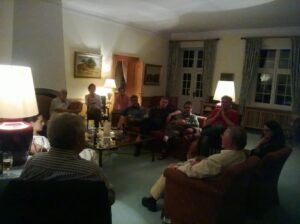
EUROPARC share an evening with Prof. Dr. Hans Kopp, in Gut Siggen, regaling stories of the early days of EUROPARC.
As such, he was at the centre of news, information, ideas and connections across the European park’s community and was especially a bridge between East and West Europe. Herr Köpp, shared his inspirational story of how the first Protected Areas in Europe came together, despite the political turmoil and life behind the iron curtain for many early EUROPARC members.
Prof Dr Köpp was also very connected with the Alfred Toepfer Academy for Nature Conservation in Lower Saxony. He began cooperation with strategic partners at home and abroad at an early stage, much of which continues to this day, including EUROPARC’s close and ongoing partnership.
Some EUROPARC members had the privilege to share an evening, with Herr Köpp sharing his fascinating experiences about how the Federation was born and grew, in our 40th anniversary in 2013. It was a privilege to enjoy his witty and engaging stories. EUROPARC captured Herr Köpp’s reflections further, in this lovely film published in celebration of our 50th anniversary.
Herr Köpp was a charming gentleman, full of joy, with twinkling eyes that retained their excitement for the future of EUROPARC. We are lucky to have captured the quiet wisdom of his experience. It is both the end of an era but, too, the relentless forward march of time for the Federation. We look back to his generation with gratitude.
Our deepest condolence goes to the Köpp family.
EUROPARC participates in the World Protected Areas Leaders Forum
On 26-30 June, the World Protected Areas Leaders Forum (WPALF), initiated by IUCN, took place in the Krkonoše National Park and the Jizera Mountains Protected Landscape Area. EUROPARC Federation was represented by its President Michael Hošek.
About the Forum
Around 20 Protected Area leaders and specialists came together in the Krkonoše National Park and the Jizera Mountains Protected Landscape Area. The purpose of the meeting is not only to enable leaders in Protected Areas management to discuss and share experiences, but above all to identify the problems and challenges Protected Area managers are facing, or are likely to face. Furthermore, it offers a chance to prepare our community to respond appropriately to them.
Our protected spaces are important drivers of sustainable development
It’s time to champion our Protected Areas
Protected Areas are one of the most successful conservation tools, and their benefits can be identified on many levels. This is exactly EUROPARC’s role: to identify and promote Protected Areas as a tool that, far from just serving nature conservation, is already serving sustainable use in general.
Protected Areas support greater involvement of local communities and local governments, also in partnership with the private sector. However, to make the most of our Protected Areas, continuous investment is needed. The wealth of knowledge the global Protected Area community holds is immense. Adapting current policies to make use of this wealth is pertinent if we want the Global Biodiversity Framework, adopted in December 2022, to be a success.
As a result of the meeting, Protected Area managers signed a declaration underlining this sentiment. You can read it here:
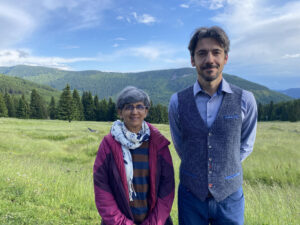
Michael Hošek and Madhu Rao at the World Protected Areas Leaders Forum 2023.
WPALF Krkonoše – Jizera Declaration
Furthermore, EUROPARC president Michael Hošek attended a separate meeting with Dr. Madhu Rao, the Global Chair of the IUCN World Commission on Protected Areas (WCPA). They discussed further close cooperation between EUROPARC and the IUCN WCPA.
Restoration of urban marine ecosystems through Nature-based Solutions
Picture by Oleg Prachuk on Pexels.
Cities need to protect, conserve and restore urban marine ecosystems to preserve well-being and progress sustainably.
On the 13th of June 2023, a technical meeting was held in Barcelona on urban marine ecosystems restoration. This meeting was organised in the framework of the UN Restoration and Ocean Decades and the controversial forthcoming EU Restoration Law. EUROPARC’s policy and project manager Teresa Pastor took part in the event.
The meeting was hosted by the Institut de Ciències del Mar (Sea Science Institute). In 2021, they launched the Ocean Cities initiative – an international network of 27 institutions to promote sustainable ocean cities in a context in which resilience of coastal cities to climate change is a critical challenge for the coming decades.
At present, there are three reference frameworks in Europe to restore sea ecosystems in cities.
- UN Ecosystem Restoration Decade 2021-2030.
- EU Green (&Blue &Brown) Infrastructure Strategy (objective 2 of 2010-2020 Biodiversity Strategy)
- EU Nature Restoration Law – a key piece of the European Green Deal, that sets legally binding targets to rehabilitate degraded habitats, and which is currently under vote in the EP.
The invited speakers gave insight into the topic from different perspectives.
Main highlights of the meeting
The main highlights were:
- We need to protect and restore biodiversity, because both our health and economy heavily depend on it.
- The first priority should be protection– we need to protect effectively what is left.
- The second priority should be restoration – soundly applying the principles of conservation biology.
- The third priority should be effective management – applying an ecosystem-based management approach.
- Restoring marine ecosystems should go beyond introducing artificial substrates (e.g. concrete blocks) to enhance biodiversity. The aim should be to recover the fully functioning ecosystem, i.e. the whole community that was there before urbanisation.
- However, there is a lack of reference ecosystems due to the extreme exploitation oceans have been submitted causing the shifting baseline syndrome (Pauly 1995).
- With restoration projects, ecosystems can be restored to a high degree, but hardly ever to their original state, as for this we are dealing with unknowns.
- Therefore, a new concept has emerged in conservation and restoration ecology: novel ecosystems, which are ecosystems that due to human influence differ from those that prevailed historically.
- The Society for Ecological Restoration distinguishes three phases in what would be a restoration continuum:
- Reduction of impacts
- Rehabilitation – improvement, but not full restoration of the original habitat
- Ecological restoration
- Effective restoration should focus first on habitat-forming species that can act as ‘climate rescuers’ e.g. seagrasses, salt marshes, mangroves, kelp forests, coral reefs and shellfish reefs, which form natural coastal protection and thereby help to adapt to increased storminess, seal level rise and flood risks resulting from climate change.
- Secondly, the goal is to recover the whole community to obtain all the potential ecosystem services.
Restoration can be twofold:
- passive: elimination of the factors of pressure (e.g. removal of ghost nets) and let nature come back
- active: restoration of vanished species (e.g. fixing coral)
Use of Nature-based Solutions to restore urban marine ecosystems
There are different interpretations of what Nature-based Solutions (NbS) consists of. In order to harmonize the concept, the IUCN has prepared the NbS Global Standard. For further reading, also check out “Planning and delivering Nature-based Solutions in Mediterranean cities: First assessment of the IUCN NbS Global Standard in Mediterranean urban areas. Executive summary” here.