Job Vacancy – Communications and IT Officer
Person connecting and sharing using social media networks - With speech bubbles featuring Facebook, Google Plus, Instagram, Pinterest, Linkedin, Skype, Tumblr, Twitter and Youtube
EUROPARC is looking for a Communications Officer with a strong IT background, an interest in nature and a passion for parks. The Communications Officer will have opportunity to contribute directly to the work of a wide European environmental organisation, working along with an international team, so needs an understanding and willingness to work in a NGO culture.
The Communications officer will support in delivering the general aims of EUROPARC communications strategy and contribute to the implementation of other communication tasks, mainly regarding digital communications. He/she will also assist in communication for project development and implementation.
Candidates should have experience in:
- management of databases
- creation and management of websites
- management and monitoring online campaigns
- website analytics
- developing online content – written, animation or video form
- knowledge of video and image edition software is an advantage
We are looking for an innovative and creative thinker who is adaptable and responsive to change. Proficient written skills in English are essential and other European languages an advantage.
For the complete description and conditions download the document below.
- Applications should be submitted before the 10th June to the email office@europarc.org, with the subject “Application – Communications and IT Officer”
- Interviews will be held via gotomeeting during the days 21th – 22th June
Training opportunities for Protected Areas’ staff
Capacity building is at the core of our work in the Federation. EUROPARC members can benefit from several opportunities developed by the Directorate and the Federation sections: join an annual training seminar organised in Siggen, participate in the several workshops organised during our Annual Conference, or even benefit from the numerous tools we provide to our members, like the Communications Toolkit, specially designed to improve communication skills of Natura 2000 managers.
Despite the opportunities within the Federation and EUROPARC sections, there are some interesting opportunities for improving your skills in different fields. EUROPARC Federation curated for you 5 interesting trainings, from governance of protected areas, to management tools, geospatial software and certified training for guides. And there is even a discount for EUROPARC members in a special training in Spain!
The European Parks Academy
Klagenfurt, Austria, 11-16 July 2016
European Parks Academy
This summer, protected areas professionals will have a unique chance to develop their skills and learn about the emerging trends, new approaches and technologies in protected areas.
The European Parks’ Academy (EPA) is a summer school with seminars, which will take place in July, in Klagenfurt, Austria. The programme has been elaborated in collaboration with IUCN WCPA, together with partners in Austria and with support of the Austrian Ministry of Environment. The first two modules will be on “Governance of protected areas” and “Financial management of protected areas”.
The seminars of EPA focus on new international and European standards, policies and guidelines and their implementation in protected areas, such as policies of IUCN, Ramsar Convention on Wetlands, UNESCO or Convention on Biodiversity.
Registration is open now as well as the application for scholarships!
More information is available here and in the flyer. For any questions, contact Michael Huber (epa_at_e-c-o.at)
II International Course on Protected Area Management
Sierra de Guadarrama National Park, Spain, 1-9 August
The II International Course on Protected Area Management (held in English) is an intensive training course that analyses the specific problems of protected areas close to urban centers. The course is offered by the Polytechnic University of Madrid in collaboration with the Directorate General for Environment of the Madrid Government and EDNYA, a company that manages different services in the Sierra de Guadarrama National Park. The programme will strengthen the skills of participants with regard to planning and managing areas that are open for public use and outdoor recreation programmes in protected areas in order to build support for conservation, contribute to public welfare and provide economic benefits to local
Members of the EUROPARC Federation benefit from a 20% discount in their registration!
For more information and registrations visit EDNYA website, or download the flyer and full description of the course.
International Guides and Guide Trainers Course
Brno, Czech Republic, 12-20 August 2016
Interpret Europe is launching a range of professional training courses to help guides from all over Europe improve the quality of their performance. This is also a highly valuable tool for heritage site and facility managers to meet their capacity building and professional development needs. The first summer courses take place in Brno (Czech Republic) and you can choose among Certified Interpretive Guides(CIG) and Certified Interpretive Guide Trainers (CIGT).
More information can be found here.
Geospatial technologies in ecosystem management
Évora, Portugal, 5-11 September 2016
“Geospatial technologies in ecosystem management — An introductory course to GIS, GPS and Remote Sensing”, is organised by Science Retreats LDA on behalf of the Évora branch of InBIO- CIBIO. This course offers an integrated overview of these three technologies and is designed for professionals of different backgrounds, which are faced with the possibility of using these technologies for their own needs, especially in the ecosystem management context. The course will be held in English and is balanced between theory and application. Participants are encouraged to bring spatial data related to their current work or interest.
More information can be found here or you can read the full description of the course.
Adaptive Management workshop – CMP Open Standards for the Practice of Conservation
Nature Park Medvednica, Croatia, 7-11 November 2016
The CMP Open Standards for the Practice of Conservation (Open Standards or OS) are a set of adaptive management standards to designing, managing, monitoring and learning from conservation projects. Created by the Conservation Measures Partnership (CMP), an international partnership of many of the world’s leading conservation organisations, the Open Standards are putting in place the building blocks to improve the practice of conservation. Its goal is to enable conservation organisations to tackle projects efficiently and achieve effective impacts.
More information can be found here.
Sustainable Tourism in Monte Rufeno Nature Reserve
Broom in Rufeno Nature Reserve (IT) © Filippo Belisario
Sustainable Tourism is a priority for Monte Rufeno Nature Reserve, who has been awarded in 2012 with the Charter for Sustainable Tourism in Protected Areas (ECST) . Along with the Charter Monitoring Forum, the Reserve is “looking at the past to build together the future for sustainable tourism”.
article issued by Filippo Belisario (versione in italiano qui sotto)
In Monte Rufeno (Acquapendente – Lazio region – Italy) there is an effort to imagine a future for local sustainable tourism in an innovative and unconventional way. An embryonic “ideas factory” activity has been led with old and new local stakeholders, thus producing a first list of possible actions and initiatives for the next five years. Many areas of interest have been involved, such as:
- Biodiversity conservation – shepherd dog breeding to protect herds against wolf in order to indirectly safeguard this important predator
- Citizen science – webcam installation for sharing pictures and the monitoring effort of a local bat colony, which has been declared “of national interest”
- Sustainable tourists mobility within Nature Reserve and the territory – purchase of a methane-fuelled minibus
- Environmental interpretation projects and activities – sensory hikes in the monumental century-old Sasseto wood.
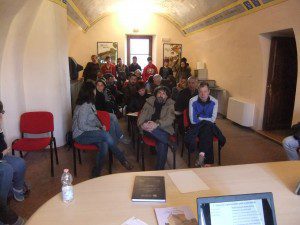
ECST Forum Meeting – Monte Rufeno Nature Reserve (IT) © Filippo Belisario
Nature Reserve’s 2015 ECST monitoring forum held in March 30th 2016, in Acquapendente, focused on these and many other aspects. This meeting with the local stakeholders, regarded the first five years of the Charter’s validity (2012 – 2016); we summarized the results reached but found ourselves already projecting the possible initiatives for the forthcoming renewal of the certification (2017 – 2021).
Among the 28 participants, 19 local stakeholders who came on behalf of 16 private, public and associative realities, 7 students of the local High School (College of Science) involved by Acquapendente’s Cabinet member for the Environment, and 2 extremely qualified external observers: a young woman who just graduated in Tourism Economics at the University of Rome (with an analytical thesis on some of the Reserve’s ECST actions) and Stefania Petrosillo, ECST consultant and expert in both a national and international context.
Thanks to the recent broadening of the ECST application area to the neighbouring municipalities of Allerona and Proceno (an important target reached by the current action plan), for the first time 6 non-strictly local stakeholders attended the forum. At the same time, a meaningful interest for the participated process that will soon lead to the making of Nature Reserve’s new ECST strategic plan stimulated the attendance of 7 new potential stakeholders: a local association, the neighbouring municipalities, a school, a small transportation enterprise, farm holidays (agriturismi).
Some time has been spent to describe the results of Nature Reserve’s participation to the experimental phase of the MEET project (Mediterranean Experience of Eco Tourism), funded by the European Union, whose main aim is the building of eco-tourist packages and their promotion and sale on Anglo-Saxon markets. The figures, in terms of visibility and economic impact on the territory, are quite gratifying: 250 overnight stays in the period May 2014 – November 2015 with 50,000 euros of income which have totally been spent in the area, a package that has been successfully assessed and appreciated by important worldwide Tour Operators, 12 local stakeholders involved (a local TO, a transportation enterprise, a museum, 3 agritourism, a hotel, 2 restaurants, 2 nature guides, an astronomic association).
Forum di monitoraggio CETS della Riserva Naturale Monte Rufeno (Acquapendente – Lazio – Italia): uno sguardo al passato per costruire insieme il futuro del turismo sostenibile nel territorio
A Monte Rufeno si cerca di immaginare il futuro del turismo nel tempo a venire in maniera innovativa e non convenzionale. Un’embrionale attività di “fabbrica delle idee” condotta con vecchi e nuovi attori CETS della Riserva ha prodotto un primo elenco di possibili azioni e iniziative per i prossimi cinque anni. Molteplici gli ambiti interessati, solo per fare qualche esempio:
- Conservazione della biodiversità – allevamento di cani da pastore per proteggere le greggi dal lupo, rafforzando indirettamente la tutela di questo importante predatore
- Divulgazione scientifica – installazione di una webcam per monitorare e diffondere in diretta momenti di vita di una locale colonia di pipistrelli dichiarata di interesse nazionale
- Mobilità turistica sostenibile in Riserva e nel territorio – acquisto di un pulmino alimentato a metano
- Realizzazione di progetti e attività di interpretazione ambientale – passeggiate sensoriali nel magico bosco monumentale del Sasseto.
Di questo e tanto altro si è parlato al forum di monitoraggio CETS 2015 della Riserva, svoltosi il 30 marzo 2016 ad Acquapendente. Quest’ultimo incontro con gli attori territoriali per il primo quinquennio di validità della “Carta” (2012 – 2016) ha sintetizzato i risultati fin qui raggiunti, con un animo già proiettato alle iniziative per l’imminente rinnovo (2017 – 2021).
Tra i 28 partecipanti, 19 attori locali, in rappresentanza di 16 entità fra private, pubbliche e associative, oltre a 7 ragazzi del locale Liceo Scientifico coinvolti per l’occasione dall’Assessore cittadino all’Ambiente, e 2 qualificate osservatrici esterne: una neo laureata in Economia del Turismo all’Università di Roma (con tesi analitica su alcune azioni CETS della Riserva) e Stefania Petrosillo, consulente ed esperta CETS in ambito nazionale ed europeo.
Grazie al recente allargamento dell’ambito di applicazione CETS della Riserva ai comuni limitrofi di Allerona e Proceno (importante obiettivo raggiunto dal piano d’azione vigente), per la prima volta il forum ha visto la partecipazione di ben 6 attori non strettamente locali. Parallelamente, un significativo interesse per il processo che a breve porterà alla costruzione del nuovo piano strategico CETS della Riserva ha stimolato la presenza di 7 nuovi potenziali attori del territorio che si stanno avvicinando con fiducia a questo percorso (associazioni sportive, amministrazioni comunali, istituzioni scolastiche, strutture ricettive, una piccola azienda di trasporti).
A trail in the Monte Rufeno Nature Reserve (IT) © Filippo Belisario
Una parte del tempo è stata dedicata ad esaminare i risultati dell’adesione della Riserva alla fase sperimentale del progetto MEET (Mediterranean Experience of Eco Tourism), completamente finanziata dall’Unione Europea e volta alla costruzione partecipata di pacchetti eco-turistici da promuovere sui mercati anglosassoni. Le cifre, in termini di ricadute e visibilità, parlano da sole: 250 presenze nel periodo maggio 2014 – novembre 2015 con un’economia di 50.000 euro interamente spesi nel territorio, un prodotto finale apprezzato da importanti Tour Operator mondiali e ormai pronto per il mercato estero, 12 attori locali coinvolti nella costruzione e realizzazione della proposta (un tour operator locale, una società di trasporti, un museo, 3 agriturismi, un albergo diffuso, 2 ristoratori, 2 guide ambientali, un’associazione astronomica).
More information about the Charter for Sustainable Tourism in Protected Areas can be found in the brochure “Good for Parks, Good for People”.
Joining forces for Nature
Nord Milano Park
Biggest network of periurban parks joins with the Europe’s largest protected area network
Fedenatur and EUROPARC Federation reach a friendly agreement to integrate and strengthen Europe’s leading protected area network.
In an exciting development, the board of Fedenatur and the council of EUROPARC have created Europe’s largest organisation, representing parks from the city to the sea and from the metropolitan to the mountain tops.
Combining our respective memberships creates a Protected Area network that will cover 40% of Natura 2000 sites (marine and terrestrial).
The periurban parks joining the new body are extremely important greenspaces where peak daily visitation can reach 34.000, more than attend most major European league football matches. In and around towns and cities, Fedenatur member parks provide services for a total population of almost 24 million people. Added to the 73 million people who visit, the 56 million who live beside and 4 million who reside in parks awarded with EUROPARC’s charter for Sustainable Tourism, the members of the combined organisation serve a constituency of at least 25% of the European population.
“We are very satisfied today. Union means strength. Strength to advocate for nature in a very much urbanized continent. Strength to defend the quality of life of city dwellers. This union symbolises the fact that nature is important for everyone and must be present everywhere: in cities, outside them and in more remote areas,” said Mr Agostino Agostinelli, Fedenatur President, following the historic decision to integrate was passed at the Fedenatur general assembly on 5th May.
Ignace Schops, President of EUROPARC, welcomed the addition of Fedenatur’s expertise in the management of periurban greenspaces to EUROPARC’s extensive experience in national and regional parks. He indicated that the extended network would add new stakeholders, together seeking nature conservation and sustainable development solutions to the challenges that face us all. He welcomed Fedenatur saying ”I am so proud! Nature has no boundaries. For EUROPARC Federation a new exciting time starts today, become the strongest and most unique nature network across Europe.
As a result, the EUROPARC network will grow by 10% – this is green growth for real!
Empowered by this new strengthened network I believe we take a strong strategic position in Europe. As biodiversity is still declining rapidly, we need to join forces and give a strong voice to the local, national and European leaders! Nature deserves more resources and attention on the political agendas. Together with Fedenatur, we can reach out to decision-makers and show that we do provide solutions for the social-economic challenges we currently face in Europe“.
EUROPARC has built considerable proficiency in the support of protected area management and looks forward to working too with stakeholders responsible for periurban parks, to share experience, which will help all of Europe’s greenspaces and landscapes be places that are good for biodiversity and good for people.
The integration of both organisation will begin working immediately, Joining Forces for Nature, and will strengthen the EUROPARC Federation’s network. A new periurban commission being launched and significant presence and workshop during the EUROPARC Conference in the Parc Jura Vaudois, Switzerland, 18th-22nd October.
 The EUROPARC Federation is the network for Europe’s natural and cultural heritage. Created in 1973, it has over 380 members in 37 countries and, as the representative body of Europe’s Protected Areas, is the collective voice for all nature and landscape areas. The Federation works to improve the management of Protected Areas in Europe through international cooperation, exchange of ideas and experience, and by influencing policy.
Fedenatur is the European Federation of Metropolitan and Periurban Natural and Rural Areas. Since 1995, the federation manages the network of those areas, enabling experience exchanges between periurban site managers on a European scale.